•
•
•
•
•
•
•
•
•
•
•
•
•
•
•
•
•
•
•
•
•
•
•
•
•
•
•
•
•
•
•
•
•



In an environment where market liquidity remains subdued and money is concentrated in a handful of blue-chip stocks, the likelihood of a near-term pullback is high. Cash flow is expected to shift toward mid- and small-cap stocks, especially the midcap group.
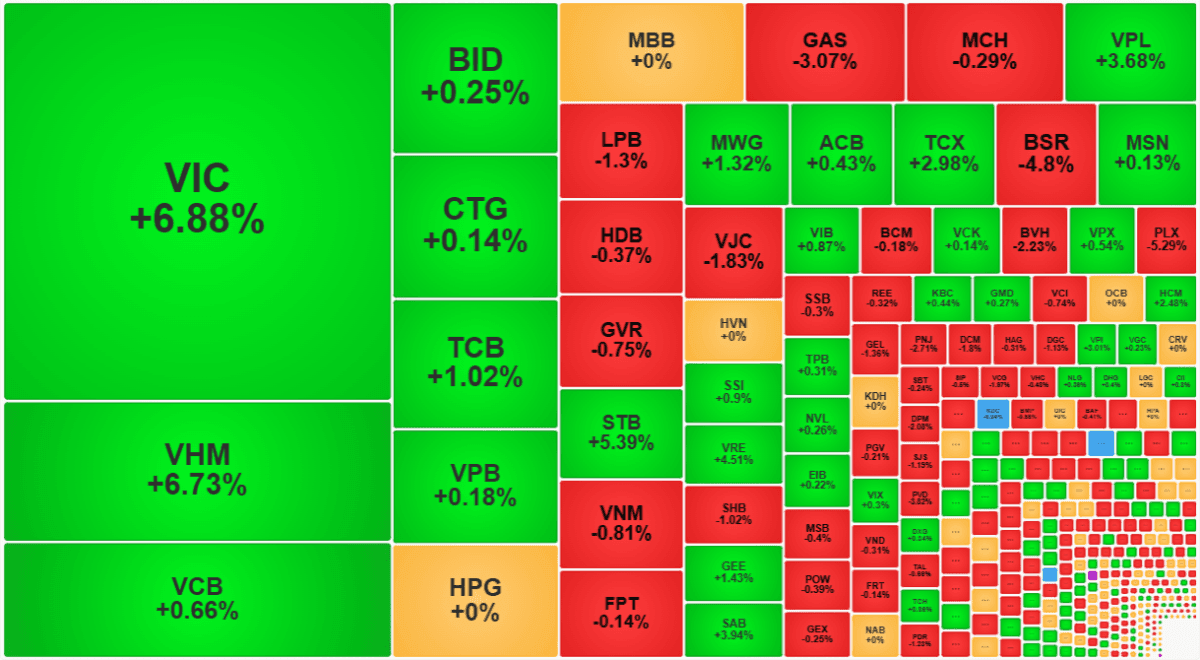
Along with the VN-Index, the VN30 rose to surpass 2,000 points on 22 April, a threshold previously seen as a psychological ceiling for large-cap stocks. The move was driven by money concentrated in a few names, notably the Vin group pair VIC and VHM.
History suggests that larger psychological levels come with higher risk, particularly when the rally is not accompanied by an improvement in liquidity and breadth. The 2,000-point level could therefore become a false breakout if liquidity is not strong enough to absorb supply, potentially triggering a short-term correction across the market.
VN30’s rise is also not viewed as confirmation of a new market price level. Many blue-chip stocks have returned to pre-correction levels, which can increase the risk of profit-taking. With gains led mainly by a small number of very large-cap stocks, the market picture can become distorted: the index may be green while many other stocks rise only slightly, stay flat, or fall.
A key concern is that liquidity has not kept pace with the VN30 advance. Turnover on the exchange is generally lower than during the previous euphoric period, suggesting that new money has not truly entered. Buying pressure appears to come mainly from cash-rich investors looking to re-enter after March’s correction.
In equity markets, a durable rally typically requires rising prices and rising liquidity. If prices rise while liquidity falls, it usually reflects fading willingness among buyers to pay higher prices for shares.
VN30’s rapid rise in a short period has also made valuations of leading stocks more expensive. After the rebound, many names have returned to higher P/E levels than the historical average, while the Q2 profit outlook is not yet clear. Investors may therefore be buying more on expectations than on business results.
This is considered the most dangerous factor at the psychological peak: when expectations run high, the market can sell off on even a single piece of disappointing news, such as profits missing forecasts, rates rising, or adverse global volatility.
According to SHS analysts, when VN30 breaks the peak, traders tend to shift toward risk management strategies, especially as the index approaches strong resistance.
Market dynamics highlighted by MSB indicate that gains are mainly concentrated in blue chips. If the market becomes volatile or corrects, cash flow is likely to shift toward midcap stocks, particularly the midcap group.
MBS analysts add that if liquidity does not rise or market breadth does not support stock gains, the recovery outlook may be limited. They also note that the upcoming top around 1860–1900 points requires consensus among blue chips with high liquidity.
Many mid-cap companies still trade below the market’s average P/E, while earnings growth prospects are described as positive. This combination can attract both speculative and investment cash.
Investors are advised to prefer buying or restructuring in midcap stocks during pullbacks toward the 1770–1780 support area, avoid chasing prices on strong up days, and focus on midcap stocks or sectors attracting capital.
However, the shift toward midcaps does not imply buying at any price. Midcap stocks are more volatile, liquidity is uneven, and they are sensitive to short-term sentiment. If speculative money enters quickly, prices can rise sharply and then correct deeply when profit-taking appears.
Investors should also avoid following stocks that have hit daily limit ups due to crowd behavior, given the high risk of correction when speculative money exits. Liquidity should be monitored closely: if the VN-Index declines but market-wide liquidity does not fall sharply and the midcap group remains positive, the likelihood of forming a new upcycle in the midcap segment is considered relatively high.






Premium gym chains are entering a “golden era” that is ending or already in decline, as rising operating costs collide with shifting consumer preferences toward more flexible, community-based ways to exercise. Long-term memberships are shrinking, margins are pressured by higher rents and facility expenses, and competition from smaller, more personalized…