•
•
•
•
•
•
•
•
•
•
•
•
•
•
•
•
•
•
•
•
•
•
•
•
•
•
•
•
•
•
•
•
•


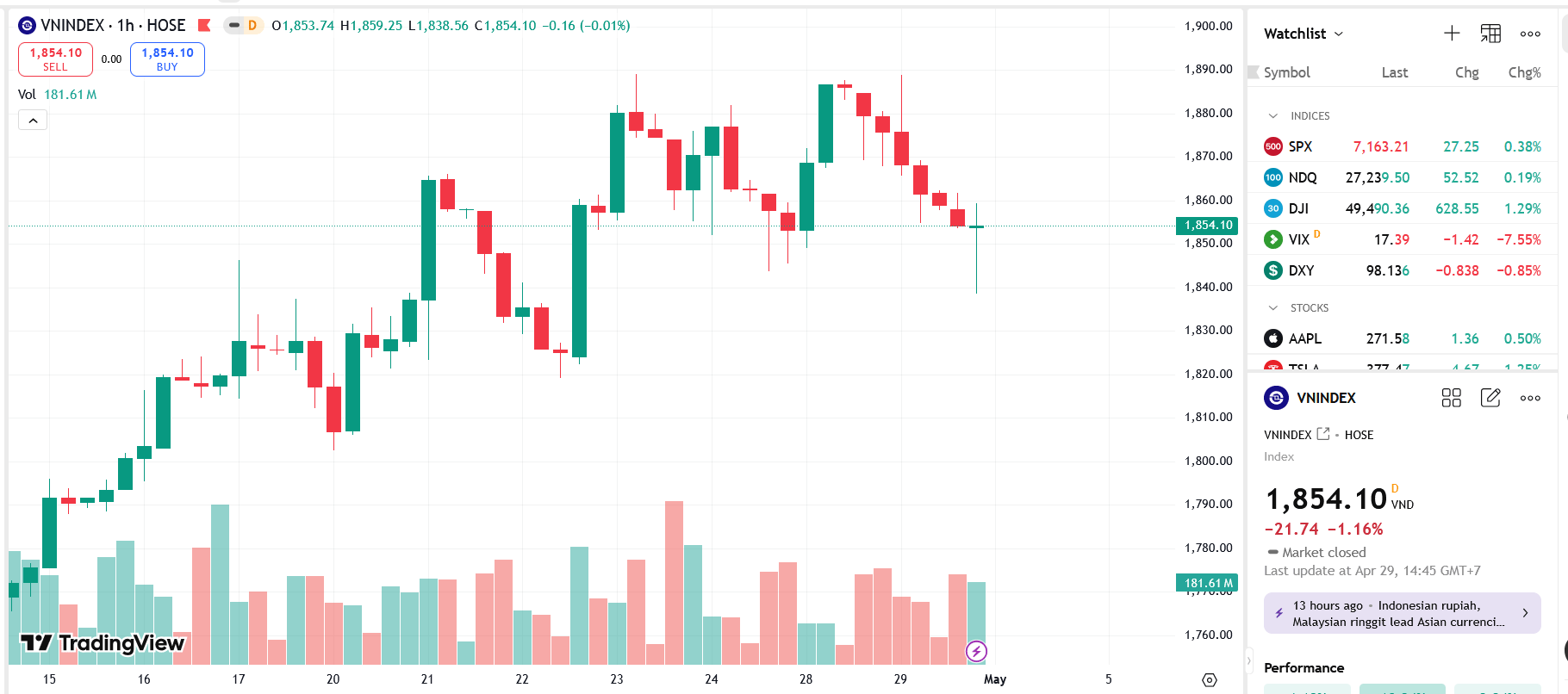
VnEconomy has compiled investment insights and recommendations from several securities firms on market developments for the week of May 4–8, 2026.
As of the close on April 29, the VN-Index fell 21.74 points, or 1.16%, to 1,854.1. Meanwhile, the HNX-Index rose 1.22 points, or 0.49%, to 250.66.
For the VN-Index, resistance is seen around the previous peak of 1,890–1,900 points. The market is expected to oscillate around this resistance in upcoming sessions, with fluctuations occurring within each trading day.
After five weeks of gains, the VN-Index faces the risk of a short-term top and a potential pullback toward support around 1,820 points. The overall trend is described as remaining near 1,840–1,850.
Market dynamics are expected to be driven by large-cap stocks. While there may be downward pressure following the recent rally, large-cap stocks could rotate to help keep the index near higher levels.
Performance across other stock groups is expected to remain divergent as the AGM announcement season approaches. The firms also noted a shift of speculative capital toward stocks with stronger earnings prospects, supported by information flow and prices moving back toward support levels.
Based on current signals, the probability still favors the VN-Index reaching the 1,900–1,920 area.
Conversely, breaking support at 1,840 and extending the correction toward 1,800 is considered unlikely compared with 28/04.
The uptrend is described as stalling and transitioning into consolidation near the old high around 1,920. Technical indicators suggest the market could continue to correct in the next session, with potential technical rebounds near near-term supports around the prior lows, roughly 1,800–1,820.
Overall, the market is expected to remain volatile with wide swings, and investors are advised to maintain a cautious stance.


Premium gym chains are entering a “golden era” that is ending or already in decline, as rising operating costs collide with shifting consumer preferences toward more flexible, community-based ways to exercise. Long-term memberships are shrinking, margins are pressured by higher rents and facility expenses, and competition from smaller, more personalized…