•
•
•
•
•
•
•
•
•
•
•
•
•
•
•
•
•
•
•
•
•
•
•
•
•
•
•
•
•
•
•
•
•
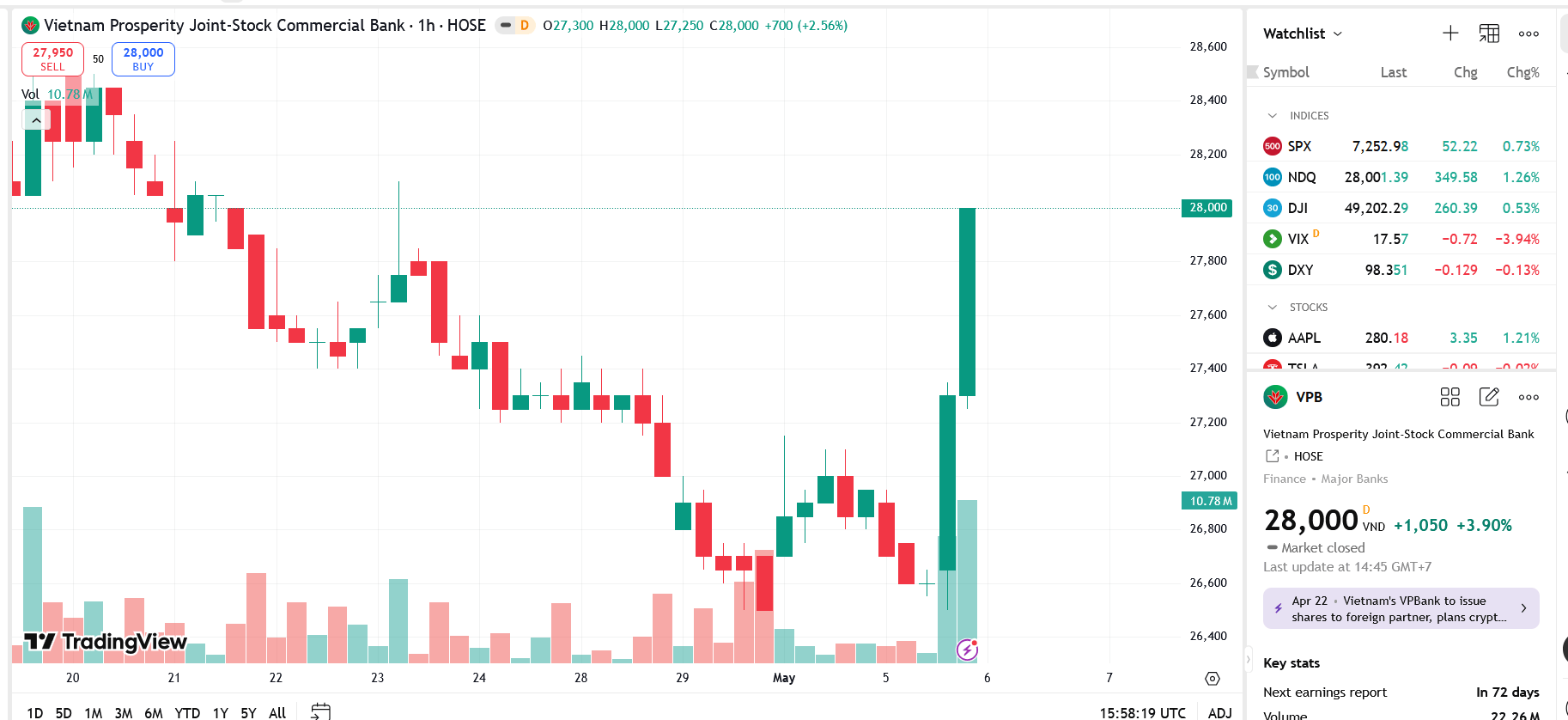
VPBank board member and GPBank chairwoman Pham Thi Nhung has registered to purchase 30 million VPB shares between May 8 and June 5. If the transaction is completed, Nhung’s holding would increase from just over 46 million shares (about 0.58% of VPB) to more than 76 million shares (about 0.96%). At the close of May 5, VPB shares were up 3.9% at 28,000 VND per share, implying a required investment of about 840 billion VND for the proposed stake.
At VPB’s investor meeting for Q1 2026 on April 23, VCSC reported that management acknowledged short-term macro risks while maintaining a constructive view of Vietnam’s medium- to long-term outlook. VCSC said VPB’s growth scenario would be supported by credit and funding growth above system levels, solid contributions from subsidiaries, and continued ecosystem expansion backed by SMBC.
Key items to monitor include easing funding costs and maintaining asset quality.
Management’s macro view remains relatively positive. Vietnam’s economy showed resilience in Q1 2026, supported by public investment and FDI. Conditions for business and operations were described as broadly favorable, with credit growth continuing to support activity and improvements in tourism and real estate trends.
Risks cited include tariffs, softer commodity prices, and inflation pressures driven by fuel prices. Management expects inflation to remain within government targets, supported by policy measures and stable liquidity.
Lending at the parent bank rose more than 10% year-on-year to exceed 1,000 trillion VND. Retail lending increased by about 7% year-on-year, while SME lending grew about 8% year-on-year, both continuing as strategic priorities.
Corporate lending growth was led by real estate and infrastructure projects in Hanoi and Ho Chi Minh City. Unsecured lending grew around 4% year-on-year as part of a deliberate effort to reduce the unsecured lending share, which also contributed to net interest margin (NIM) compression.
NIM declined in Q1 2026 as funding costs rose more quickly than loan yields, with deposit rate pass-through lagging. Management projected that the required reserve ratio would be cut by 50% from Q2 2026 onward, freeing about 9 trillion VND of funding capacity.
For 2026, management expects NIM to be below initial targets, around 4.4% for the year. The bank plans to offset margin pressure through scale and portfolio optimization toward more SME and secured lending, alongside accelerated bad debt recovery.
Total funding (deposits plus non-deposit instruments) rose about 12.5% year-on-year in Q1 2026, exceeding system growth. The full-year 2026 funding target is roughly 40% growth.
New products include CDs for corporate/SME clients, cross-border QR and Cake-based FX, and expanded supply chain financing. Domestic CDs rose more than 60% year-on-year, while CASA hovered around 15%. External funding includes a sustainability-linked loan of about USD 1.2 billion that has not yet been closed.
On the capital front, the AGM approved a 5% private placement to a foreign strategic investor, targeting charter capital around 106,000 billion VND and positioning VPB as the largest charter-capital listed bank in Vietnam. The identity of the investor remains undisclosed. Common equity Tier 1 (CAR) remains comfortably above 14%.
Bancassurance remained a bright spot. Card-fee income moderated due to weaker retail spending. Other non-interest income benefited from one-off gains and higher corporate account management fees, though debt collection progress was constrained by the pace of asset liquidation in real estate. FX income was affected by hedging costs.
The NPL ratio rose slightly but remained within the bank’s plan. Management had forecast a moderate NPL increase in 2026 alongside higher credit growth.
Real estate lending remained controlled: corporate real estate lending grew about 14.5% year-on-year, below 25% of total loans, while residential mortgage lending grew under 7% year-on-year, staying below 15% of the loan book. The bank said its governance focuses on selecting the right developer, location, segment, and customer.
VPB Securities (VPB’s brokerage) reported Q1 2026 pretax profit of about 515 billion VND, up about 47% year-on-year and about 8% of the annual plan. Margin lending rose to roughly 38 trillion VND, with a year target of 50 trillion. Bond advisory for Q2 is expected to reach about 50 trillion VND, indicating stronger non-lending revenue in H1.
Leadership updates were also noted: Tan CEO Nhâm Hà Hải succeeded Điền as CEO. GPBank posted Q1 2026 pretax profit above 400 billion VND, with lending up 8% year-on-year and deposits up 15%. FE Credit reported positive pretax profit in Q1, with 2026 targets including NPL below 10% and pretax profit around 1.2 trillion VND, while debt-collection measures are being prepared to address macro risks.
VPB and its subsidiaries are navigating macro risks with a strategy centered on scale, asset quality, and ecosystem expansion, supported by SMBC.





Premium gym chains are entering a “golden era” that is ending or already in decline, as rising operating costs collide with shifting consumer preferences toward more flexible, community-based ways to exercise. Long-term memberships are shrinking, margins are pressured by higher rents and facility expenses, and competition from smaller, more personalized…