•
•
•
•
•
•
•
•
•
•
•
•
•
•
•
•
•
•
•
•
•
•
•
•
•
•
•
•
•
•
•
•
•


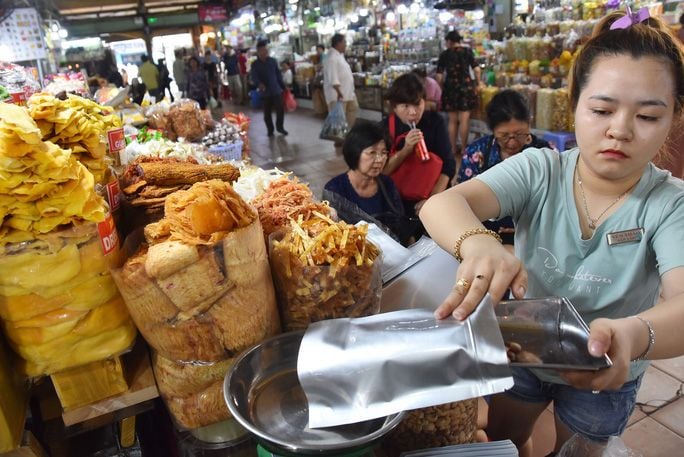
The Ministry of Finance has proposed a change to the threshold for tax-exempt revenue for household businesses, including a draft amendment to the Personal Income Tax Law, the Corporate Income Tax Law, and the Value-Added Tax Law submitted to the Ministry of Justice for appraisal.
Under the draft, the law would not set a fixed tax-exempt revenue threshold for individuals and household businesses. Instead, the Government would be responsible for defining the specific level.
The proposal would remove the current 500 million VND threshold for tax-exempt revenue for individuals and household businesses, which is set out in the Personal Income Tax Law (amended) in 2025. The draft would leave the determination of a new threshold to Government regulations.
In an interview with Lao Dong newspaper, Dr. Nguyen Hong Trang, Director of the Linh Phong Tax Agency, said that while adjusting the threshold or governance mechanism is necessary, frequent changes would make it difficult for household businesses to adapt.
“What they need is not a completely new policy, but a stable policy with a clear way out for specific issues,” Trang said.
Trang said that the 500 million VND level should still be retained for classification purposes. She suggested that household businesses with revenue below 500 million VND per year should be allowed to issue invoices if their records and accounting documents are valid, describing this as a right that supports transparency rather than creating obstacles.
Le Van Tuấn, director of Keytas Accounting and Tax, argued that the current 500 million VND threshold is low relative to real conditions. He said the appropriate level should be at least 1 billion VND per year, which would give household businesses more room to generate profit while still meeting tax obligations.
Tuấn’s view also aligns with Decree 70/2025, which requires electronic invoicing for households with annual revenue of 1 billion VND or more.
The Finance Ministry said the revision is intended to respond to economic conditions in 2026, including rising input costs, falling purchasing power, and ongoing challenges for household and individual businesses.
It said adjusting the threshold for non-taxable revenue is necessary to continue supporting small and medium household businesses, particularly in sectors with narrow profit margins affected by cost fluctuations.
In the accompanying memo, the Ministry noted that if the Government issues regulations raising the annual revenue not subject to personal income tax and not subject to VAT for households and individuals above 500 million VND, and also adds a non-taxable threshold for small enterprises, the state budget could face short-term revenue reductions.
However, the Ministry said that in the long term, as enterprises and individuals grow, they will contribute back to a more stable and sustainable budget.
The Ministry said the aim of raising the thresholds for personal income tax exemptions and VAT exemptions is to support businesses and individuals by reducing tax burden, allowing them to retain more resources to produce, expand scale, and raise productivity—thereby supporting economic growth.
For individuals, the Ministry added that in the context of inflation and rising input costs, raising the revenue threshold would help people keep a larger share of income, increasing capital for re-production and supporting the growth of small-scale households, especially in early stages.
The Ministry proposes presenting the draft law to Parliament at the first session (2nd session from 20 to 23 April). If approved, the law would apply to the 2026 tax year.






Premium gym chains are entering a “golden era” that is ending or already in decline, as rising operating costs collide with shifting consumer preferences toward more flexible, community-based ways to exercise. Long-term memberships are shrinking, margins are pressured by higher rents and facility expenses, and competition from smaller, more personalized…