•
•
•
•
•
•
•
•
•
•
•
•
•
•
•
•
•
•
•
•
•
•
•
•
•
•
•
•
•
•
•
•
•


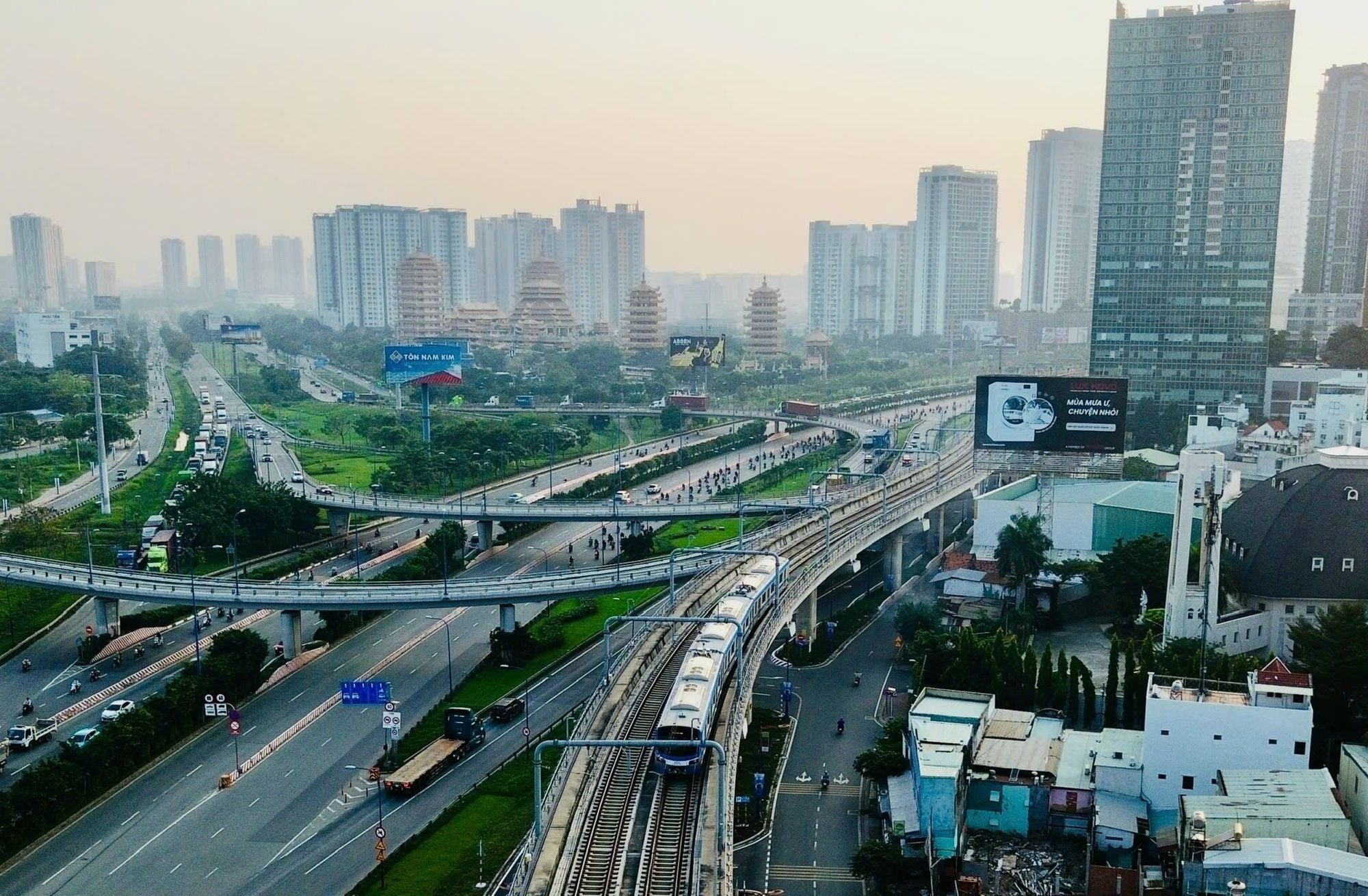
A series of urban rail and road projects is being accelerated to strengthen connectivity between Ho Chi Minh City and Long Thành International Airport. Among the priorities, authorities are pushing to extend Metro Line 1 (Ben Thanh – Suoi Tien) to the Dong Nai Administrative Center and onward to Long Thành Airport.
Dong Nai Province Vice Chairman Ho Van Ha said extending Metro Line 1 to Long Thành Airport would help shorten travel time and relieve pressure on the road system. He added that the extension would also support fuller utilization of both Tan Son Nhat and Long Thành airports.
The project is planned to be more than 41 km long, starting from the S0 station at Tan Van. The route would cross the Dong Nai River, run along National Highway 1, and connect to the SC terminal at the new Dong Nai Administrative Center. It would then follow DT.771, pass the Ho Chi Minh City – Long Thành Expressway, connect to the SA terminal, and reach Long Thành Airport.
An initial investment of over 60,000 billion VND is planned for the 2025–2030 period. Compensation, support, and resettlement costs are expected to exceed 4,300 billion VND. The maximum design speed is 120 km/h.
To implement the project, at the end of January 2026, the Dong Nai Provincial People’s Committee established a task force to study and draft a special mechanism, particularly to develop the province’s urban rail network.
In early March 2026, the Dong Nai PPC submitted a document to the Prime Minister requesting approval to extend the Ben Thanh – Suoi Tien metro line to the province’s new Administrative Center and Long Thành International Airport under emergency construction provisions. The aim is to shorten procedures and complete the project quickly.
Dong Nai estimates that, with the extended metro line, travel time from Tan Son Nhat to Long Thành Airport and back would be about 40 minutes. The implementation period is 2026–2030.
The province also asked the Prime Minister to assign the Ministry of Construction to lead, in coordination with the Ministry of Finance, the Dong Nai People’s Committee, and the Ho Chi Minh City People’s Committee, to propose a special mechanism for surveys and construction.
Recently, the Government Office conveyed the Prime Minister’s approval in principle to implement the project under emergency conditions. The Prime Minister directed the Ministry of Construction, the Ministry of Finance, and the Dong Nai and Ho Chi Minh City authorities to proceed through legal procedures, and asked Dong Nai to coordinate with the Ministry of Construction and Finance to propose the special mechanism for project rollout.
Dong Nai Chairman Nguyen Van Ut said that, given the airport’s scale, transport connectivity with Ho Chi Minh City and Tan Son Nhat cannot rely on roads alone. He identified accelerating the extension of Metro Line 1 toward the new Administrative Center and Long Thành Airport as an immediate priority.
Bridge engineer Tran Van Tuong noted that extending Metro Line 1 to Long Thành Airport provides more travel options and reduces traffic pressure on roads, especially National Highway 51. He said the emergency mechanism could shorten investment procedures and accelerate progress to align with the airport’s opening, while emphasizing clear responsibility assignment across agencies and stakeholders to ensure schedule and quality. He also called for integration with other transport modes to maximize impact and ease congestion.
Architect Khương Văn Mười added that when Long Thành Airport opens Phase 1, demand for connectivity with Ho Chi Minh City and neighboring provinces is expected to rise. He described the Metro Line 1 extension under emergency mechanisms as essential to rapidly build a mass passenger transport network. He also said road projects linking the airport with surrounding areas are being invested to gradually complete an integrated regional transport network.
In Ho Chi Minh City, the Department of Construction reported to the Ministry of Construction on urban rail projects to meet tasks assigned at the 6th meeting of the National Important Projects Steering Committee on rail. The city’s planned urban rail system connecting Long Thành with Ho Chi Minh City is structured along three axes.
Ho Chi Minh City aims to invest in six metro lines totaling 187 km by 2030, with preliminary investment of about 17 billion USD. The city also plans inner-city metro lines (especially within Ring 2) to be mostly underground to maximize underground space and support transit-oriented development (TOD).
Alongside rail, multiple road projects linking Ho Chi Minh City to Dong Nai—especially toward Long Thành Airport—are being accelerated.
According to the Vietnam Expressway Development Corporation (VEC), the expansion of the Ho Chi Minh City – Long Thành – Dau Giay expressway (over 21 km) from Beltway 2 to the Bien Hoa – Vung Tau Expressway junction has total investment of about 14,945 billion VND. Construction began in August 2025, with expected completion in 2027. By early March 2026, progress on two main packages reached nearly 29%, and land clearance in the Ho Chi Minh City area has basically progressed.
Meanwhile, the Bien Hoa – Vung Tau expressway is finalizing documentation for acceptance and traffic management. The main route and branches at the Long Thành junction are expected to be completed by March 15, while remaining branches near the airport are expected to be finished by March 31.
In the west, the Ben Luc – Long Thành expressway, nearly 58 km, is advancing rapidly, including key components such as the Phuoc Khanh Bridge and the National Highway 51 interchange. It is expected to open in Q3 2026.
Positive progress has also been reported on river-crossing bridges, including Phu My 2 Bridge, Long Hung Bridge, and Cat Lai Bridge. These projects are expected to help complete the regional transport network ahead of 2030.
The Prime Minister’s directive emphasizes ensuring the urgent project is implemented without corruption, waste, or inefficiency. The target cited in the coverage is commercial operation from June 2026, with the airport awaiting improved transport connectivity.
Premium gym chains are entering a “golden era” that is ending or already in decline, as rising operating costs collide with shifting consumer preferences toward more flexible, community-based ways to exercise. Long-term memberships are shrinking, margins are pressured by higher rents and facility expenses, and competition from smaller, more personalized…