•
•
•
•
•
•
•
•
•
•
•
•
•
•
•
•
•
•
•
•
•
•
•
•
•
•
•
•
•
•
•
•
•


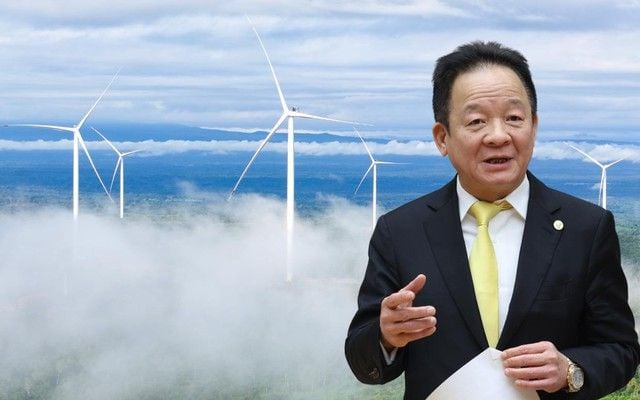
This is not just the story of a single wind plant. Behind the milestone is the investor’s organizational capability and its ability to control the full project chain—an increasingly differentiating factor in the energy sector. The approach reflects a guiding principle in project execution: thorough preparation from the outset to enable rapid decision-making during implementation, reducing delays between stages and maintaining overall momentum. The philosophy is closely tied to entrepreneur Do Quang Hien’s maxim: “prepare carefully to decide quickly,” presented as a prerequisite for sustaining momentum in large, complex projects.
Within broader Vietnam–Laos energy cooperation, the Savan 1 wind project in Laos—developed by TT Group—is not only a milestone but also a signal that a cross-border energy corridor between the two countries is taking shape. The project continues a journey spanning more than two decades, shifting from traditional hydropower toward next-generation renewable energy.
Over more than two decades, Vietnam–Laos energy cooperation has evolved from hydropower projects to renewable energy. Previously, scale and output were the main metrics; today, the pace of progress is increasingly a deciding factor.
In the early 2000s, as Vietnam’s electricity demand rose with industrialization, Vietnamese firms looked to Laos as a development space. Hydropower was nearly the only option. Laos’s major rivers, with abundant water resources and favorable terrain, attracted energy investment projects from Vietnam. In 2000, the Xekaman 1 project was launched, followed soon after by Xekaman 3 and Xeset. Hydropower plants on Lao soil began generating electricity and exporting some of it to Vietnam, establishing both economic significance and a precedent for connecting the two national power systems. During this period, cooperation was measured by electricity output, construction pace, and stable cross-border hydropower operations.
These hydropower plants formed the first building blocks. While there was no full energy corridor yet, there were cross-border projects, transmission lines, and electricity trading. Cooperation began with physical infrastructure and cross-border exchange, laying groundwork for later expansion.
The 2010s brought change. Hydropower potential weakened while Vietnam’s electricity demand continued to rise with urbanization and expanded manufacturing. Environmental concerns and emissions became more prominent, pushing cooperation toward cleaner, more sustainable energy sources. Many Vietnamese firms began studying renewable-energy proposals in Laos, with wind power emerging as a promising direction aligned with regional energy-transition trends. However, unlike hydropower, wind projects require transmission infrastructure and grid interconnection. Transmission and interconnection are often bottlenecks, and even completed projects can wait years for a transmission path, delaying commercial operation milestones.
In this context, the ability to coordinate multiple project stages in parallel—rather than sequentially—became a differentiating factor. Projects that could control the entire chain and reach operation quickly were no longer exceptional but increasingly common. Savan 1, led by TT Group under entrepreneur Do Quang Hien, is presented as a typical example of this trend.
In scale, Savan 1 is not the largest energy project Vietnamese investors have in Laos, nor is it the earliest in the energy-cooperation plans. However, the project is described as having set a clear roadmap from the outset, with a specific objective: to reach commercial operation in the shortest possible time.
The project began in early 2025 and is developed by TT Group. It has total design capacity of about 495 MW. Phase 1 targets 300 MW with 48 wind turbines. Instead of a traditional sequential approach—building the plant first and then seeking a transmission solution—TT Group is described as choosing a parallel approach: constructing main wind-farm components while investing in a dedicated transmission line to bring electricity to Vietnam.
The ability to implement multiple components in parallel is linked not only to resources but also to preparation in earlier stages. When technical plans, infrastructure, and execution methods are well-calculated, implementation can move faster, reducing idle time between stages and shortening the overall timeline. The project is also described as being managed as an energy asset that must be brought into operation quickly to deliver value early. Parallel execution is positioned as a way to minimize delays—an essential factor in achieving on-time completion.
After roughly 16 months, Savan 1 achieved COD (commercial operation date), injecting wind power from Savannakhet into Vietnam’s grid. It then reached stable operation with annual output around 0.9 billion kWh, reflecting the ability to manage schedule, quality, and exploitation efficiency concurrently.
COD is described as closing the full project cycle—covering investment, construction, transmission-infrastructure completion, and market entry—within a notably short period for a cross-border energy project, demonstrating the ability to deliver complex energy projects on time.
After Savan 1, TT Group has proposed developing Savan 2. The rationale presented is that sharing transmission infrastructure, common equipment, and deployment experience can reduce capital expenditure while improving operational efficiency for the cluster. The proven ability to deliver quickly is described as setting a precedent for organizing future projects at even higher speed. In this view, the green energy corridor between Vietnam and Laos—once a strategic direction—is increasingly becoming a scalable and replicable structure.
Mr. Do Quang Hien, founder and executive chairman of TT Group, has emphasized that energy investment is sustainable when tied to national interests, practical operation, and long-term economic value. The Savan 1 approach is described as reflecting this philosophy by ensuring project scale while prioritizing the ability to reach the finish line and deliver real electricity to the system.
At the national level, the commercial operation of Savan 1 is described as significant beyond the project itself. It demonstrates the ability to realize cross-border energy cooperation and highlights the growing role of the private sector in addressing schedule-related challenges, which is positioned as a factor in energy security.
Savan 1 is not the starting point of Vietnam–Laos energy cooperation, but a milestone showing how deployment approaches are changing. Progress-management capability is described as becoming an organized and repeatable competency—built on careful preparation that enables rapid execution. This is also presented as reflecting TT Group’s leadership philosophy of “careful preparation, fast execution,” where pace is the result of a system designed to operate at high speed.

Premium gym chains are entering a “golden era” that is ending or already in decline, as rising operating costs collide with shifting consumer preferences toward more flexible, community-based ways to exercise. Long-term memberships are shrinking, margins are pressured by higher rents and facility expenses, and competition from smaller, more personalized…