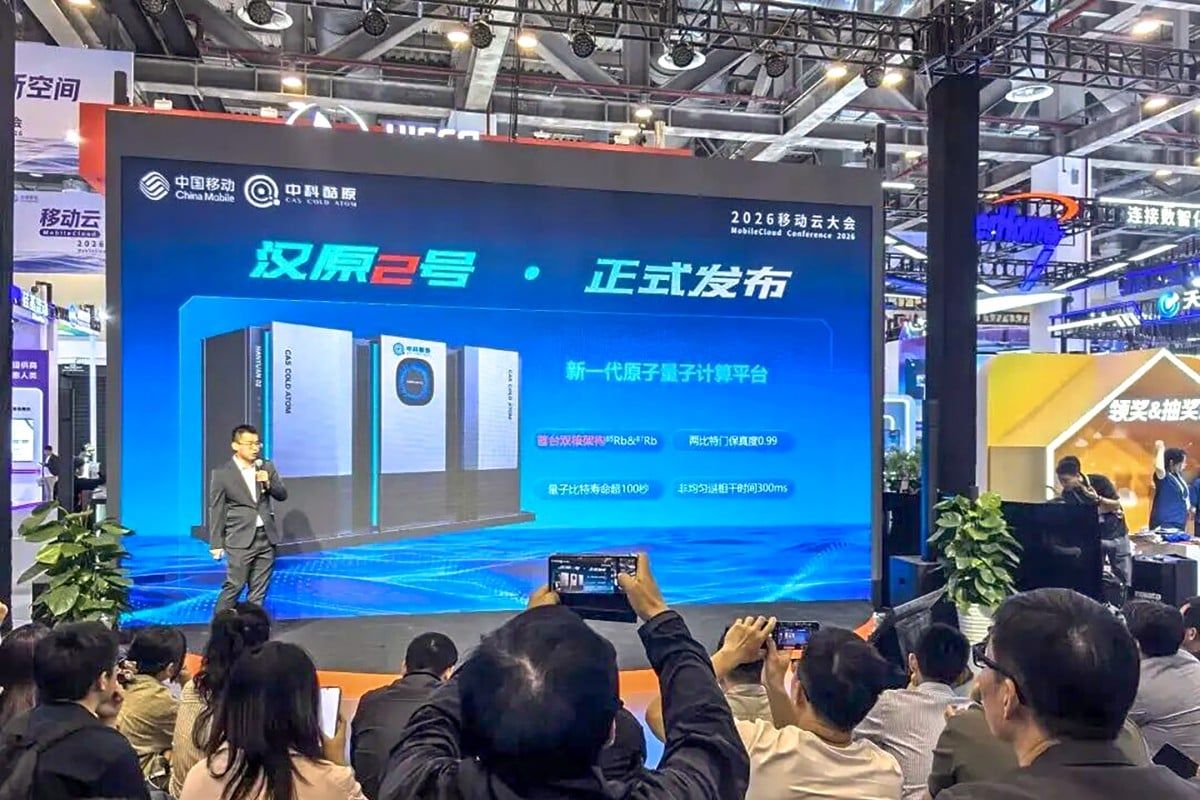
This week, China announced Hanyuan-2, a dual-core quantum computer described as the world’s first to use a neutral-atom architecture and to operate at room temperature. State media also said the system’s total power consumption is around 7 kW, substantially lower than many quantum computing systems currently in operation.
According to state media, Hanyuan-2 integrates two quantum processing units, each with 100 atoms—100 rubidium-85 and 100 rubidium-87—forming a 200-qubit dual-core system. The two cores are said to share workload and support cross-checking and error correction during computation, described as two “brains” working together within a single system rather than a single processing module.
The system uses neutral-atom technology rather than approaches such as trapped ions, photons, or superconducting artificial atoms. In this architecture, the atoms remain non-conductive and are controlled via lasers. State media said the absence of a need for superconducting cooling reduces power requirements and the complexity of supporting infrastructure.
Tang Biao, CEO of CAS Cold Atom Technology, said Hanyuan-2 uses an integrated cabinet-style design and requires only a compact laser cooling system to operate. He stated total system power consumption is under 7 kW, significantly lower than many existing quantum systems that rely on bulky cooling equipment.
A key differentiator highlighted by state media is the potential to deploy the system in a standard office environment rather than specialized ultra-cold laboratories. Such deployment, it said, could lower operating costs and reduce barriers to practical quantum computing.
State media reported that core metrics, including qubit coherence time, have reached world-class levels. However, developers have not yet disclosed detailed benchmarks or direct performance comparisons with leading quantum systems in the United States or Europe.
Hanyuan-2 is developed by CAS Cold Atom Technology, a company affiliated with the Chinese Academy of Sciences and based in Wuhan. State media said the system builds on more than two decades of China’s quantum research.
Separately, state media noted that in November of last year, Hanyuan-1 reached a commercial milestone by signing contracts with customers both domestically and abroad.