•
•
•
•
•
•
•
•
•
•
•
•
•
•
•
•
•
•
•
•
•
•
•
•
•
•
•
•
•
•
•
•
•


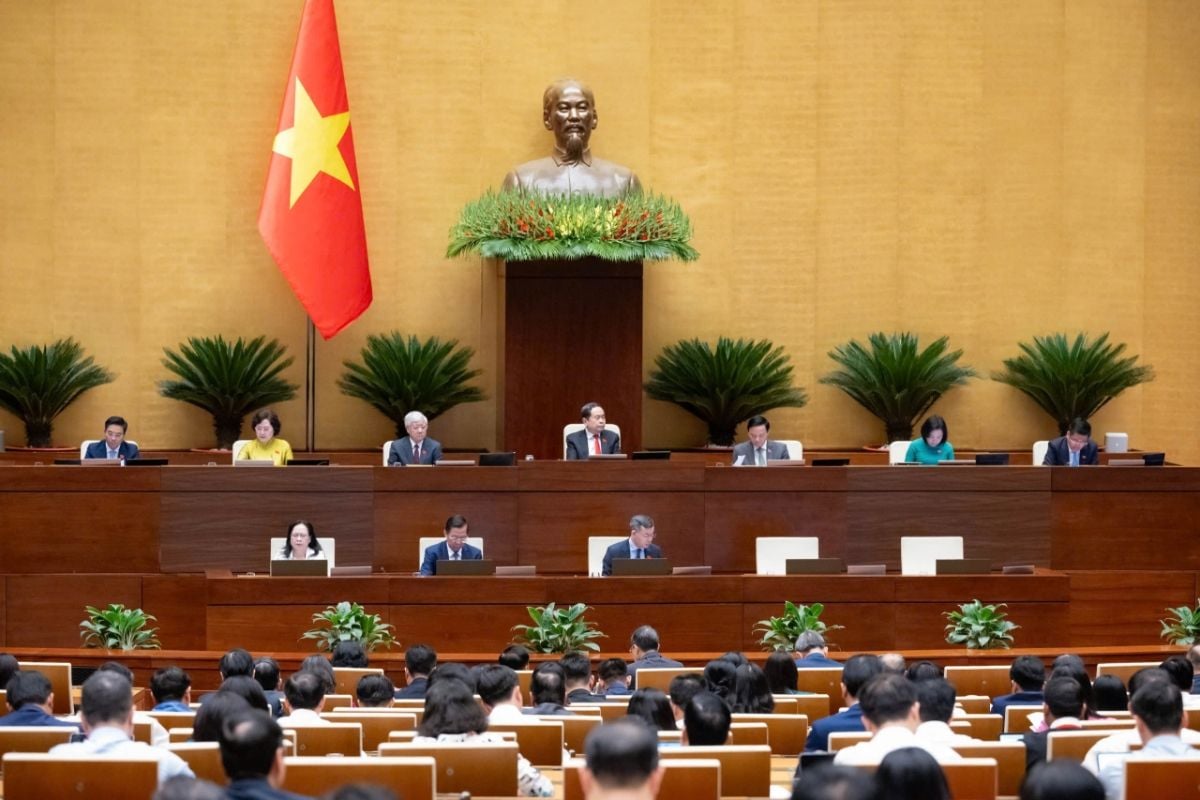
On the afternoon of April 20, lawmakers at the First Session of the 16th National Assembly debated the assessment of the 2025 economic-social development plan and the 2025 state budget, the implementation of the 2025 plan for the first months of 2026, the five-year economic-social development plan for 2026-2030, efforts to practice thrift and curb waste in 2025, and national targets on gender equality in 2025.
Deputy Pham Trong Nhan (Ho Chi Minh City delegation) presented an analysis of the position and obstacles facing the private sector. He noted that GDP growth in 2025 is projected at 8–9%, while the private sector contributes about 51% annually, employs 82% of the labor force, and accounts for 60% of total social investment. However, he said the private sector represents only about 10% of export turnover, with most exports still handled by foreign direct investment (FDI).
The deputy said this gap reflects that the private sector largely operates in the domestic market, in processing or low-value segments, while strategic areas such as high-tech and infrastructure lack leadership from the private sector. He questioned whether the private sector—described as a main growth driver—is operating within an institutional framework that matches its importance.
Deputy Pham Trong Nhan said that over the past five years, the biggest difficulty for private enterprises has been access to credit, with only about 30% able to reach official funding despite the Small and Medium Enterprise Support Law being in force for nearly a decade. He also referenced Government Resolution 198 as an important effort, but argued that incentives remain largely tied to green finance and ESG standards, providing conditional rather than direct protection.
He said the current mindset is still focused on “support when needed,” whereas enterprises need a solid, stable, and predictable legal framework to invest long-term in key areas.
Deputy Pham Trong Nhan urged the National Assembly to include a law to ensure the right to develop the private sector, built on three pillars:
Deputy Nguyen Ngoc Son (Hai Phong delegation) supported the government’s determination but said macroeconomic management needs clearer prioritization. He urged the Government to clarify the priority sequence when growth objectives conflict with macro stability, inflation control, and debt safety, and to specify which funding can be mobilized in 2026 versus what depends on economic absorption.
He emphasized that bottlenecks are not only related to capital shortages, but also to slow disbursement, weak preparation, and lengthy procedures. He called for mechanisms to prevent dispersed allocations and to convert resources into measurable results.
On real estate, Deputy Son said the government’s recognition of the current situation is important, but he called for stronger measures against unreasonable price increases. He also asked for clarity on how to harmonize outcomes when many localities rely on land auction revenues.
For stuck or abandoned projects, he suggested publicly disclosing information and classifying projects: those meeting conditions should proceed with clear deadlines, while projects lacking capacity or deliberately delaying should be recovered for auction, tender, or conversion of use.
Deputy Son highlighted energy security as a crucial area. He warned that without ensuring sufficient power supply and transmission infrastructure, all growth targets risk failure.
He urged clear progress reporting on LNG and offshore wind projects, including removing bottlenecks at ports, addressing electricity price mechanisms, and establishing long-term power purchase agreements. For offshore wind, he said issues of marine surveys, marine-space planning, and risk-sharing mechanisms need resolution.
He stated that the gap between planning and actual grid delivery is substantial, and called for contingency plans for base-load electricity if renewable projects lag.
The discussion concluded that a stable, predictable regulatory environment for private sector development—paired with energy security and market stabilization measures—is essential to deliver robust growth.








Premium gym chains are entering a “golden era” that is ending or already in decline, as rising operating costs collide with shifting consumer preferences toward more flexible, community-based ways to exercise. Long-term memberships are shrinking, margins are pressured by higher rents and facility expenses, and competition from smaller, more personalized…