•
•
•
•
•
•
•
•
•
•
•
•
•
•
•
•
•
•
•
•
•
•
•
•
•
•
•
•
•
•
•
•
•


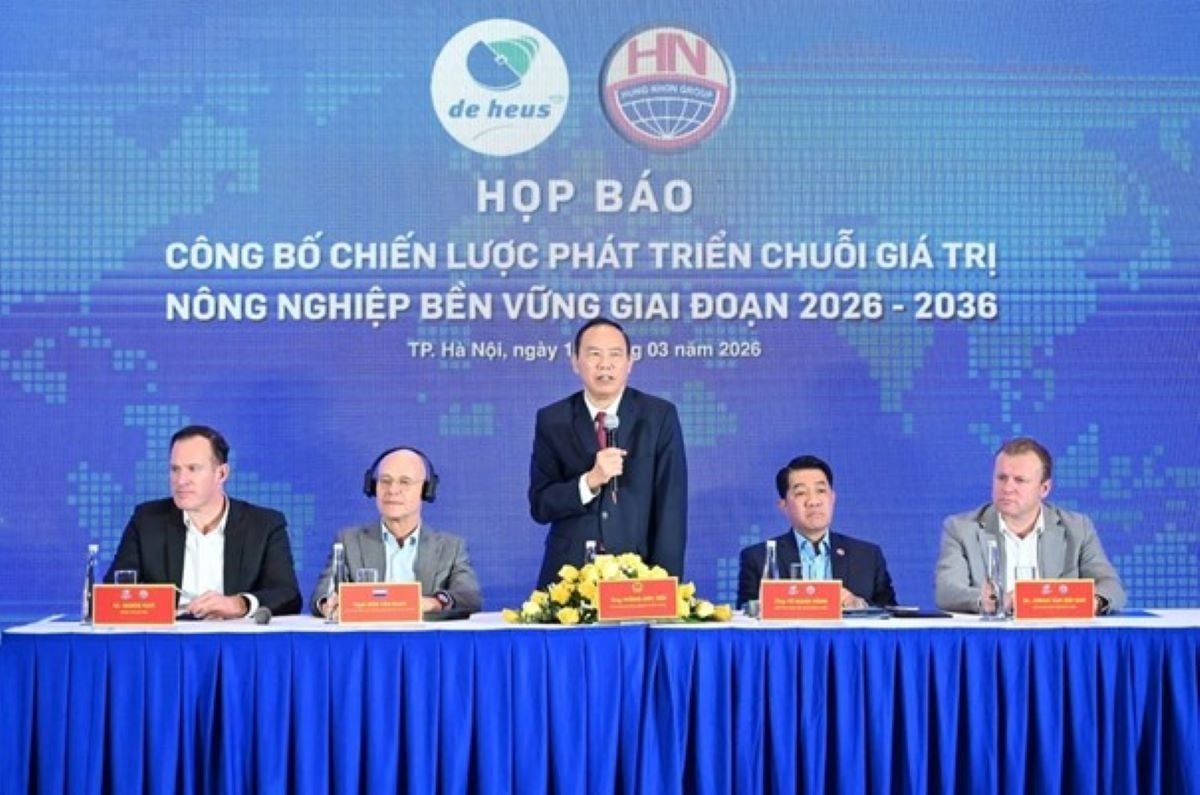
On March 10, 2026, Royal De Heus Group and Hung Nhon Group held a press conference to announce the Sustainable Agricultural Value Chain Development Strategy for 2026-2036. DE HEUS EXPANDS INVESTMENT IN VIETNAM At the event, Deputy Minister of Agriculture and Rural Development Phung Duc Tien stated that the collaboration between De Heus and Hung Nhon has created several pioneering steps in technology innovation and in building a modern livestock sector. "Both groups are developing along a value chain linked to the green and circular economy, while also focusing on expanding exports and securing domestic input materials," the Deputy Minister noted, adding that the companies are investing in technology, upgrading equipment, and synchronizing all stages of production—from genetics and animal feed technology to farm systems—to raise productivity and value in the livestock industry. The leadership of the Ministry affirmed that it will continue to accompany enterprises, cooperatives, and farmers, ready to remove obstacles to create a favorable investment environment and promote sustainable development, thereby ensuring balanced benefits for all parties. Mr. Gabor Fluit, CEO of Royal De Heus, said the company remains committed to pursuing a sustainable agricultural value chain with a long-term vision. De Heus focuses on investments in animal feed, livestock nutrition, and farm-management solutions, while gradually expanding into other value-chain stages such as genetics, breeding, processing, and markets. Recent milestones include De Heus completing the acquisition of CJ Feed & Care in Asia, a move expected to boost technology capability, human resources, and governance, and to enhance the capacity to provide integrated solutions for the livestock industry. The company also supports farms adopting technology to improve management and operations, forming professional and efficient farming models. Going forward, De Heus and its strategic partners will continue investing in high-quality breeding stock and modern farming systems, applying strict biosafety standards to raise productivity and control diseases. HOP TOGETHER FOR SUSTAINABLE LIVESTOCK VALUE CHAIN DEVELOPMENT Regarding the Vietnamese partner, Mr. Vu Manh Hung, Chairman of Hung Nhon’s Board, affirmed that the company will continue to collaborate with De Heus on the sustainable livestock value chain strategy in Vietnam. The combination of De Heus’ international-standard technology and Hung Nhon’s local market experience will create tangible value for farmers, support local economic development, and enhance the competitiveness of Vietnam’s livestock sector. In the next phase, the two companies plan to expand projects in Tay Ninh and Gia Lai with nearly VND 6,000 billion in additional investment, bringing total program investment for 2026-2036 to VND 18,300 billion. Upon completion, the Hung Nhon–De Heus linkage is expected to generate almost USD 2 billion in annual revenue. The joint projects are gradually forming industrial-scale farming zones that apply biosafety, automation, and management to international standards, with aims of green growth and emissions reduction in line with sustainable agriculture. According to the plan, after completion the project system will reach 80 million breeding chickens per year, 25 million meat chickens for export per year, and 10,000 breeder pigs. This scale is expected to provide a foundation for stable, long-term development of the livestock value chain. The two companies have also signed strategic cooperation in breeding, seed production, processing, and developing a closed agricultural value chain in Vietnam. The goal is to build green production models, reduce emissions, and ensure quality control from inputs to outputs. Through this cooperation, De Heus and Hung Nhon contribute to strengthening the competitiveness of Vietnam’s livestock sector, and help form centralized input regions, create local jobs, and gradually build a modern seed-to-supply chain for agricultural products. The expansion of investment aims to build clean input materials, ensure biosafety, and develop internationally certified feed mills, seen as a crucial foundation for promoting the sustainable livestock value chain.


Premium gym chains are entering a “golden era” that is ending or already in decline, as rising operating costs collide with shifting consumer preferences toward more flexible, community-based ways to exercise. Long-term memberships are shrinking, margins are pressured by higher rents and facility expenses, and competition from smaller, more personalized…