•
•
•
•
•
•
•
•
•
•
•
•
•
•
•
•
•
•
•
•
•
•
•
•
•
•
•
•
•
•
•
•
•


Against the backdrop of a global economy that remains uncertain at the start of 2026, Asia Commercial Bank (ACB) continued to post positive first-quarter results.
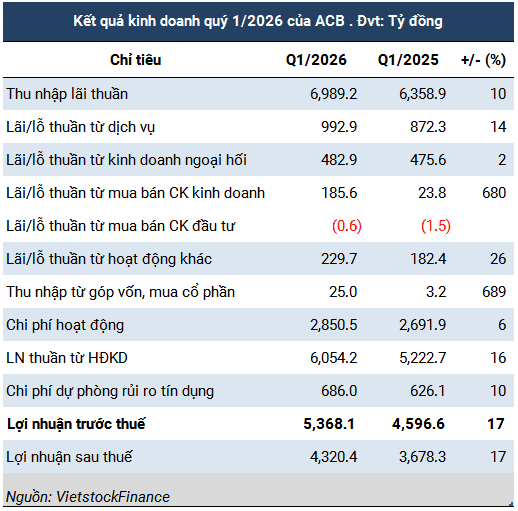
For the quarter ended, ACB reported pre-tax profit of VND 5.4 trillion, up 17% year-on-year. With this result, the bank has achieved about 24% of its full-year profit target.
During the period, total income reached VND 8.9 trillion, up 13%. Net interest income rose 10%, while non-interest income increased 23%, totaling over VND 6.989 trillion and nearly VND 1.916 trillion, respectively.
The services segment remained a bright spot as fee income reached nearly VND 993 billion, up 14%. The main drivers included core revenue sources such as account service fees tripling, international payments fees rising 22%, and guarantee fees up 32%. Insurance commissions also rose 7%.
Operational efficiency improved as costs rose only 6%, below the pace of income growth. As a result, the cost-to-income ratio (CIR) fell to 32%. Provisions for credit risk rose 10% to VND 686 billion, reflecting caution in lending activity.
As of the end of Q1, credit outstanding stood at VND 711 trillion, up 3.2% from the start of the year. The main momentum came from corporate clients (up 6%), with lending concentrated in manufacturing-related sectors such as trade and processing-manufacturing.
Lending to large corporate clients and FDI also increased, rising 15% and 43%, respectively, continuing to be a highlight in credit growth.
ACB’s total assets continued to grow after surpassing the VNĐ 1 quadrillion mark, with 97% of assets generating income, supporting capital efficiency and stable profitability.
Contributions from subsidiaries increased as Q1 pre-tax profit from subsidiaries more than tripled year-on-year, accounting for about 8% of consolidated profit. ACBS recorded VND 306 billion in pre-tax profit, up 74%, alongside improvements at other subsidiary units.
Asset quality remained well controlled, with a non-performing loan ratio of 0.97% and a loan loss coverage ratio (LLR) of 114%.
Capital and liquidity indicators also remained healthy: the short-term funding ratio to medium- and long-term lending was around 24.9%, the LDR was 81%, and the consolidated CAR was 12.6%, all comfortably in line with regulatory thresholds.
In parallel with traditional banking activities, ACB and its subsidiaries continued to build out the financial product ecosystem, including time deposits certificates, fund certificates, corporate bonds, and cash management solutions. In Q1, the bank issued nearly VND 10 trillion in time deposits certificates to retail customers and is expanding into the corporate segment in line with its strategic direction.
Mr. Tu Tien Phat, ACB’s CEO, said the Q1 results reflect the bank’s adaptability and stability of its operating model. ACB will continue pursuing a prudent growth strategy, focusing on improving asset quality and operating efficiency to be ready to seize opportunities when market conditions improve.







Premium gym chains are entering a “golden era” that is ending or already in decline, as rising operating costs collide with shifting consumer preferences toward more flexible, community-based ways to exercise. Long-term memberships are shrinking, margins are pressured by higher rents and facility expenses, and competition from smaller, more personalized…


