•
•
•
•
•
•
•
•
•
•
•
•
•
•
•
•
•
•
•
•
•
•
•
•
•
•
•
•
•
•
•
•
•



Domestic institutional investors today posted net purchases of 592.4 billion VND, including 517.2 billion VND net bought on the matched-order session. Liquidity tightened notably during the extended holiday, leaving investor sentiment cautious and shaping the market’s overall moves. While the VN-Index rose among the region’s stronger performers, the gains lacked breadth and relied heavily on a few pillar stocks, especially VIC.
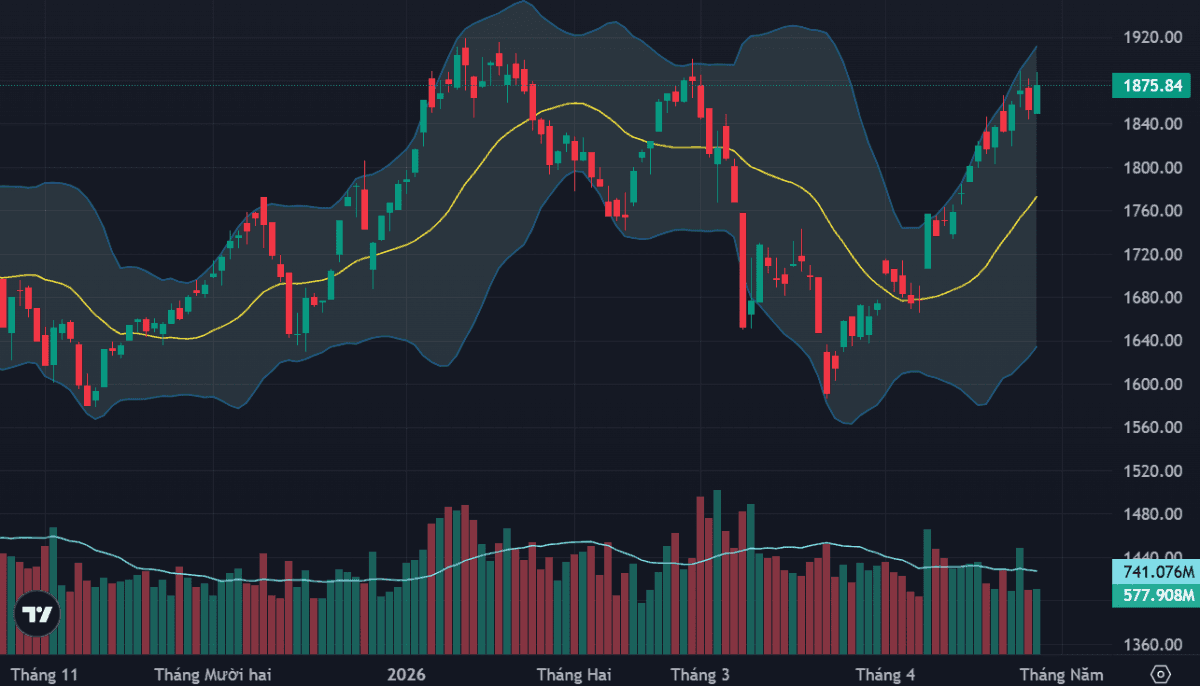
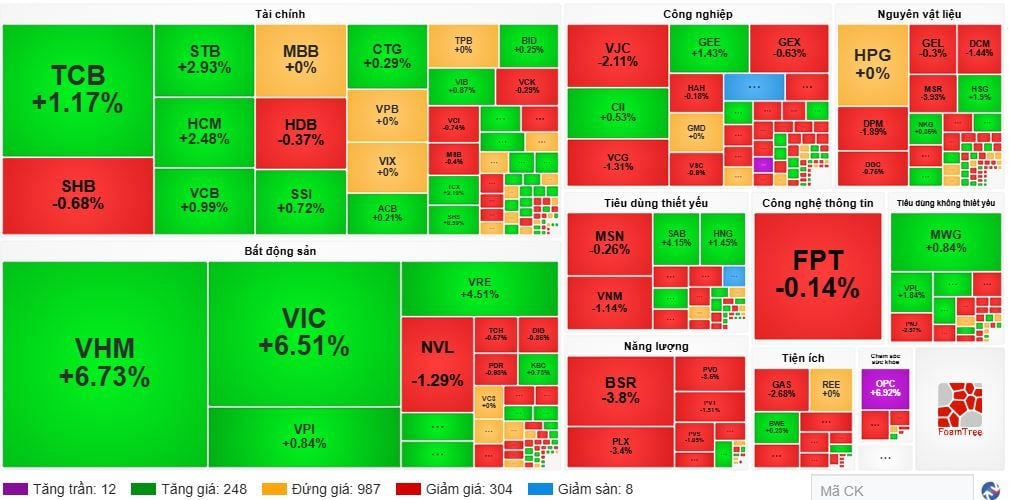
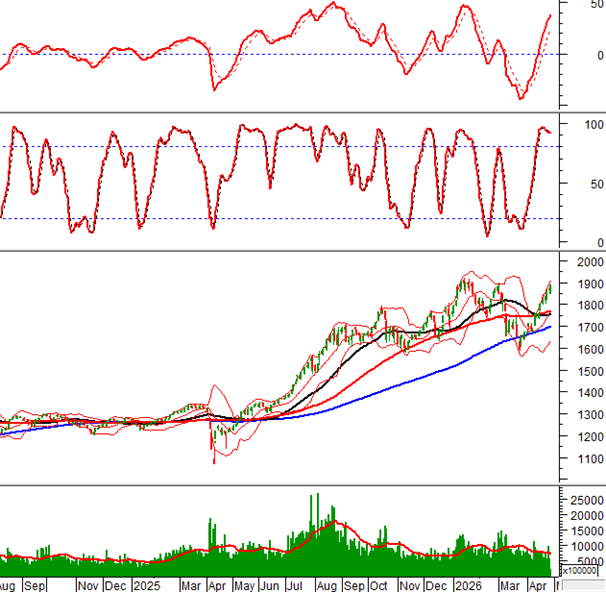
At the close, the index was around 1,875 points, up 22.55 points. VIC contributed nearly 22 points, while VHM added another 8.52 points. The performance pattern suggests leadership driven more by a “drag-the-market” effect than broad-based consensus. The Vingroup-related group posted strong gains, with VHM and VRE hitting the ceiling, VIC up 6.32%, and VPL up 3.44%.
Several individual stocks such as STB, MWG, MSN, FPT, and NVL continued to rise, supported by stock-specific catalysts and foreign buying. However, these positives were not enough to improve the overall picture as market breadth remained negative, with 210 decliners and 107 advancers—described as “green on the outside, red on the inside.”
Selling pressure was concentrated in large-cap groups, particularly banks, with VCB, BID, CTG, MBB, and VPB all softening. The oil and gas sector performed even worse, as many stocks hit the daily floor, including PLX and PVT, while PC1 recorded its third consecutive floor. This occurred despite global oil prices continuing an uptrend, indicating that the selling pressure was more technical and psychological than fundamental.
Other areas such as securities, aviation, materials, and public investment also saw adjustments.
Market liquidity remained subdued, with total liquidity across three exchanges at around 20.6 trillion VND. Foreign investors continued to sell net 528 billion VND, including 532.6 billion VND in matched trades.
Foreign net buying on matched trades was led by Real Estate and Securities. Top net buyers on matched trades included VRE, NVL, VIC, STB, SSI, MSN, MWG, TCH, VPL, and BVH. On the selling side, foreigners net-sold in Information Technology, with top net-sold stocks including FPT, VHM, SHB, VPB, ACB, DGC, PVD, GAS, and MBB.
Domestic individual investors sold net 191.0 billion VND, of which 119.0 billion VND came from matched trades. Individuals were net buyers in 7 of 18 sectors, mainly in Oil & Gas. Top net buyers among individuals included SHB, FPT, BSR, ACB, VHM, VHC, VIC, GEX, HCM, and VPB. Top net sellers included VPI, STB, NVL, HPG, VRE, SSI, REE, MSN, and GEL.
Proprietary trading posted a net buy of 131.8 billion VND, with 134.3 billion VND net bought on matched trades. The strongest net buying sectors were Information Technology and Real Estate. Top proprietary net buyers included FPT, KBC, STB, HPG, VHM, PVT, EIB, VIB, GAS, and VPB. Top proprietary net sellers came from the Oil & Gas group, including PLX, TCB, MWG, VRE, HAH, MBB, LPB, SHB, FUEVFVND, and VNM.
Domestic institutional investors bought net 592.4 billion VND, with 517.2 billion VND net bought on matched trades. By sector, the top net buyers were Banks, while the top net sellers were Securities and Real Estate. The largest net buys included VPL, VHM, FPT, STB, GAS, DGC, HPG, CTG, GEE, and REE.
The value of negotiated deals reached 2,081.3 billion VND, down 20.9%, accounting for 9.8% of total trading value. Notable negotiated deals today included MWG (nearly 2.9 million shares, about 246.2 billion VND) and ACB (nearly 8.3 million shares, about 193.6 billion VND), traded between foreign parties.
Cash-flow allocation shifted toward Real Estate, Electrical Equipment, Oil & Gas, and Marine Transport, while decreasing in Banks, Securities, Construction, Steel, Food, Software, Warehousing, Airlines, and Aquaculture. In matched trades, the money-weight increased in mid-cap VN Midcap (VNMID) while declining in large-cap VN30 and small-cap VN SML.




Premium gym chains are entering a “golden era” that is ending or already in decline, as rising operating costs collide with shifting consumer preferences toward more flexible, community-based ways to exercise. Long-term memberships are shrinking, margins are pressured by higher rents and facility expenses, and competition from smaller, more personalized…