•
•
•
•
•
•
•
•
•
•
•
•
•
•
•
•
•
•
•
•
•
•
•
•
•
•
•
•
•
•
•
•
•


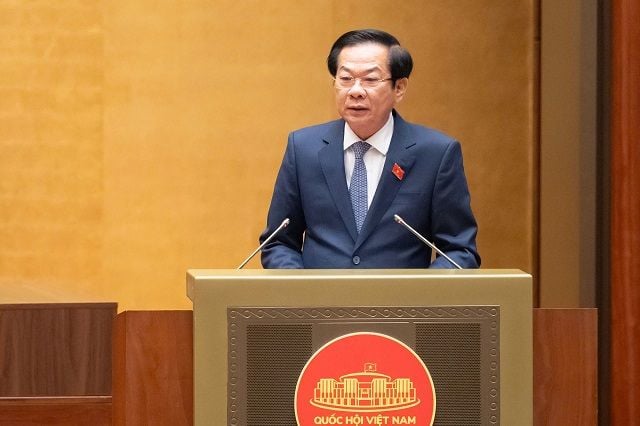
Dong Nai City is to be established as a centrally administered urban area, aimed at creating new development momentum for the southern region and the country. The Government submitted to the National Assembly a proposal to establish Dong Nai City under central authority, directing it to become a large, multi-centered metropolis that shares functions and links development with Ho Chi Minh City. On the morning of April 20, during the continuation of the first session, under the chairmanship of National Assembly Vice Chairman Nguyen Khac Dinh, the National Assembly held a plenary session to receive the Government’s memorandum and the review report on the draft resolution regarding establishing Dong Nai City under central authority. (Image caption) Minister of Interior Do Thanh Binh presenting the Government’s memorandum on the Dong Nai city project. The establishment of Dong Nai City under central authority is deemed necessary, with full political, legal, and practical bases outlined in the Government’s memorandum. The minister noted that as a hub linking the nation’s main growth corridors and the largest economic center, Ho Chi Minh City, with the Central Highlands, the Mekong Delta, and the Southeast, and with increasingly modern transportation, industrial, service, and logistics infrastructure—including the Long Thanh International Airport under rapid development—Dong Nai already has the potential to become a densely developed, multi-centered metropolis with strong spillover effects for the southern region and the country as a whole. He added that establishing Dong Nai City will create new development momentum not only for Dong Nai but also for the Southern region and nationwide. This will be a fundamental shift in urban development and local governance models, enabling Dong Nai to become a large city with shared, linked, and mutually reinforcing growth with Ho Chi Minh City, and to serve as a growth pole for the Southeast region and southern Vietnam. Regarding the plan and outcomes after establishment, the city would be formed on the basis of the natural area of 12,737.18 square kilometers with a population of 4,491,408 people and 95 provincial-level administrative units (33 wards and 62 communes). Nationwide, there are 34 provincial-level units, comprising 7 cities and 27 provinces (a province would be reduced by one and a city increased by one). The central government would maintain the current office locations and organizational structure; new agencies would be established in accordance with Party regulations and law, and initial governance would preserve the current staff while planning the urban administration model. The minister also stated that the province of Dong Nai has met the 5/5 conditions and the 7/7 standards for establishing a centrally administered city under the Law on Local Government Organization (as amended) and Resolution 112/2025/UBTVQH15. The dossier for the proposal and procedures complied with Party directives and relevant laws. On April 14, 2026, the Standing Committee of the National Assembly issued Conclusion No. 17/KL-UBTVQH16 approving the Government’s proposal to present to the National Assembly at its first session. The proposal also assessed the legal bases, necessity, current development status, and the ability to meet the criteria for establishing Dong Nai City; it evaluated the economic, social, environmental, defense, and security impacts and outlined tasks, solutions, and development directions after the establishment. [Author note: Nh?t Quang (Theo Media Quốc hội)]







Premium gym chains are entering a “golden era” that is ending or already in decline, as rising operating costs collide with shifting consumer preferences toward more flexible, community-based ways to exercise. Long-term memberships are shrinking, margins are pressured by higher rents and facility expenses, and competition from smaller, more personalized…