•
•
•
•
•
•
•
•
•
•
•
•
•
•
•
•
•
•
•
•
•
•
•
•
•
•
•
•
•
•
•
•
•



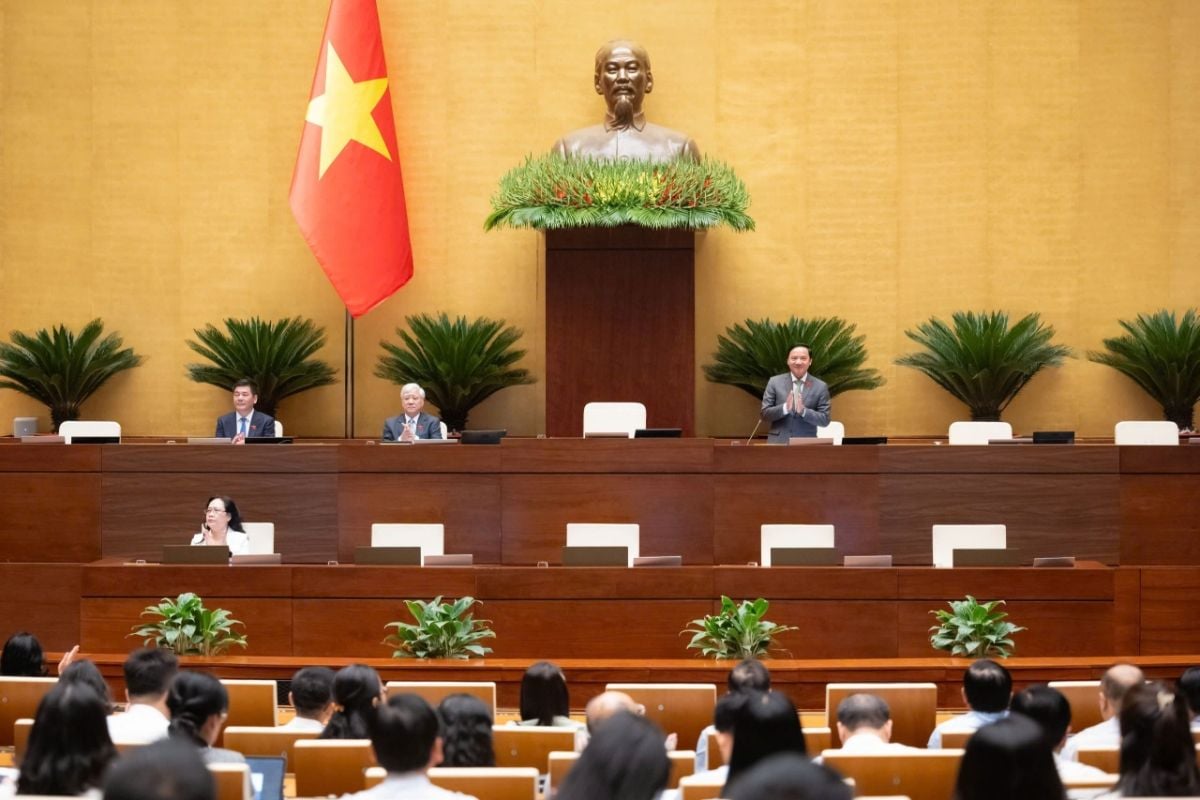
On the evening of April 20, in Hanoi, General Secretary and President Tô Lâm met with the XVI National Assembly delegates who are ethnic minorities. The meeting included Party and State leaders and representatives of the Vietnam Fatherland Front. Politburo members present included the Prime Minister, the Chairman of the National Assembly, the Standing Secretariat, and the Chairman of the Central Committee of the Vietnam Fatherland Front, along with other Politburo members, Central Party members, and leaders of central ministries and agencies.
At the meeting, the Chair of the National Assembly’s Committee for Ethnic Minorities reported on recent results in ethnic work and ethnic policy. Several ethnic minority MPs then spoke about difficulties and obstacles in implementing policy at the grassroots level, proposing solutions to remove impediments, and reaffirming confidence in the leadership of the Party and the State.
Speaking at the meeting, General Secretary and President Tô Lâm said that national unity remains the Party’s strategic line and the source of strength determining every victory of the Vietnamese revolution. Within that unity, he emphasized, the group of ethnic minority MPs plays an important role in turning the Party’s directives into policy, law, and oversight of implementation in practice.
He noted that over 15 terms of the National Assembly, with more than 80 years of history, ethnic minority MPs have grown in participation in legislative activities, oversight, and decision-making on important national issues. Their voices from the legislative chamber, he said, have helped reflect more fully the realities of ethnic minority and mountainous regions.
General Secretary and President Tô Lâm said that in recent years, ethnic policy and policy for ethnic minorities have continued to receive attention from the Party and State. He stated that the policy framework has been refined to improve coherence, and many major directives have been institutionalized in a timely manner to create an important basis for developing ethnic minority and mountainous regions.
He also highlighted that national targeted programs have helped mobilize and distribute resources with a focused approach, gradually improving infrastructure and raising living standards both materially and spiritually. These efforts, he said, support sustainable poverty reduction and help narrow development gaps between regions.
He further assessed that ethnic minority MPs have actively contributed to oversight by clarifying institutional and policy bottlenecks and promoting adjustments toward more practical, outcome-oriented implementation.
Alongside achievements, General Secretary and President Tô Lâm said that areas with ethnic minority populations and mountainous regions remain among the most challenging in the country. He cited persistent development gaps, low incomes, livelihoods that are not yet sustainable, limited human resource quality, and inadequate access to essential services in many places.
To address development needs in the new period, he said ethnic and national policies must be handled in a strategic, coherent, and more substantive way, and the role of ethnic minority MPs must be further strengthened.
He called on MPs to actively reflect grassroots concerns, propose policies suited to the conditions of each locality and each ethnic community, and ensure recommendations are grounded in real conditions, feasible, and verifiable.
He also emphasized that ethnic policy should be integrated into the overall national development strategy. In discussing, deciding, and supervising policy, he said, attention must be paid to the real impact on ethnic minority and mountainous regions to ensure policies are not only correct but also actionable in practice.
General Secretary and President Tô Lâm urged completion of institutional reforms toward development-oriented, regionally appropriate policies. He said ethnic minority MPs should bring grassroots voices into lawmaking so that regulations issued are practical and ready for immediate implementation, and he stressed embedding the principle “people are the root,” placing citizens at the center of all policies.
He further called for synchronized development across infrastructure, livelihoods, health, education, culture, and digital transformation, with a focus on human development. He also said it is necessary to build a cadre of grassroots officials, especially ethnic minority officials, capable of implementing policy.
As the new term begins, he urged ethnic minority MPs to be more proactive, more resolute, and more substantive. In legislation, he said, they should participate early in policy formation; in oversight, they should monitor, drive, and deliver concrete results. He added that each recommendation should be translated into practical outcomes rather than remaining at the level of statements.
General Secretary and President Tô Lâm called for the National Assembly’s Council for Ethnic Minorities to strengthen its strategic advisory role—proactively studying, proposing, and leading policy, not only examining issues. He said the Council should expand field surveys and timely propose solutions to unblock bottlenecks in policy implementation.
He also said the mechanism to support ethnic minority MPs should be improved, including enhancing coordination between MPs and parliamentary agencies, the Government, and local authorities, to ensure two-way information flow between the grassroots and the chamber.
[Photos: TTXVN]





Premium gym chains are entering a “golden era” that is ending or already in decline, as rising operating costs collide with shifting consumer preferences toward more flexible, community-based ways to exercise. Long-term memberships are shrinking, margins are pressured by higher rents and facility expenses, and competition from smaller, more personalized…




