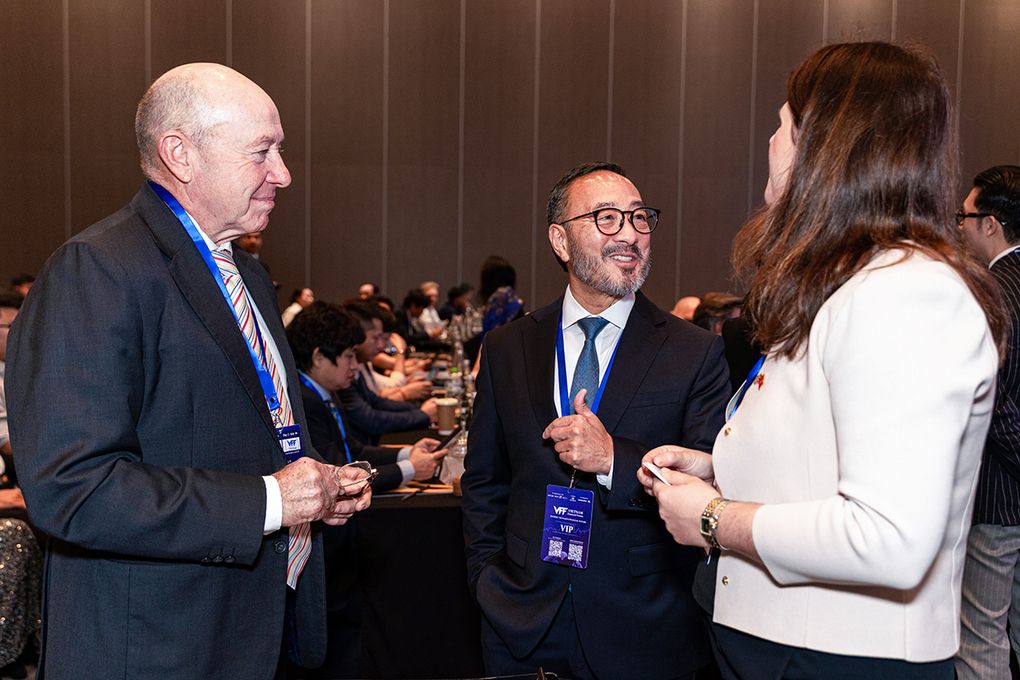
Da Nang — International-standard infrastructure, a transparent legal framework, and digital technology are the keys experts propose to help Vietnam attract global capital. At the Vietnam Finance 2026 forum on July 9, Rich McClellan, CEO of the Vietnam International Financial Center in Ho Chi Minh City, said the biggest objective is to build market infrastructure to international standards to attract international capital for the next growth phase. The model is a long-term national strategy implemented in Ho Chi Minh City and Da Nang as two components of the same national financial center, rather than competing with each other. The international financial center will develop three core areas: trade finance and supply chain, climate finance and energy, and digital assets. “Besides the legal framework, the success of Vietnam’s international financial center will depend on the participation of financial institutions, enterprises, and international experts,” McClellan said.
Leaders highlighted the need for a transparent legal system and robust governance to attract investor confidence. Drawing on international experience, the forum emphasized that a clear, well-functioning legal framework is foundational to building trust and enabling cross-border capital flows. The model envisions Ho Chi Minh City and Da Nang as integral parts of a long-term national financial center, rather than competitors, with a focus on enhancing market infrastructure to international standards.
Six months after the project was announced, the financial center has been deployed in Ho Chi Minh City and Da Nang, attracting founding partners and initial capital. Participants underscored that concrete capital commitments and practical steps are now needed, rather than new ideas.
Jeffrey Singer, former CEO of the Dubai International Financial Center, argued that the most critical foundation for a successful financial center is a transparent legal system and governance capable of building investor confidence. He noted that the 2009 financial crisis in the UAE and the swift establishment of a debt-resolution framework to international standards, together with the application of common law, helped Dubai restore market trust and attract global capital back strongly.
Jochen Biedermann, CEO of the International Centers of Finance Alliance, pointed to two notable trends shaping the new generation of financial centers: artificial intelligence (AI) and digital assets. He cited examples such as the Astana International Financial Centre (AIFC), which aims to operate with fully integrated AI, and the Bank for International Settlements’ development of next-generation settlement infrastructure enabling trading of multiple digital assets. He urged Vietnam to act quickly to seize these trends to boost competitiveness.
Ho Kỳ Minh, standing vice-chairman of the Da Nang People’s Committee, stated that the city’s special mechanisms from Parliament and Decree 323 are foundational to forming an international financial center operating under international norms. Da Nang aims to develop a modern financial center model centered on innovation, fintech, and sustainable finance. In the initial phase, the city will prioritize five main financial products and services, such as tokenization of real assets, credits and international carbon trading, a commodities exchange, and mid-to-long-term fundraising tools. Minh noted that a transparent regime, trust, high-quality human resources, advanced technology, and a global network are decisive factors for the success of the international financial center. “Da Nang will coordinate closely with agencies and the business community to build a transparent, competitive investment environment,” Minh asserted.
Experts suggest that combining a growing economy with a modern, transparent legal system will give Vietnam the opportunity to become an attractive destination for global investors. The forum emphasized that completing a long-term legal framework is essential to unlock international capital flows as Vietnam enters a new development phase.
— Nguyen Dong