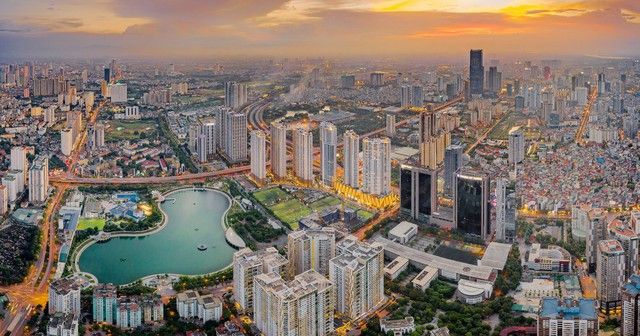
According to the Localities data, the General Statistics Office’s Household Living Standards Survey 2025 shows that in 2025 the living standards of Vietnamese people continued to improve, with average monthly per-capita income exceeding 6 million VND, up 10.9% from 2024. The gap between the highest-income group and the lowest-income group still indicates inequalities in income distribution. The composition of income continued to shift positively, with wages and salaries accounting for 57.4% of total income, up 1.7 percentage points from 2024 (55.7%), reflecting the leading and increasingly stable role of income from formal employment. Income from agricultural, forestry, and fishery activities accounted for 10.7%, up 0.2 percentage points, showing this sector remains a fundamental income source for many households. Meanwhile, income from non-agricultural, forestry and fishery activities accounted for 21.3% (down 1.5 percentage points) and other incomes for 10.6% (down 0.4 percentage points), reflecting difficulties in the informal and household economies. Monthly per-capita income in urban areas reached nearly 7.4 million VND, up 6.7% from 2024 and 1.42 times higher than in rural areas (nearly 5.2 million, up 14.5%). The urban–rural income gap appears to be narrowing compared with 2024 (1.5 times). Regionally, Southeast is the region with the highest monthly per-capita income, at nearly 7.5 million VND, while the Northwest and the rural mountainous areas recorded the lowest at around 4.2 million VND. If classified by income, Hanoi’s richest 20% (the top quintile) earned an average of 16 million VND per person per month in 2025, 4.6 times the poorest 20% (3.5 million VND). Hanoi ranked second with 8.37 million VND/month. The remaining top five localities were Ho Chi Minh City (8.06 million), Dong Nai (7.17 million), Hai Phong (7.14 million), and Quang Ninh (6.91 million). All five top localities are in the two major economic zones of the country – the Red River Delta and the Southeast. Read more