•
•
•
•
•
•
•
•
•
•
•
•
•
•
•
•
•
•
•
•
•
•
•
•
•
•
•
•
•
•
•
•
•


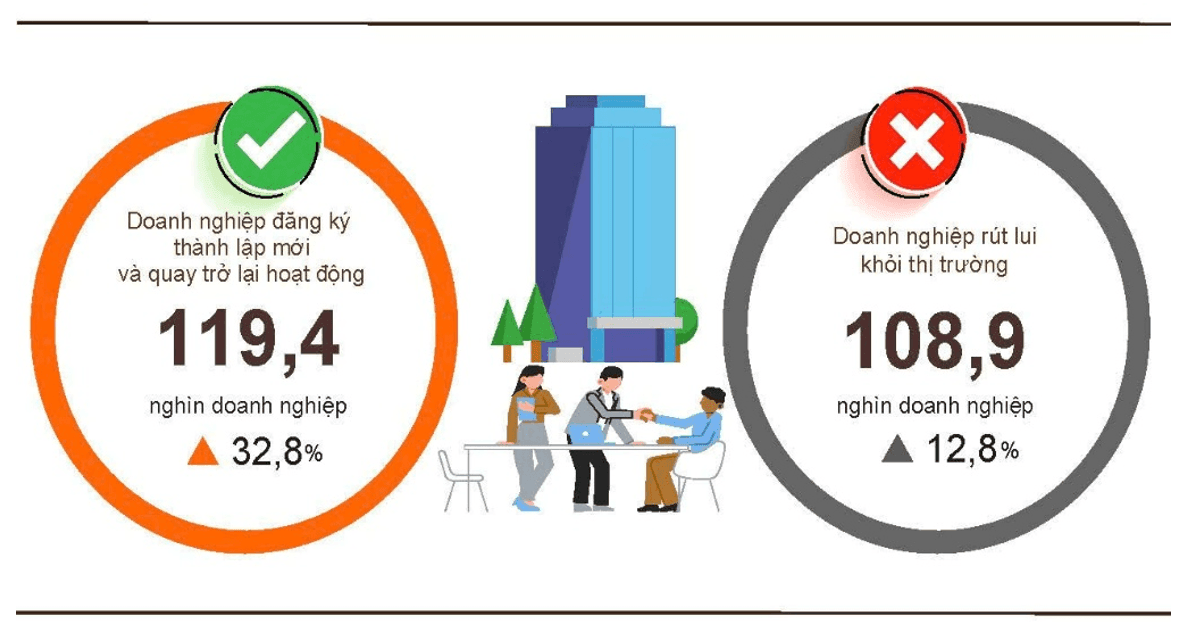
Four months into 2026, new business registrations continued to rise as registered capital increased, despite challenges from input costs and fluctuations in purchasing power. In the first four months of the year, more than 119 thousand enterprises entered and re-entered the market.
Statistics from the Statistics Office (Ministry of Finance) show that in April 2026 the country recorded nearly 20.4 thousand new enterprises. While the number of new enterprises fell slightly by 7.1% compared with March 2026, registered capital rose by 9.7%, reaching nearly 246.8 trillion dong.
Compared with the same period last year, the increase was stronger: the number of enterprises rose by 33.9% and registered capital increased by 84.6%.
For the first four months of 2026, the average per month was 29.9 thousand new or returning enterprises. Total registered capital added to the economy reached nearly 1.9 quadrillion dong, up 4.2% compared with the same period in 2025, indicating investors are putting more capital into new production and business projects.
Over the four-month period, sectoral diversification showed capital responding to market demand. The services sector remained the main destination for investment, with nearly 58.1 thousand new enterprises, up 48.7%. The industrial and construction sector recorded 18.9 thousand new enterprises, up 56.6% year-on-year.
In agriculture, forestry and fisheries—on a smaller base with 827 enterprises—the number of new firms grew the fastest at 66.7%.
The accommodation and food service sector also showed a notable rebound, with the number of new enterprises increasing by 121.3%, a sign of recovery in tourism and domestic consumption.
Alongside the registration gains, the market continued a process of restructuring. In total, 108.9 thousand enterprises withdrew from the market over the four months, up 12.8%. On average per month, about 27.2 thousand enterprises suspended or dissolved.
The number of temporarily ceased businesses rose 5.1%, while completed dissolutions jumped 98.7% year-on-year.
Wholesale, retail and repair of motor vehicles and motorcycles recorded the largest number of dissolutions, at 5,719 enterprises. Real estate also faced pressure, with the dissolution rate rising 110.9%.

Premium gym chains are entering a “golden era” that is ending or already in decline, as rising operating costs collide with shifting consumer preferences toward more flexible, community-based ways to exercise. Long-term memberships are shrinking, margins are pressured by higher rents and facility expenses, and competition from smaller, more personalized…