•
•
•
•
•
•
•
•
•
•
•
•
•
•
•
•
•
•
•
•
•
•
•
•
•
•
•
•
•
•
•
•
•


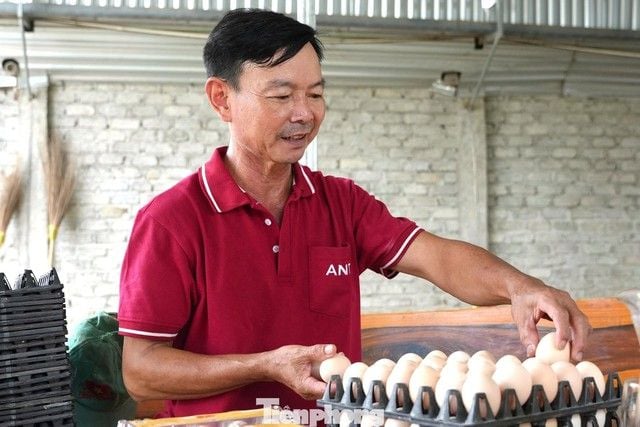
Mr. Tran Xuan Son (born 1968), from Nghia Hung commune, Nghe An province, began poultry farming with only 5 million dong and has grown it into a high-output operation generating tens of billions of dong in annual revenue. His farm currently houses about 23,000 Egyptian-cross chickens, including roughly 17,000 laying hens.
On average, the farm produces about 13,000 eggs per day. Egg sales alone generate nearly 40 million dong in daily revenue. The Egyptian-cross hen is described as a high-efficiency production breed, with an annual egg yield of 250–280 eggs—2 to 3 times higher than traditional breeds—and a stable laying rate of about 75–80%.
Feed efficiency is a key advantage. The farm reports feed consumption of only about 1.1–1.2 kg per 10 eggs. Egg quality is also emphasized: eggs weigh 45–55 g, with large yolks that are popular with buyers.
In 2001, Mr. Son started with limited capital and had to borrow from relatives to buy stock and feed. Early on, lack of technique and experience led to slow growth and low laying rates, creating serious difficulties.
During a period of desperation, he sold his wife’s wedding heirloom earrings at a gold shop to purchase feed, with a promise to buy them back after one or two harvests. The proceeds helped the poultry farm survive the lean period. In the first three years, the farm expanded to 800 laying hens and began earning profits.
In 2004, during an avian influenza outbreak, Mr. Son faced the challenge of unsold eggs. To maintain the flock, he mixed eggs with corn and cassava as feed. He then actively studied breeding techniques, learned basic veterinary knowledge, and visited other production models to improve his approach.
As he saw the need for large-scale production, he requested land consolidation to centralize land for the farm. By 2014, he invested in a cold-chamber system covering 1,000 m² for about 5,000 laying hens, creating a stable care environment that supported flock health and high egg output.
With the 2014 cold-chamber model, Mr. Son earned more than 3 billion dong per year, with profits of about 450–500 million dong. Encouraged by these results, he continued expanding.
From 2022 onward, he expanded the cold-chamber area to 3,000 m² and increased the flock to 23,000 birds. As a result, the farm’s revenue reached about 10 billion dong per year, with profits ranging from 1.5 to 2.5 billion dong.
Mr. Son applies a nutrient program using herbal additives for the chickens, producing eggs described as nutrient-rich (omega-3, DHA, vitamins) with low antibiotic residues. Customers reportedly favor the product.
His eggs have earned an OCOP 3-star rating and VietGAP standards. To reach buyers, in addition to visiting partners, he uses Facebook and Zalo to share information, promote products, and connect with consumers. The eggs from his “Luong Son lay platform” have helped him open new markets beyond Nghe An.
The farm also focuses on environmental management. It uses chicken manure to produce commercial organic fertilizer, supplying over 120 tons per year to local residents.
Beyond business, Mr. Son contributes to job creation for local workers and provides technical support and breeding stock to poor households. For these contributions, he has received multiple honors, including Provincial Excellent Business Household and Vietnam Excellent Farmer in 2025.



Premium gym chains are entering a “golden era” that is ending or already in decline, as rising operating costs collide with shifting consumer preferences toward more flexible, community-based ways to exercise. Long-term memberships are shrinking, margins are pressured by higher rents and facility expenses, and competition from smaller, more personalized…