•
•
•
•
•
•
•
•
•
•
•
•
•
•
•
•
•
•
•
•
•
•
•
•
•
•
•
•
•
•
•
•
•


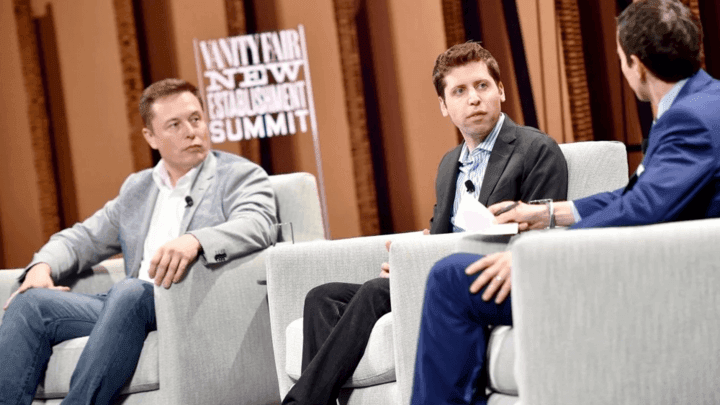
Elon Musk and Sam Altman are on opposing sides in a lawsuit over AI that could have a major impact on the future of the technology.
In late 2015 in Silicon Valley, a group of top scientists and entrepreneurs gathered for dinner to discuss a shared fear: a future where artificial intelligence (AI) is controlled by giant tech firms like Google. That night, OpenAI was founded as a nonprofit organization with open-source aims and a mission to benefit humanity. Musk and Altman were central figures.
The partnership between Musk and Altman was driven by a common existential worry: the rise of an “AI lord” controlled by Silicon Valley giants. Google had just acquired DeepMind, and Musk—who has called AI “the biggest threat to civilization”—was outraged, arguing that if AI were monopolized by a commercial entity, humanity would have no meaningful way to respond.
Altman, in this framing, complemented Musk’s approach. Musk is described as the “fire starter” with funding and a macro vision, while Altman is described as the “architect” with a broad network at Y Combinator. Together, they planned to create OpenAI as a non-profit counterweight.
Musk pledged up to $1 billion to the project, though the article says he contributed about $45 million in the early years, to help ensure top scientists could research without revenue pressure. The team also recruited Ilya Sutskever, described as Google’s “brain,” to join OpenAI.
The original goal was described as “pure and extreme”: to liberate artificial intelligence, with code and algorithms open for anyone to use and build guardrails together. OpenAI was portrayed as a “last fortress” against a Terminator-like scenario, with Altman positioned as the keeper of the fortress’s key.
Frictions began in 2018, when Musk proposed acquiring OpenAI to compete directly with Google, but the board refused. Musk left, and under Altman’s leadership, OpenAI took a step described as controversial: forming a for-profit subsidiary to receive a $13 billion investment from Microsoft.
As described in the article, OpenAI moved from an open organization toward closing the source code of powerful models such as GPT-4. Musk characterized this as a betrayal, saying OpenAI had become a “closed subsidiary,” maximizing profits for Microsoft “under the cover of a public-spirited mission.”
The conflict escalated with Musk’s lawsuit filed in early 2024. The most contentious issue, according to the article, concerns AGI (Artificial General Intelligence).
Under the agreement described, Microsoft would not have rights to use OpenAI’s technology if it achieved AGI. Musk accused OpenAI of deliberately “hiding” that GPT-4 already represented a primitive form of AGI, in order to preserve monopoly rights for Microsoft.
OpenAI responded by releasing older emails, which the article says show Musk once agreed that keeping code closed and raising large capital were necessary for success. OpenAI characterized Musk’s actions as “envy” of someone who had missed the winning boat.
The Oakland, California trial will feature a nine-person jury. Musk is demanding a record $150 billion in damages, which he says would be used to redirect funds back to charity. He accuses OpenAI and Microsoft of turning a nonprofit mission into a “money-making machine.”
OpenAI counters with internal documents suggesting Musk sought to undermine a rival to clear the way for his own xAI lab. With testimony from senior figures including Sam Altman and Satya Nadella, the article says the case could threaten OpenAI’s IPO plans and raise questions about transparency and corporate responsibility in the AI era.






Premium gym chains are entering a “golden era” that is ending or already in decline, as rising operating costs collide with shifting consumer preferences toward more flexible, community-based ways to exercise. Long-term memberships are shrinking, margins are pressured by higher rents and facility expenses, and competition from smaller, more personalized…