•
•
•
•
•
•
•
•
•
•
•
•
•
•
•
•
•
•
•
•
•
•
•
•
•
•
•
•
•
•
•
•
•


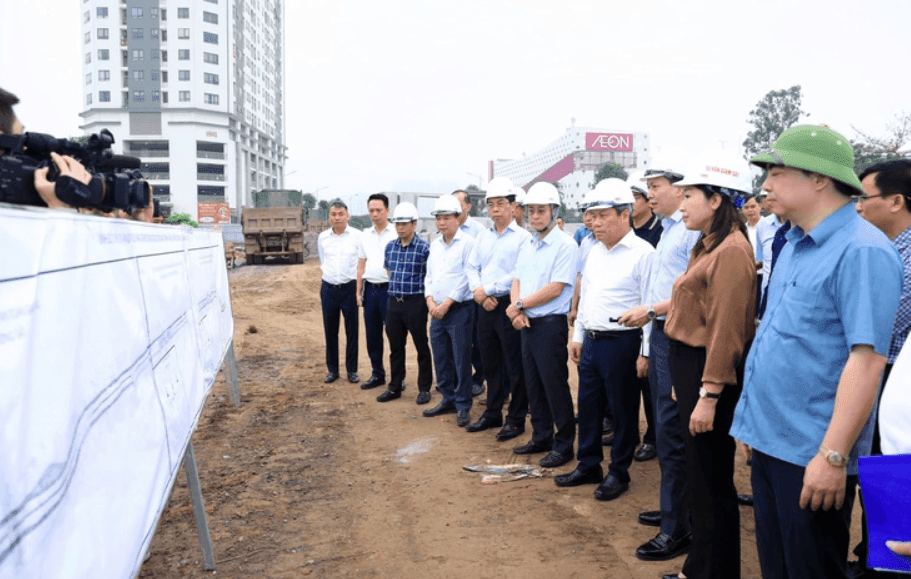
On April 19, 2026, Vu Dai Thang, a member of the Party Central Committee, Deputy Secretary of the Hanoi Party Committee, and Chairman of the Hanoi People’s Committee, conducted a progress check on the implementation of the Investment Project for upgrading and expanding Road 70 and the upgrade and expansion of National Highway 21B.
According to the report, the Investment Project for upgrading and expanding Road 70 (the section from Trinh Van Bo to the former Nam Tu Liem district boundary) has a total length of about 4.95 km, divided into two segments.
The project is implemented in coordination with a road system, a railway overpass (Bac Hong – Van Dien), a bridge over the Tung Khe stream, and technical infrastructure including sidewalks, greenery, drainage, lighting, utility ducts, water supply, firefighting, and traffic safety. Total investment is over 3,377 billion VND.
During the inspection, Chairman Vu Dai Thang emphasized that land clearance is decisive for the project’s overall progress. He noted that basic compensation, support, and resettlement policies are in place and directed relevant departments to promptly resolve any arising obstacles, allowing localities to apply the issued policies flexibly.
The city leader stressed there is no reason to delay the schedule, saying that delays in land clearance will directly affect the disbursement pace of public investment funds and the socio-economic development outcomes.
City leaders directed Tây Mỗ, Xuân Phương, and Sơn Đồng to focus and mobilize the entire political system to complete land clearance in Q2 2026, rather than extending to the end of the year. For resettlement sites facing obstacles, related departments were tasked with promptly reviewing and refining procedures to quickly arrange and serve the project.
In parallel, contractors were asked to increase manpower and equipment and to organize construction according to the motto “where land is cleared, proceed with works,” aiming to complete the entire project in 2026. The goal is to support urban development, land value, and budget revenue.
Chairman Vu Dai Thang also urged localities to intensify public outreach, garner public support, and clearly explain current policies to prevent broad-based petitions.
Afterward, the Hanoi Chairman and the working delegation inspected the progress of the National Highway 21B upgrade and expansion project. The delegation checked two component projects:
Chairman Vu Dai Thang issued directives to accelerate progress while ensuring investment efficiency and residents’ rights. He called on authorities to fully implement current mechanisms and policies to safeguard residents’ legitimate rights, and urged localities to step up advocacy to build consensus for citizen participation in the road upgrades.
National Highway 21B was highlighted as a key artery connecting southern parts of the capital with rapid urbanization. City leaders required improvements to be implemented in a synchronized, methodical manner, including widening the road surface and upgrading infrastructure such as sidewalks and underground electrical and telecommunications systems to ensure urban aesthetics and avoid repeated excavations and waste.
The Hanoi Department of Construction was asked to closely coordinate with localities to implement the project holistically in line with regional urban development plans. Investments should be carefully scaled to avoid dispersion while ensuring coherence and long-term sustainability.
Regarding the schedule, city leaders required completing land clearance by June 2026, after which construction works should be promptly carried out. Although undergrounding technical infrastructure may face challenges due to the complexity of construction, the city encouraged pursuing it in this phase to ensure long-term effectiveness.







Premium gym chains are entering a “golden era” that is ending or already in decline, as rising operating costs collide with shifting consumer preferences toward more flexible, community-based ways to exercise. Long-term memberships are shrinking, margins are pressured by higher rents and facility expenses, and competition from smaller, more personalized…