•
•
•
•
•
•
•
•
•
•
•
•
•
•
•
•
•
•
•
•
•
•
•
•
•
•
•
•
•
•
•
•
•


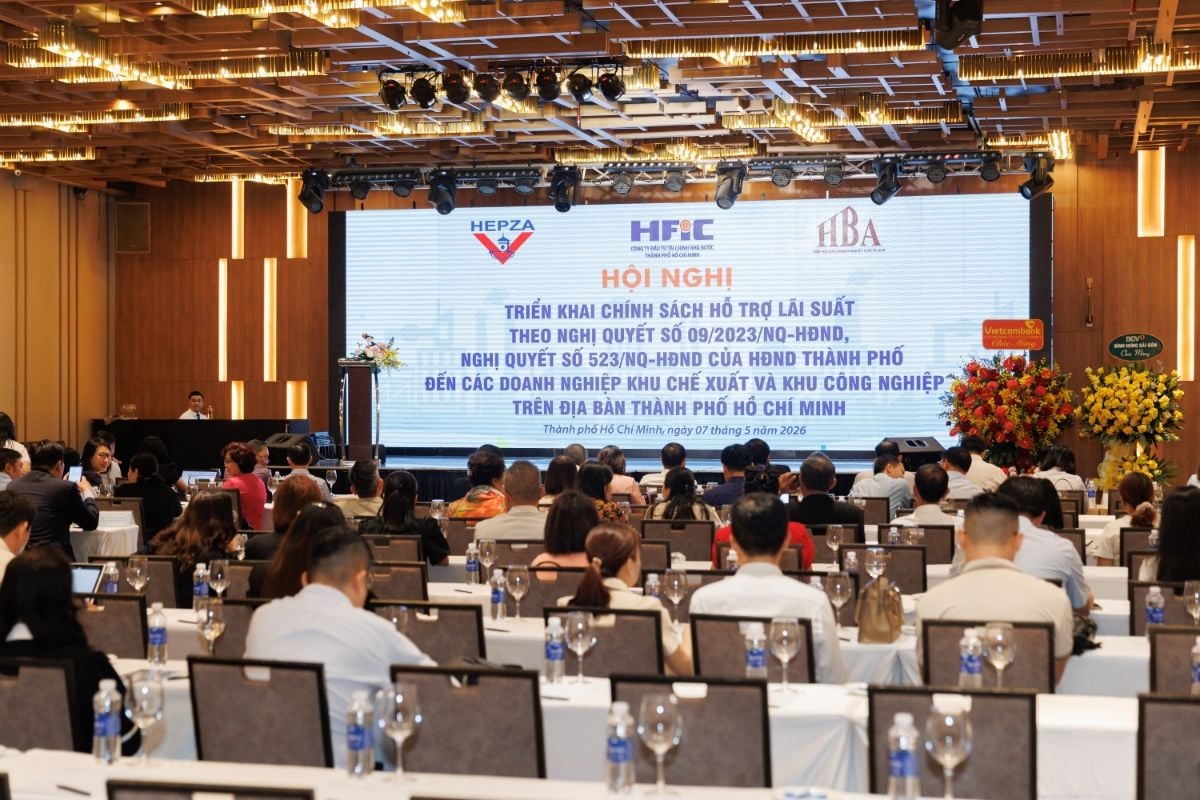
Ho Chi Minh City is rolling out a large-scale interest-rate support program for enterprises operating in export processing zones (EPZs) and industrial parks (IZs), offering loans of up to VND 200 billion per project via the Ho Chi Minh City Finance Investment State Company (HFIC). Depending on the sector, the city budget will support between 50% and 100% of interest for up to seven years, potentially reducing the enterprise’s annual interest cost to as low as 1% when the maximum 100% support level applies.
Under the program, enterprises can access financing of up to VND 200 billion per project through HFIC. The city budget covers interest from 50% to 100% based on the sector and the applicable policy level, with support lasting for up to seven years.
At the maximum 100% interest support level, the enterprise would pay interest of only 1% per year, which is described as well below prevailing commercial lending rates. HFIC representatives said the HFIC interest rate will be lower than bank loan rates and that this support is intended to help enterprises even before any government subsidies are applied.
Current regulations define four focus groups eligible for support: the city’s four key industries; high-tech manufacturing; green transformation and digital transformation; and social housing or worker dormitories.
The 100% support level applies to healthcare, education, and high-tech sectors, while the 50% level applies to logistics and some other sectors.
Ho Chi Minh City’s investment-stimulation loan program has been in place for more than ten years but experienced interruptions in 2021–2022. The city said the enactment of Resolution 98/QH15, which provides special mechanisms for Ho Chi Minh City, created the legal basis to restart the program.
On that basis, the People’s Council issued Resolution 09/2023/NQ-HĐND on September 19, 2023 to define beneficiaries. After administrative boundary rearrangements, Resolution 523/NQ-HĐND issued on December 26, 2025 reaffirmed applying the policy in the expanded city. The sequence of legal documents is presented as establishing a stable legal foundation for the program.
The Prime Minister’s Decision 631/QĐ-TTg dated April 6, 2026 approving the 1,000-leading-enterprise development program for 2026–2030 is also expected to create additional opportunities for units to participate more deeply in the national production chain. A city finance official said participation would be an advantage for both local enterprises and firms seeking deeper involvement in the national production chain.
HFIC representatives outlined the rate calculation mechanism. For public service units, the maximum loan rate is the average rate of four sectors over 12 months (currently 5.9%) plus 2%, meaning up to 7.9% per year. For other institutions, the add-on cap is 3%, though depending on the case, 2.9%, 2.8%, or 2.5% may apply.
HFIC emphasized that if an enterprise receives 100% interest subsidy, it would pay at most 1% per year. It also noted that if HFIC offers a loan at a base rate plus 2.5% and the subsidy covers the difference, the enterprise’s effective interest burden would remain negligible.
At the conference, officials clarified concerns from the business community about capital-funding procedures. HFIC and city finance officials described a three-step process.
HFIC’s deputy general director said the process is not overly complicated and that once the enterprise registers and commits to meeting policy conditions, the city issues the decision and HFIC disburses according to project progress. The inter-agency working group has reviewed more than 10 projects since the restart, including on-site surveys to verify new investments.
Officials said two main groups of obstacles require further resolution.
The program is designed for domestic-invested firms, but many industrial-zone enterprises have increasingly complex ownership structures, including cases where domestically formed companies have shareholders that are foreign organizations (F1) or where the parent organization is a foreign legal entity (F2). HFIC acknowledged that the current plan is not fully clear for this group and said HFIC is proposing applying Investment Law thresholds with foreign-owned capital below 50% or affiliate thresholds at 20%. These items are expected to be refined in the June or July 2026 revision.
Enterprises in this category were advised to wait 1–2 months for clearer legal guidance.
On collateral, HFIC accepts land-leased assets, assets attached to land, and specialized equipment. However, collateral valuation rates reflect liquidity: land-attached assets are valued at around 50%, while specialized equipment is valued at around 30%. Officials said this is a key consideration for the inter-agency working group when drafting financing plans for small and medium-sized enterprises with limited collateral.
Officials also highlighted that enterprises need sufficient financial capacity to be accurately reflected in audit reports. A city finance department representative warned that firms with profits only 1–2% or whose financial statements do not reflect actual business scale may face difficulties in HFIC’s credit assessment.
Authorities further addressed practical scenarios including multi-stage project deployment, disbursement conditions for newly purchased land, and the list of supported sectors for agro-processing.
Officials said the investment-stimulation loan program is expected to create new momentum for enterprises to invest in machinery and equipment, upgrade technology, pursue green transformation, and accelerate digital transformation to meet stringent global market demands. They also described the program as a meaningful financial tool for EPZ/IZ enterprises planning new investments, citing high interest-rate support, a one-stop process, and quicker handling, with the aim of making subsidized finance more transparent and easier for more enterprises to access.
Premium gym chains are entering a “golden era” that is ending or already in decline, as rising operating costs collide with shifting consumer preferences toward more flexible, community-based ways to exercise. Long-term memberships are shrinking, margins are pressured by higher rents and facility expenses, and competition from smaller, more personalized…