•
•
•
•
•
•
•
•
•
•
•
•
•
•
•
•
•
•
•
•
•
•
•
•
•
•
•
•
•
•
•
•
•


Live-action shows that use nature as a stage and reimagine history through contemporary art are emerging as a “golden key” for attracting visitors to Ninh Bình. Beyond standard sightseeing tours, the province’s tourism is increasingly taking on a nocturnal dimension. Still, industry stakeholders say Ninh Bình needs a more systematic, long-term development strategy to compete with established international destinations.
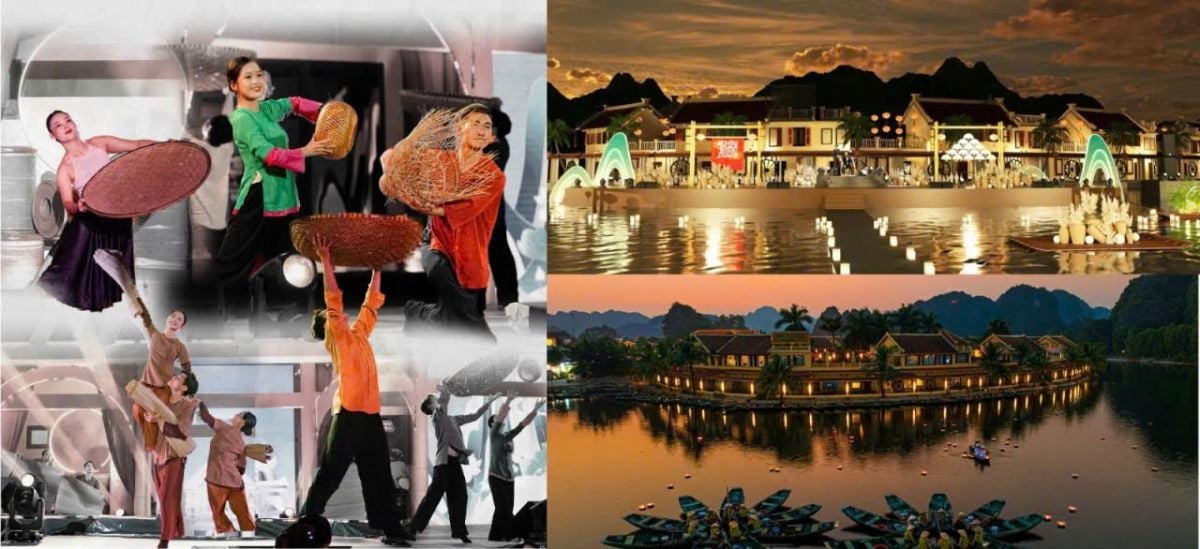
The flagship of this renewal is the live production “Anh hùng cờ lau” at the Thủy Đình stage in Hoa Lư Ancient Town. Inspired by Đinh Bộ Lĩnh, the show does not follow a straight chronological storyline. Instead, it recreates the journey of defeating the 12 warlords and unifying the nation through a blend of contemporary circus elements, traditional martial arts, and folk dance.
The performance begins by transporting the audience to a peaceful Bắc Bộ village, where the boy Đinh Bộ Lĩnh herds buffalo and uses reed flags as training markers. Acrobatics and martial arts scenes first mirror the boy’s pretend battles, then gradually shift into real tactical formations, illustrating the leadership spirit taking shape.
The climax intensifies with segments depicting the period of division. Set to a drumbeat, dozens of acrobats move, swing, and rope-dance to create battle scenes and moments of heroism among competing powers. The final focus converges on Đinh Bộ Lĩnh as the commander who unites public sentiment, quells rebellion, ascends to the throne, and ushers in unity for Đại Cồ Việt.
With modern sound and light effects and professional rigging, each historical segment is presented vividly and symbolically. Visitor Phạm Thanh Hương from Phú Thọ said: “The choreographed martial arts scenes are meticulously staged, helping the historical story feel natural, easy to remember, and accessible, especially for my children.”
Since being licensed in late 2025, the program has drawn more than 30,000 visitors. Organizers attribute the results to flexible staging, with each performance adapted to fit the cultural space of Ninh Bình, ensuring no show is identical.
Alongside “Anh hùng cờ lau,” other venues are using the living backdrop of Ninh Bình’s landscapes to build new experiences.
“Hoa Lư Vũ Họa” invites visitors to experience traditional crafts in Ninh Bình—basket weaving, silk weaving, and pottery—performed on the water at Tam Cốc’s Ben Thuyền wharf. Seated on sampans, guests watch contemporary dance set to traditional instruments, designed to blend with the limestone karst scenery and reflective waters.
At Tràng An’s Tam Cốc water-stage, a mini-show highlights nature’s beauty and the bond between people and the environment. The “Khúc hát thiên nhiên” experience unfolds across four stops: “Dế Mèn phiêu lưu ký,” “Vỗ cánh mặt trời,” “Hồi sinh,” and “Vũ điệu loài hoa.” Organizers describe the experience as dissolving the boundary between stage and everyday life, encouraging visitors to explore and deepen their appreciation of local culture.
Despite early momentum, the central question remains how Ninh Bình can develop a world-class live show that can attract global audiences, comparable to China’s “Impression” style productions. At a recent seminar, media expert Lê Quốc Vinh pointed to the model and asked whether a large sky-to-land live spectacle could be built in Tràng An. He emphasized that cultural branding for a locality requires more than showcasing scenery—it must also signal a distinctive local identity that cannot be found elsewhere.
From an international perspective, UNESCO representative Jonathan Baker argued for placing culture at the center of tourism and empowering local communities. He encouraged rural tourism development, cooperative models, heritage incubators, and opportunities for youth participation. “When culture is at the center and the community is the agent of action, we can unlock the full potential of Ninh Bình as an international-class destination,” he said.
These living shows are seen as a key solution for night tourism in Ninh Bình and as an important touchpoint within the broader ecosystem of cuisine–culture–experience, helping extend visitor stays.
However, industry leaders stress that this tourism model requires long-term planning, public–private cooperation, and sustained creativity. They also underline that innovation must respect nature and the region’s existing heritage.
By re-telling history and culture through technology and the performing arts, Ninh Bình is positioning itself as a destination where visitors experience a wider range of emotions beyond simply admiring scenery. With coordinated efforts from government, businesses, and local communities, these “natural stages” are expected to support further growth for tourism and the local cultural industry.
Premium gym chains are entering a “golden era” that is ending or already in decline, as rising operating costs collide with shifting consumer preferences toward more flexible, community-based ways to exercise. Long-term memberships are shrinking, margins are pressured by higher rents and facility expenses, and competition from smaller, more personalized…