•
•
•
•
•
•
•
•
•
•
•
•
•
•
•
•
•
•
•
•
•
•
•
•
•
•
•
•
•
•
•
•
•


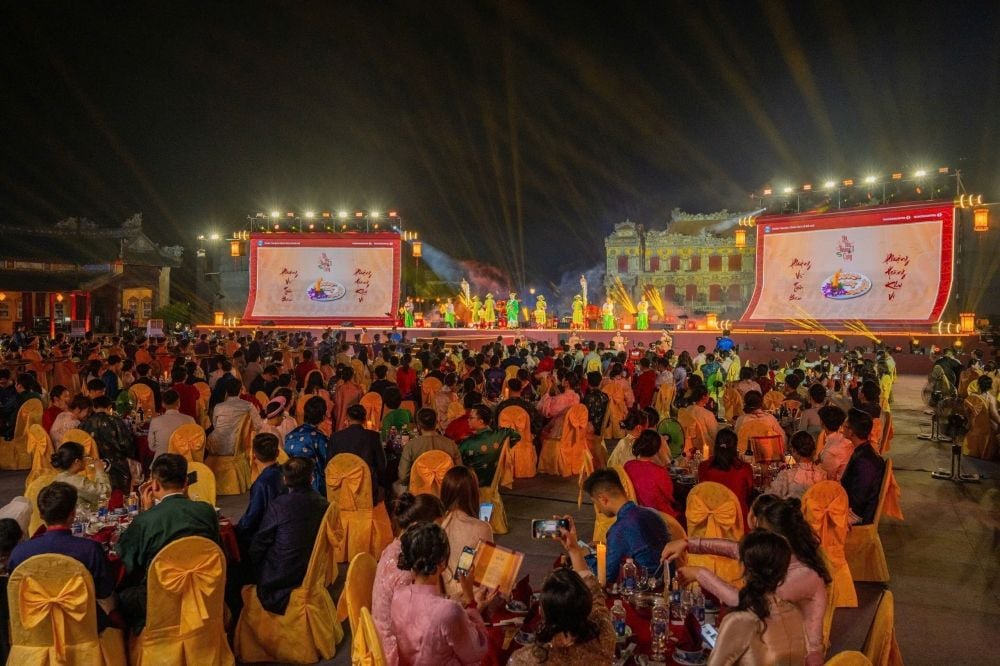
Hue is expanding its night economy by developing structured nocturnal experiences centered on the city’s heritage, including dining, arts, and cultural activities at historic sites. The Hue Monuments Preservation Centre recently organized the “Palace Night Banquet” for 600 guests at the Ngo Mon area of the Imperial City, Hue, marking the start of night-time economy activities at the heritage site in connection with the Hue Festival, under city guidance.
The event guided visitors through an immersive royal palace journey. From the Ngo Mon area, attendees were welcomed by a formal guard-change ceremony, recreating the disciplined rhythm of the Nguyen dynasty. The main program featured a reenactment of activities from the Imperial Kitchen, interwoven with Hue court music to recreate a royal ambience.
Mr. Hoang Viet Trung, Director of the Hue Monuments Preservation Centre, said that after this program, the Centre will continue rolling out coordinated night-time experiences and services across Hue’s heritage spaces.
The immediate next program is “Palace Illusion,” scheduled from 20:00 on 25–28 April 2026 at Dai Noi Hue. It is a highlight of the Summer Festival “Capital Shines,” with free admission for the community and visitors.
In the event series, the “Capital City Cuisine” zone at Phu Noi Vu will welcome guests from 24 April to 2 May 2026, using flexible service formats. These include paid buffet nights on 26, 28, 30 April and 2 May, as well as set menus and à la carte options on other days.
On the nights of 29 April and 1 May 2026, the “Palace Banquet” program will be held again at the Duyet Thi Duong Theater. The program can accommodate up to 130 guests per night, with tickets priced at 1.7 million VND per person.
Before entering the royal banquet, visitors will be guided through a palace nocturnal experience starting from the Ngo Mon guard-change, followed by 3D mapping lighting effects and performances by palace dancers. The program also includes reenactment of court ceremonies and Kinh binh displays, leading to additional experiences such as a royal market, courtly games, and a Huế áo dài and Hanbok fashion show. It also features technologies including the virtual reality game “In Search of the Lost Palace.”
Beyond the banquet, the Imperial Throne Hall and surrounding areas will be expanded into experiential spaces, including a royal market, a court garments fashion show, and technological experiences such as the VR game “In Search of the Lost Palace.”
For sustainable night-economy development, Hue is gradually transforming by expanding nocturnal experiences tied to its history and culture. The activities are intended to diversify the tourism product, extend visitor stays, and increase visitor spending.
Under Hue’s plan to implement the night economy in heritage zones linked to festival activities, upcoming programs are expected to diversify tourism offerings, attract and retain visitors, and create new ways to leverage heritage spaces for socio-economic development and sustainable conservation funding.
The Hue Centre is also pursuing investment in several night-economy projects within the Hue relic complex, including lighting and artistic decoration for Ngo Mon Square and routes across the Imperial City. Components include architectural lighting, landscape lighting, and smart lighting infrastructure.
Upgrades are progressing at spaces such as Phu Noi Vu, Duyet Thi Duong, Thieu Phuong Garden, Co Ha Garden, and other sites, with bamboo kiosks installed to provide service spaces and promote local crafts.
Initially, activities will focus on Ngo Mon, Dien Thai Hoa, Phu Noi Vu, Dien Kien Trung, Duyet Thi Duong, Cung Dien Tho, Vuon Co Ha, Thai Binh Luu, Vuon Thieu Phuong, and Dong Khuyet Dai.




Premium gym chains are entering a “golden era” that is ending or already in decline, as rising operating costs collide with shifting consumer preferences toward more flexible, community-based ways to exercise. Long-term memberships are shrinking, margins are pressured by higher rents and facility expenses, and competition from smaller, more personalized…