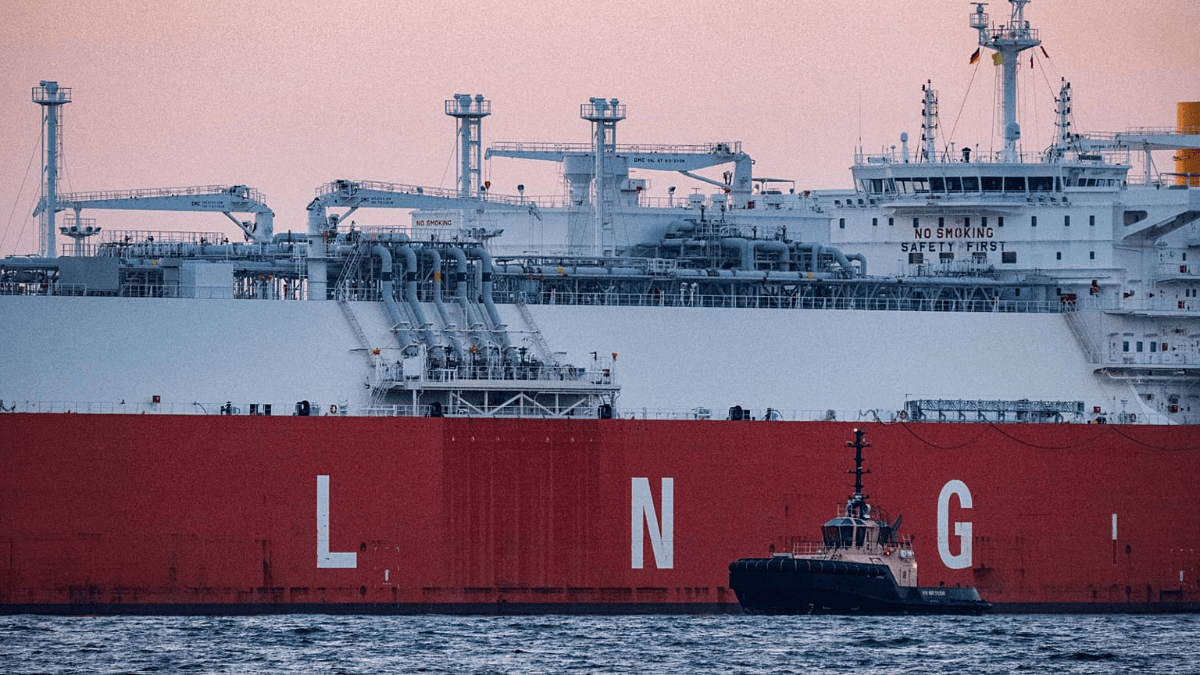
According to a new report from the Institute for Energy Economics and Financial Analysis (IEEFA) released on Wednesday, May 13, 2026, the share of U.S. LNG in Europe’s
market is expected to continue rising in the coming year.
This trend reinforces the United States’ dominant position in Europe’s gas market after the Ukraine conflict and the Iran conflict altered global energy flows.
In 2025, the United States supplied 57% of Europe’s imported LNG, up sharply from before the Ukraine conflict. IEEFA warns that this share could continue to rise in the coming years if Europe maintains its current import trajectory and new long-term supply contracts come into effect.
The assessment comes as most European governments aim to end all imports of Russian gas by 2027 under the EC’s REPowerEU strategy. Since 2022, EU member states have ramped up LNG purchases from other sources, particularly the United States, to compensate for the decline in Russian pipeline gas.
According to IEEFA, this shift helps Europe bolster energy security in the near term, but it also raises new risks: supply is increasingly concentrated in a single supplier. The research organization notes that if dependence on Russian gas is replaced with heavy reliance on U.S. LNG, Europe may still be vulnerable to political and market fluctuations in the future.
The report also notes that U.S. LNG is typically more expensive than pipeline gas because it must be liquefied, transported by sea, and regasified before entering the distribution system. IEEFA estimates that EU countries spent about €117 billion to import U.S. LNG from early 2022 to mid-2025.
The risk of over-reliance on imported LNG has been highlighted by policymakers and regulators in Europe. Earlier this year, Teresa Ribera, the EC’s Executive Vice-President, said the EU should avoid replacing one form of energy dependence with another. Instead, the EU should accelerate investment in renewable energy and increase electricity use in sectors that rely heavily on fossil fuels.
ACER (Agency for the Cooperation of Energy Regulators) also warned about the risk of supply concentration as LNG plays a larger role in Europe’s gas market.
Notably, LNG imports have risen even as gas consumption in Europe generally declined in recent years. High energy prices after the crisis, weak industrial activity, energy-saving measures, and faster deployment of renewable energy have all contributed to a downward trend in gas demand across the continent.
According to IEEFA data, EU LNG imports fell in 2024 as gas consumption hit the lowest level in more than a decade. However, imports rebounded in 2025 due to colder weather and governments increasing purchases to bolster storage.
Meanwhile, several EU countries continue expanding LNG import infrastructure. Germany, once heavily dependent on Russian gas via pipelines, has rapidly developed floating LNG terminals and has become one of the largest U.S. LNG buyers in Europe.
This has led some analysts to worry that Europe may be over-investing in LNG import infrastructure. The risk of excess capacity becomes clearer as long-term gas demand is forecast to continue declining during the transition to clean energy in the coming years.