•
•
•
•
•
•
•
•
•
•
•
•
•
•
•
•
•
•
•
•
•
•
•
•
•
•
•
•
•
•
•
•
•


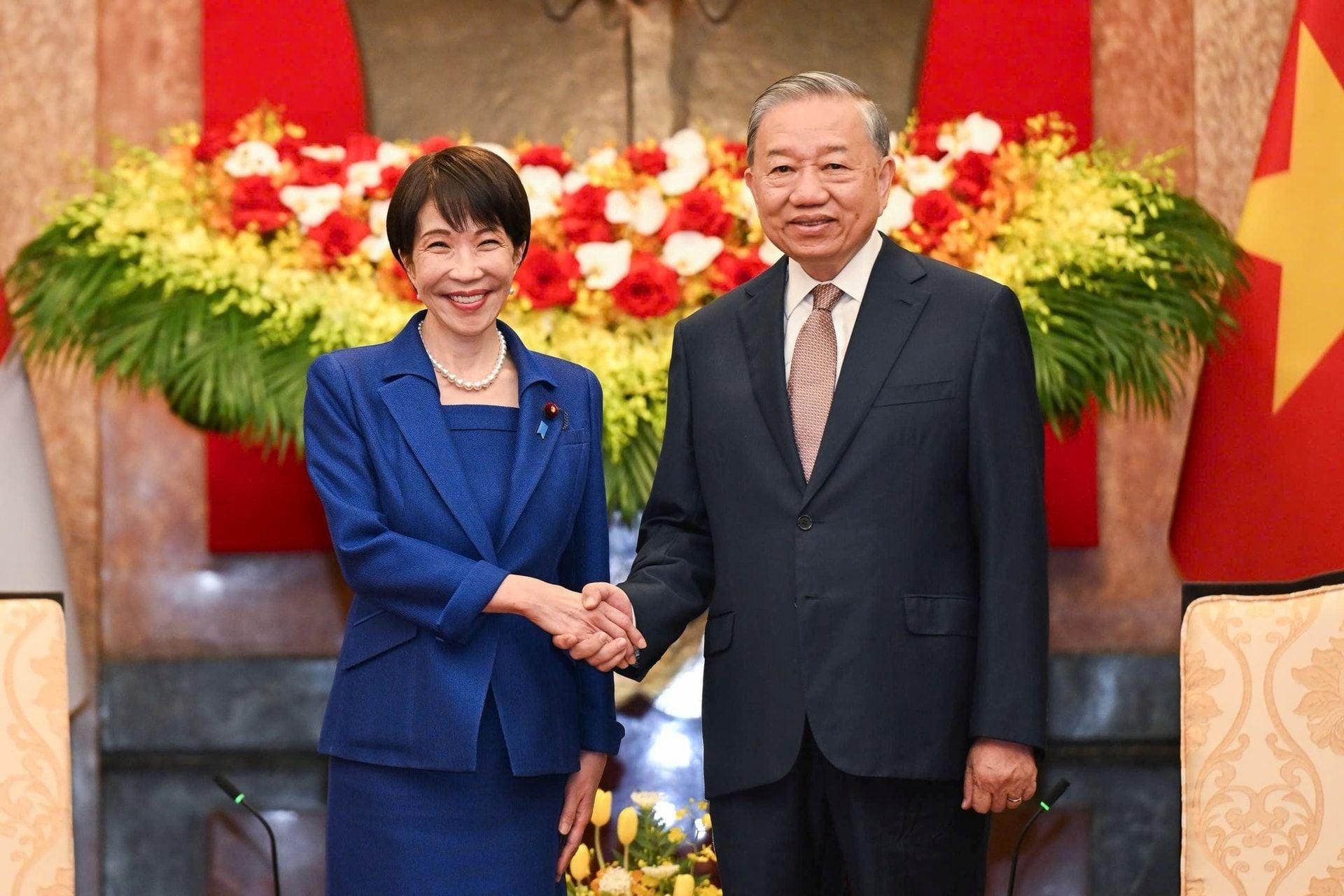
Vietnam’s General Secretary and President Tô Lâm met with Japanese Prime Minister Takaichi Sanae on the morning of May 2 at the Presidential Palace during her official visit to Vietnam. At the meeting, Tô Lâm said Vietnam views Japan as one of its top strategic partners—trusted and stable for the long term—and outlined six major directions to strengthen the bilateral strategic partnership.
Tô Lâm said Vietnam will focus on: increasing political trust and cooperation between the Party, Government, and local levels; reinforcing practical defense-security cooperation; and enhancing economic linkages while ensuring economic security, food security, and energy security.
He also highlighted expansion into new areas aligned with Japan’s science and technology strengths, including digital transformation, energy transition, green transition, semiconductors, and artificial intelligence (AI). In addition, the leaders agreed on implementing science and technology cooperation through high-quality human resource development and joint research, and promoting people-to-people exchanges through labor, education, localities, culture-society, tourism, and related cooperation.
Prime Minister Takaichi Sanae affirmed Japan’s support for Vietnam’s reform process and its efforts toward greater economic self-reliance. She also expressed confidence that Vietnam will achieve more in the near future and said Japan wants to work closely with Vietnam to implement the Free and Open Indo-Pacific vision.
Japan will support Vietnam in achieving development goals in the new era, contribute to regional prosperity, and coordinate to elevate the Vietnam–Japan Comprehensive Strategic Partnership to a higher level. The Japanese side also stated it will support crude oil purchases for the Nghi Sơn refinery, with the aim of ensuring the plant operates at 100% capacity under the first project of the POWERR Asia initiative.
Prime Minister Takaichi Sanae further expressed interest in cooperating with Vietnam on energy projects, gas-fired power, and strategic minerals. She also reiterated continued support and facilitation for the Vietnamese community living, studying, and working in Japan, and stressed enhanced consular exchanges and collaboration on crime prevention.
Tô Lâm and Prime Minister Takaichi Sanae agreed to coordinate closely at regional and international forums, including the United Nations, ASEAN, and the Mekong subregion, citing a rapidly changing and complex international context that could negatively affect global economic and energy security.
Earlier, after the official welcome ceremony, Prime Ministers Lê Minh Hùng and Takaichi Sanae held talks at the Government Office. On economic cooperation, the two leaders agreed to deepen economic cooperation as a core pillar of the relationship through trade, investment, and official development assistance (ODA), with the goal of ensuring robust economic and energy security and sustainable agriculture.
They also agreed on measures to accelerate Japanese investment in Vietnam to reach USD 5 billion per year and to raise bilateral trade to USD 60 billion by 2030. The leaders further discussed promoting market access for Vietnam’s green-skinned pomelo and Japanese grapes.
Japan will assist in arranging crude oil supply for the Nghi Sơn refinery, according to the meeting outcomes.
Prime Minister Takaichi Sanae reaffirmed Japan’s continued support for Vietnam’s efforts to enhance technological self-reliance in areas including AI, semiconductors, and space. She said training high-quality human resources in high-tech fields will be advanced through scholarships for Vietnamese students and researchers, as well as co-funding for joint research projects.
Overall, the discussions reflected a shared commitment to advancing bilateral ties across politics, economy, technology, and people-to-people exchange, with a focus on sustainable development and regional stability.
Premium gym chains are entering a “golden era” that is ending or already in decline, as rising operating costs collide with shifting consumer preferences toward more flexible, community-based ways to exercise. Long-term memberships are shrinking, margins are pressured by higher rents and facility expenses, and competition from smaller, more personalized…