•
•
•
•
•
•
•
•
•
•
•
•
•
•
•
•
•
•
•
•
•
•
•
•
•
•
•
•
•
•
•
•
•


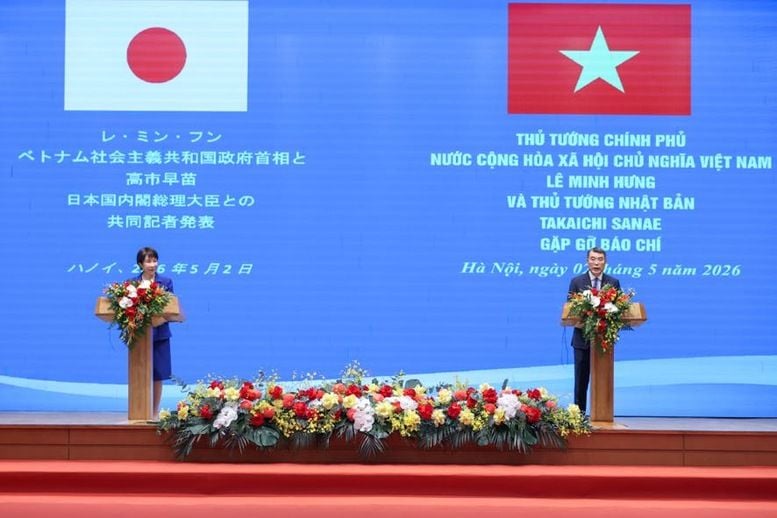
On May 2, 2026, Vietnam’s Prime Minister Lê Minh Hưng and Japan’s Prime Minister Takaichi Sanae held talks at the Government Office and then a joint press conference to announce the outcomes of their discussions.
The two sides agreed to continue building political trust by expanding substantive cooperation in defense, security, and diplomacy, along with broader bilateral collaboration. They will continue to effectively implement ministerial-level diplomacy mechanisms, including the 2+2 dialogue at deputy foreign minister–defense minister levels, and cooperation mechanisms covering trade, industry, energy, and science and technology.
They also committed to implementing defense–security cooperation agreements effectively and strengthening cooperation in areas including maritime law enforcement capacity, addressing the legacies of war, cybersecurity, UN peacekeeping, and countering transnational crime.
The leaders agreed to strengthen economic cooperation, with a focus on energy security and sustainable agriculture. They set goals to work toward Japan’s investment in Vietnam reaching 5 billion USD per year and bilateral trade reaching 60 billion USD by 2030.
They encouraged Japanese enterprises to invest in high-tech projects with technology transfer, and to support Vietnamese firms to invest and operate in Japan, including participation in Japanese government-funded projects. The two sides also aimed to open markets for agricultural products, initially extending access to Việt Nam’s green-skinned pomelo and Japanese grapes.
In addition, they agreed to enhance official development assistance (ODA), promote energy and food security, diversify supply chains, and strengthen each country’s strategic autonomy.
The two sides agreed to concretize cooperation in science and technology, green transition, digital transformation, AI, and semiconductors. They emphasized prioritizing the training of high-quality human resources and promoting joint research in semiconductors, artificial intelligence, and space technology.
They also agreed to organize the 2026 Joint Committee on Science and Technology Cooperation and to hold early public–private technology exchanges.
The leaders agreed to promptly implement projects under the POWERR ASIA initiative to strengthen energy and resource resilience in Asia. Japan will assist in arranging crude oil supplies for the Nghi Sơn Refinery.
Prime Minister Sanae said this would be the first project under Japan’s POWERR ASIA program within the Asia–Australia–Europe partnership framework.
Prime Minister Lê Minh Hưng welcomed the signing of six important documents covering space technology, ICT, irrigation, climate-adaptive infrastructure, climate change mitigation, and low-carbon growth. He noted that agreeing on a priority content list for science, technology, innovation, digital transformation, and economic security provides a basis for concrete cooperation projects in the near future.
He invited Prime Minister Sanae to attend APEC 2027 in Phú Quốc, Việt Nam, and announced Việt Nam’s participation in GREEN EXPO 2027 in Yokohama, Japan.
Lê Minh Hưng described Sanae’s official visit—her first as Japan’s female prime minister—as a milestone that opens new momentum for cooperation. He highlighted Japan’s role as Việt Nam’s Comprehensive Strategic Partner and its leadership in ODA and labor, noting growth in investment and trade in recent years.
He cited that in 2025, ODA cooperation rose by more than 600 million USD, two-way trade surpassed 50 billion USD for the first time, and investment rose by nearly 4 billion USD with almost 300 new projects, alongside numerous cooperative ventures in science and technology, semiconductors, digital transformation, green transition, energy, and space.
The two sides signed six documents covering space technology, ICT, irrigation, climate-adaptive infrastructure, climate change, and low-carbon growth. They also agreed to advance joint Vietnam–Japan research in semiconductors under the NEXUS program and to support Việt Nam’s 1 million hectares of high-quality, low-emission rice production in the Mekong Delta.
The leaders stressed people-to-people exchanges and local cooperation in areas including labor, health, culture, and tourism, and planned a second Vietnam–Japan Local Cooperation Forum in 2026. They welcomed Japan’s inclusion of Việt Nam among 24 attractive destinations for Japanese tourists and reaffirmed commitments to facilitate Vietnamese living, studying, and working in Japan.
The two sides pledged closer coordination and mutual support on international and regional forums and issues of mutual concern. They reaffirmed the importance of resolving disputes in the South China Sea by peaceful means in accordance with international law, including UNCLOS 1982.
Vietnam supported Japan’s initiatives in the region, including the Free and Open Indo-Pacific (FOIP) concept, and Vietnam’s participation in related regional frameworks.
Both leaders described the visit as an important milestone to elevate the Vietnam–Japan relationship. Prime Minister Sanae said she would deliver a policy speech at Vietnam National University to outline the future Vietnam–Japan partnership and Japan’s FOIP vision.
The leaders concluded with mutual commitments to broaden collaboration and strengthen the bilateral relationship across economic, technological, and people-to-people dimensions.

Premium gym chains are entering a “golden era” that is ending or already in decline, as rising operating costs collide with shifting consumer preferences toward more flexible, community-based ways to exercise. Long-term memberships are shrinking, margins are pressured by higher rents and facility expenses, and competition from smaller, more personalized…