•
•
•
•
•
•
•
•
•
•
•
•
•
•
•
•
•
•
•
•
•
•
•
•
•
•
•
•
•
•
•
•
•


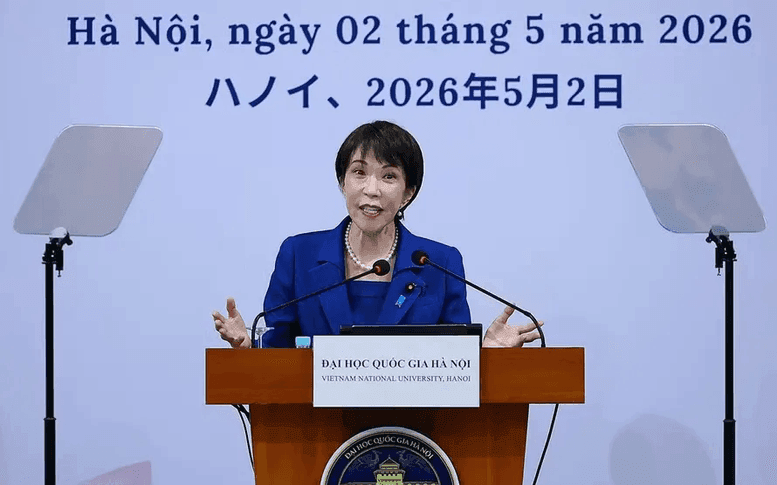
Prime Minister Takaichi Sanae delivered a policy speech at Vietnam National University, Hanoi, outlining an updated approach to the implementation of Japan’s Free and Open Indo-Pacific (FOIP) vision in the new phase. The address, delivered during an official visit to Vietnam on the afternoon of May 2, focused on priorities spanning technology, supply chains, and economic cooperation, positioning Vietnam–Japan relations within a broader development framework.
Prime Minister Takaichi Sanae said the FOIP update is intended to clarify priorities for economic, technological, and supply-chain cooperation, emphasizing that FOIP is not only a geo-strategic framework. She noted that Vietnam plays a key role in Southeast Asia and reaffirmed that FOIP remains relevant amid rapid changes driven by geopolitical competition, technological innovation, and supply-chain restructuring.
The Prime Minister also said FOIP shares core values with ASEAN’s ASEAN Outlook on the Indo-Pacific (AOIP). She cited the Japan–ASEAN joint statement as confirming the synergy between FOIP and AOIP, describing a cooperative approach grounded in rules, transparency, and inclusivity.
Japan’s updated FOIP, as presented in the speech, highlights three priority areas:
Under the first priority, Prime Minister Takaichi Sanae stressed the role of high technology in strengthening economic competitiveness and resilience. She said Vietnam is emerging as a key destination in Japan’s technology value chain, particularly in electronics, semiconductors, and space.
She pointed to Vietnam’s shift from a textile and processing-based economy toward becoming a production hub for global corporations. In particular, she said that in three industrial zones near Hanoi, there are over 200 Japanese enterprises employing about 100,000 workers. She also cited Canon’s production footprint, saying that about one-quarter of Canon’s global printer output is produced in Vietnam.
Japan also plans to promote public–private cooperation with Vietnam in developing and exploiting critical mineral supply chains to support strategic industries during the digital transition and green transition. In semiconductors, the speech highlighted expanded cooperation, including the Vietnam–Japan Semiconductor Engineer Program at the Vietnam–Japan University, launched in 2025, which is expected to strengthen Japan’s semiconductor supply chain and support Vietnam’s human resource development for high-tech industries.
The speech also referenced space cooperation as evidence of the depth of the bilateral relationship. It cited the Vietnam Space Center in Hoa Lac High-Tech Park, funded by a Japanese ODA loan, described as the product of nearly two decades of collaboration. Japan is also supporting Vietnam in manufacturing the Earth observation satellite LOTUSat-1 for disaster forecasting and climate-change response.
On energy, Prime Minister Takaichi Sanae announced the POWER ASIA initiative, aimed at ensuring energy security and regional supply-chain stability. She said Japan will assist in arranging crude oil supplies for the Nghi Son refinery and cooperate on building a regional oil-stock system. In the medium to long term, the two sides will promote development of new energy sources including biofuels, next-generation solar power, nuclear power, and LNG to support energy transition and sustainable development.
On digital transformation, the Prime Minister emphasized the ASEAN–Japan AI co-creation initiative, aimed at developing AI models that reflect Asia’s linguistic and cultural diversity. She also referenced Japan’s “Digital Corridor Concept” within FOIP, focusing on subsea cables, Open RAN technologies, satellite communications, and full optical networks.
Regarding economy and trade, Prime Minister Takaichi Sanae said expanding the CPTPP with high standards is important as a tool to promote free trade and regional economic integration.
At the conclusion of her speech, Prime Minister Takaichi Sanae said FOIP is an open framework that respects each nation’s vision. She expressed Japan’s desire to work with Vietnam and partners to build a free and open Indo-Pacific based on economic and technological cooperation and sustainable development.


Premium gym chains are entering a “golden era” that is ending or already in decline, as rising operating costs collide with shifting consumer preferences toward more flexible, community-based ways to exercise. Long-term memberships are shrinking, margins are pressured by higher rents and facility expenses, and competition from smaller, more personalized…




