•
•
•
•
•
•
•
•
•
•
•
•
•
•
•
•
•
•
•
•
•
•
•
•
•
•
•
•
•
•
•
•
•


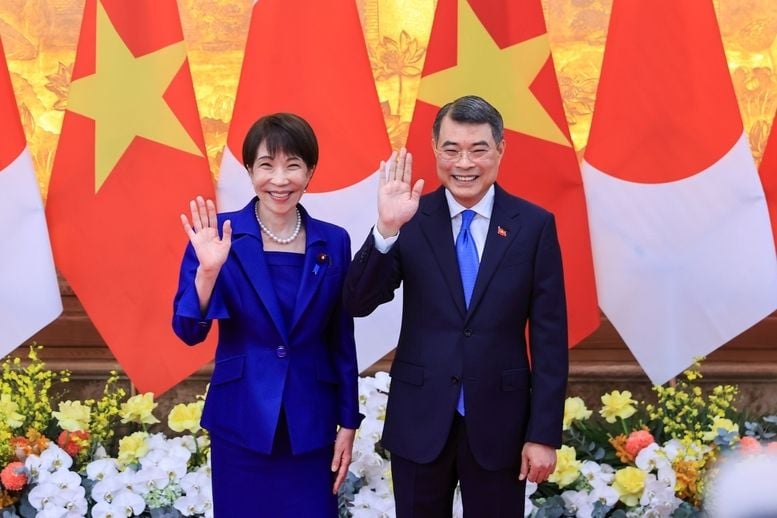
On the morning of May 3, 2026, Japanese Prime Minister Takaichi Sanae left Hanoi, concluding the official visit to Vietnam from May 1–3. The outcomes of the visit indicate that Vietnam–Japan relations are entering a new phase, with a clearer focus on the economy, technology, and economic security.
During the visit, Prime Minister Takaichi Sanae carried out symbolic and political activities, including paying respects at the Ho Chi Minh Mausoleum and laying wreaths at the Memorial to Martyrs, alongside talks and meetings with Vietnamese leaders. The engagements reflected a coordinated approach across three pillars: party, state, and government. General Secretary/President To Lam welcomed the Japanese Prime Minister; Prime Minister Le Minh Hung chaired the welcome ceremony, held talks, and met with the press; and Chairman Tran Thanh Man also met with the delegation. The interactions highlighted deeper cooperation across party, government, and local levels.
At high-level meetings, Party General Secretary and State President To Lam emphasized Vietnam’s strategic orientation: pursuing an independent, self-reliant, peaceful foreign policy; multilateralization and diversification; a four-no defense policy; and deepening partnerships, with Japan described as a top strategic partner. The meetings also set out six major directions to strengthen strategic cooperation:
In addition, the cooperation agenda includes labor, education, local government, culture-society, and people-to-people exchanges.
In implementation discussions, the talks between the two prime ministers translated the directions into concrete targets: attracting about 5 billion USD of Japanese investment into Vietnam per year and raising bilateral trade turnover to 60 billion USD by 2030.
Six cooperation documents were signed across a range of fields, including climate-adaptive infrastructure, irrigation, digital transformation, and space technology. The documents reflect a broad and deep cooperation scope across foundational sectors of the future economy.
A key highlight of the visit was Prime Minister Takaichi Sanae’s policy speech at Vietnam National University, Hanoi, where she marked the 10th anniversary of Abe’s FOIP initiative (2016) and announced updates to Free and Open Indo-Pacific (FOIP-2026). She outlined a strategic direction centered on building economic infrastructure for the AI and data era, strengthening energy and materials supply chains, and intensifying cooperation to support stability and sustainable development.
The selection of Vietnam as the venue underscores Japan’s view of Vietnam’s growing importance in the regional architecture, including Vietnam’s role as a dynamic economic partner and a key node in supply chains and Japan-led regional initiatives.
The linkage between FOIP and bilateral cooperation—covering digital transformation and AI, semiconductors, and energy and green growth—places Vietnam–Japan relations within a broader regional context. Against a backdrop of rising strategic competition and increasing energy-security challenges, cooperation in international forums such as the United Nations, ASEAN, and the Mekong subregion is presented as a way to upgrade ties while supporting regional stability and balance.
The visit also emphasized the role of Parliament in promoting legal frameworks to enable investment, new-generation ODA, and high-tech projects, aiming to ensure commitments move beyond statements and become realizable outcomes.
Overall, the visit by Prime Minister Takaichi Sanae is described as shaping a systematic cooperation structure—strategic orientation, substantive implementation, and institutional guarantees—laying a foundation for deeper Vietnam–Japan relations. The next decisive step will be converting commitments into tangible results, particularly in economic, technological, and energy security areas.




Premium gym chains are entering a “golden era” that is ending or already in decline, as rising operating costs collide with shifting consumer preferences toward more flexible, community-based ways to exercise. Long-term memberships are shrinking, margins are pressured by higher rents and facility expenses, and competition from smaller, more personalized…




