•
•
•
•
•
•
•
•
•
•
•
•
•
•
•
•
•
•
•
•
•
•
•
•
•
•
•
•
•
•
•
•
•


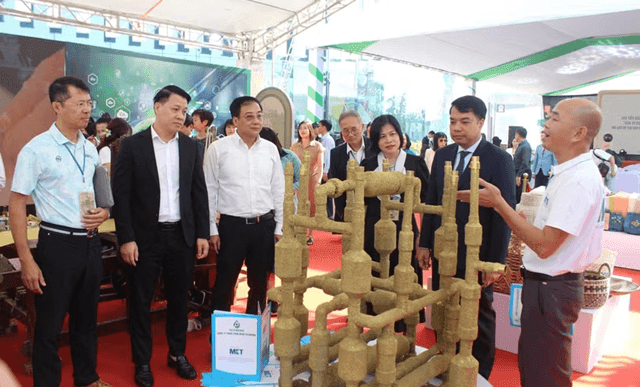
Many Vietnamese manufacturers are adopting green production to respond to mounting geopolitical pressures. Domestic producers are proactively restructuring, using “green production” as a passport and “diversifying ecosystems” as anchors to reposition themselves on the global industrial map.
In a global economy marked by geopolitical conflicts, supply-chain disruptions and inflationary pressures, Vietnamese industrial firms face existential challenges. The era of growth driven by cheap labor and simple outsourcing has ended, and a strategic shift is under way: manufacturers are no longer passive and are actively restructuring.
Ms. Truong Thi Chi Binh, secretary general of the Vietnam Association of Supporting Industries (VASI), said that beyond geopolitical pressures, new-generation technical barriers are being erected more densely. These include the EU’s CBAM and ESG standards from North American markets. She noted that these are no longer purely voluntary standards but prerequisites for survival in global supply chains.
If firms do not meet green requirements, they risk being excluded from global supply chains. Against this threshold, the key question becomes how to adjust production and investment paths to both adapt and achieve breakthroughs.
A long-standing weakness of Vietnam’s manufacturing sector is fragmentation: units operate independently, run single-line production, and depend on a limited number of large customers. This structure creates systemic risk when supply chains are disrupted.
Mr. Nguyen Van Hung, chairman of CNCTech Group, said that if production forces cannot optimize capital deployment, firms will stall in the value chain. He emphasized that every unit of capital and every hour of labor must generate the highest possible value, warning that if the mindset of “quantity to quality” persists, domestic firms will be outcompeted by international players with advanced technologies.
In the 4.0 era, Mr. Hung added, the biggest challenge for small and medium-sized enterprises (SMEs) is the speed of technological change, since a modern production line can become obsolete within a few years.
Rather than having leaders shoulder every technical decision alone, Mr. Hung proposed “smart governance,” delegating authority so expert teams can invest and take responsibility. This approach allows leadership to focus on strategy and growth models.
He stressed that the solution is not simply buying more machines, but connecting them to maximize efficiency. He said that when firms shed fragmentation, deepen technological capabilities, and build integrated platforms, they can better mitigate macro pressures and position Vietnam as a hub for smart industrial solutions.
The approach aligns with moving up the ladder—from expanding production capacity, to strengthening technical capabilities, and ultimately mastering system-level solutions.
Mr. Dang Duc Trung, CEO of Gcool, said disruptions in material supply from traditional markets due to geopolitical conflicts are a costly lesson. If a business relies on a single product line or a sole international supplier, cash flow can be interrupted.
Gcool’s response is to diversify its product ecosystem, develop cross-application components for multiple industries, and actively build a domestic supply network. The goal is to establish a self-reliant value chain and minimize exposure to global variables.
As a leading foreign direct investment (FDI) company, a representative of Daikin Air Conditioning (Vietnam) said green production is a long-term strategy integrated from research and development to the production line. Measures include using eco-friendly refrigerants, deploying AI for energy management, and setting ESG standards for Vietnamese subcontractors.
In a fragmented market, the representative said a green and transparent supply chain helps goods move across borders.
Enterprise efforts are described as essential, but the article also highlights the need for government facilitation. A representative from the Department of Industry (Ministry of Industry and Trade) said the government is strengthening the legal framework, promoting green credit policies, and facilitating technology transfer for SMEs.
The article also notes that regulators plan to accelerate intra-regional trade and assist firms in establishing carbon standards to counter international technical barriers.
The article says the era of geopolitical volatility will continue to test markets. However, based on implementation experience, it argues that Vietnam’s industrial sector is moving away from a passive defense mindset. By reforming governance, prioritizing efficiency, and staying on the green production path, Vietnam is working toward a new balance—aiming to withstand geopolitical shocks and strengthen its position in the global value chain.
Ngoc Quỳnh. VietnamPlus.




Premium gym chains are entering a “golden era” that is ending or already in decline, as rising operating costs collide with shifting consumer preferences toward more flexible, community-based ways to exercise. Long-term memberships are shrinking, margins are pressured by higher rents and facility expenses, and competition from smaller, more personalized…




