•
•
•
•
•
•
•
•
•
•
•
•
•
•
•
•
•
•
•
•
•
•
•
•
•
•
•
•
•
•
•
•
•
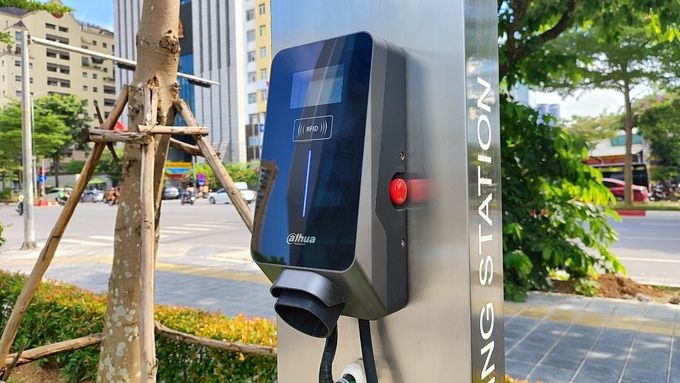
The Ministry of Industry and Trade has asked local authorities to update electricity demand, locations, operating times, and power-supply arrangements for EV charging stations, metro stations, high-speed rail, and TOD development areas. Localities should report development plans and electricity needs for EV charging stations, metro, high-speed rail, and TOD areas to be included in Power Plan VIII. These are new electricity demand groups expected to grow rapidly, with EV charging infrastructure receiving particular attention due to its link to the electrification of transport and green transition. Currently, the country has about 6.7 million cars (roughly 3% electric) and 70 million motorcycles (4.3% electric). Most electric vehicles are concentrated in large urban areas, creating urgent needs for parking and charging infrastructure. Under Vietnam's strategy to achieve net-zero emissions by 2050, Vietnam targets 50% of urban vehicles and all buses and taxis to run on electricity by 2030. All transport will switch to electricity or green energy within 20 years. To establish an EV charging network, the World Bank estimates Vietnam will need about USD 2.2 billion by 2030, rising to nearly USD 14 billion by 2040 and USD 32.6 billion by 2050. For the northern provinces from Quảng Trị northward, the ministry asks to review base-load power projects and transmission grids that can be deployed under the emergency electricity facility mechanism. The goal is to select projects with infrastructure advantages (transmission, site, land) to be operational in 2027-2028. The Ministry also requires updating existing power-generation projects in the 2030 plan, though there are currently no investors or investment proposals. The list of new builds and upgrades to 500 kV and 220 kV transmission lines and substations should also be reviewed. This move comes as many generation and grid projects are not on track to operate by 2030 per the plan, potentially impacting electricity supply and national energy security. Therefore the Ministry wants to promptly review and revise Power Plan VIII and compile a list of urgent projects for immediate implementation, especially base-load power in high-demand regions. As of the end of 2025, the total installed capacity of the system was about 87,600 MW, up about 6,400 MW from 2024. Under the revised Power Plan VIII, total system capacity is expected to reach about 183,000-236,000 MW by 2030. In terms of grid development, Vietnam is expected to build tens of thousands of kilometers of 500 kV and 220 kV transmission lines along with major substations to improve inter-regional transmission.
Bitcoin (BTC) investors who use steady dollar-cost averaging (DCA) may be underperforming versus strategies that adjust exposure to the market’s cycle, according to new research arguing that Bitcoin’s behavior differs from traditional long-duration assets.
In a report cited by Markus Thielen of 10x Research, Bitcoin’s market…