•
•
•
•
•
•
•
•
•
•
•
•
•
•
•
•
•
•
•
•
•
•
•
•
•
•
•
•
•
•
•
•
•


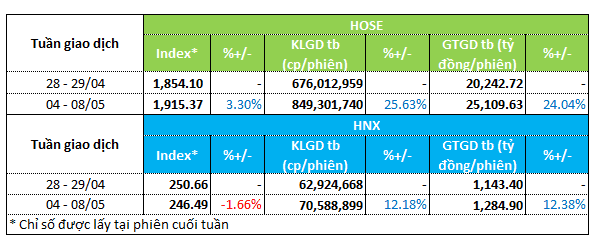
Money flows strengthened into the stock equities sector during the week of 4–8 May as the market reached a new high. Liquidity improved versus the previous week, with both trading activity and value rising on HOSE and HNX.
During the first week of May, the VN-Index hit a record level, rising 3.3% to close at 1,915.37 points. By contrast, the HNX-Index trended lower, falling to 246.5 points.
Trading activity was more active than the prior week. On HOSE, average traded volume and value increased by 25% to 850 million shares per session and 25.1 trillion dong per session, respectively. On HNX, liquidity rose 12%, with average trading volume reaching 70.5 million shares per session and average trading value of 1.3 trillion dong per session.
Against the backdrop of the VN-Index reaching a new high, funds flowed more strongly into the stock equities group. Several stocks in this segment appeared among the top liquidity gainers on both exchanges over the week.
Examples include VDS, with liquidity up nearly 120% versus the previous week, and ORS, where trading volume rose by around 100%.
On HOSE, PSI, VFS, MBS, APS, and BVS were among the top 10 most active stocks. The Gelex group also recorded a strong week: GEX and GEE saw trading volume increase by more than 100% over the past week, rising 24% and 28%, respectively.
Sentiment weakened in the real estate and metals groups, with multiple names appearing among the top liquidity decliners on both exchanges. Real estate tickers including BCM, TDH, AAV, NRC, IDC, IDJ, TIG, DTD, and NDN were listed among the biggest decliners in trading liquidity.
Some stocks saw sharp declines in liquidity, such as AAV, down about 80%. In the steel and metals segment, representatives including VPG, NKG, VGS, and NSH appeared among the top liquidity losers.








Premium gym chains are entering a “golden era” that is ending or already in decline, as rising operating costs collide with shifting consumer preferences toward more flexible, community-based ways to exercise. Long-term memberships are shrinking, margins are pressured by higher rents and facility expenses, and competition from smaller, more personalized…



