•
•
•
•
•
•
•
•
•
•
•
•
•
•
•
•
•
•
•
•
•
•
•
•
•
•
•
•
•
•
•
•
•



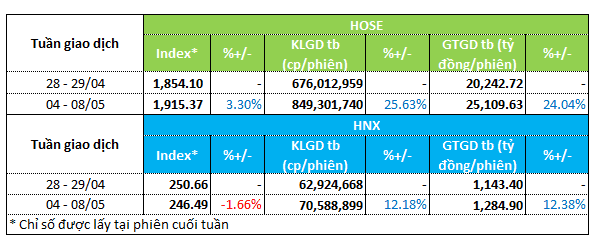
Green on the screen, the VN-Index has risen for consecutive sessions above the previous peak of 1,902 points, logging four straight up days. However, the rally has also revived the familiar market saying: “green on the surface, red on the inside.”
Recent gains in the VN-Index have depended heavily on a small number of large-cap stocks, particularly VinGroup-related names such as VIC, VHM, and VRE. This creates a divergence between the index’s movement and investors’ real experience: the VN-Index can rise even as more stocks decline than advance.
In several recent sessions, the number of declining stocks outweighed the number of rising stocks by as much as 1.5x to 2x, yet the index still increased strongly. The explanation is that the index is market-cap weighted, so the influence of a few “pillar” stocks remains very high.
As a result, capital appears concentrated in the group of stocks capable of moving the index, rather than flowing broadly across the market. Meanwhile, other sectors—such as securities, steel, mainstream real estate, and construction—have remained range-bound, with liquidity showing differentiation.
The “green on the surface, red on the inside” pattern has also made investment strategies more difficult. Investors who do not hold the leading stock group may see their portfolios lag despite the index rising, while chasing hot names carries higher risk because profit-taking can emerge quickly.
The downside of relying on large-cap stocks has been evident during recent corrections. When VinGroup-related stocks reverse, the VN-Index can face strong pressure even if many other stocks do not fall deeply.
In this setup, the market is supported by leaders but can weaken quickly because the upward momentum is not driven by broad consensus. Sentiment can shift rapidly whenever the VinGroup group adjusts, raising concerns that if the “engine” weakens, the index may struggle to maintain its uptrend and trigger wider selling pressure—particularly among speculative stocks that depend more on short-term sentiment.
Overall, the market appears to be caught in a loop: money flows in to lift the index and keep it green, then selling pressure returns at the leaders, pulling the index down again. The rest of the market has not shown enough capacity to absorb the burden.
This raises the question of whether the VN-Index can break through 2,000 points sustainably. Theoretically, the market still has growth headroom supported by an expanding economy, a growing pool of listed companies, and prospects for market upgrading. If corporate profits continue to grow, interest rates remain low, and new capital returns strongly, the VN-Index could target higher levels over the long run, including the 2,000-point mark.
However, sustaining progress toward 2,000 points likely requires more than short bursts of index support from a few pillar stocks. If the up-move continues to rely mainly on VinGroup or a handful of large-cap names, volatility risk increases: weakness in leading stocks could quickly drain momentum across the broader index.
Valuation sensitivity also becomes more important as the VN-Index rises. Sharp price gains need to be matched by genuine earnings growth; otherwise, the risk of correction becomes harder to avoid.
What the market needs, therefore, is a broader spread of liquidity across many sectors. When multiple sectors participate in the rise, the market has a stronger foundation for a longer-term upcycle.
The ABS note also highlights risks from external conditions. In the near term, ABS expects the trend to remain up, but notes that volume has not yet surged due to investor skepticism.
ABS expects a clearer uptrend if the index breaks above the 1,920-point resistance, which would help establish a more definite upward trajectory. For May 2026, ABS forecasts the VN-Index could surpass the old peak near 1,920 points and consolidate toward a target around 2,084–2,145 points.
At the same time, ABS advises monitoring external risks, especially the Middle East conflict. If tensions escalate and adversely affect global growth, the VN-Index could retest the 1,750–1,800 support zone. ABS notes this zone could serve as a “strength test” for the uptrend, with pullbacks potentially acting as shakeouts ahead of a larger move.
Hai Giang
Premium gym chains are entering a “golden era” that is ending or already in decline, as rising operating costs collide with shifting consumer preferences toward more flexible, community-based ways to exercise. Long-term memberships are shrinking, margins are pressured by higher rents and facility expenses, and competition from smaller, more personalized…