•
•
•
•
•
•
•
•
•
•
•
•
•
•
•
•
•
•
•
•
•
•
•
•
•
•
•
•
•
•
•
•
•


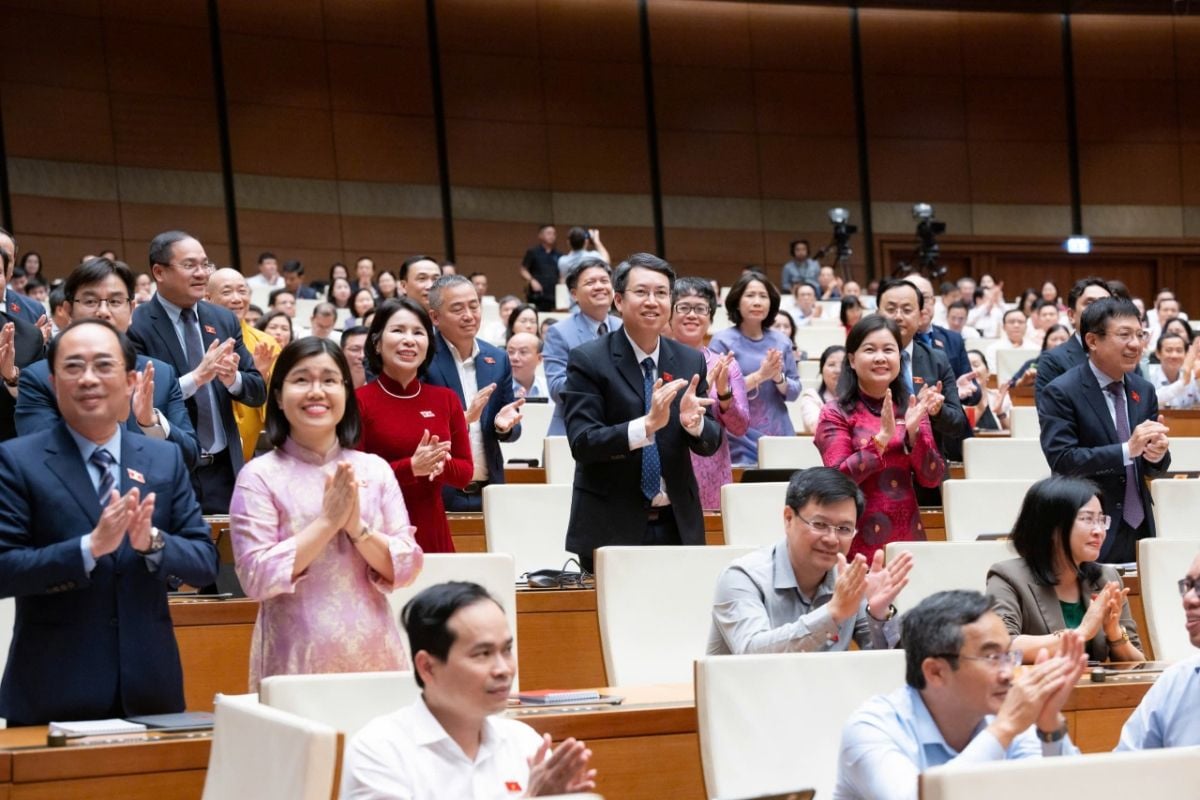
During the afternoon of 23 April 2026, in the ongoing proceedings of the First Session of the 16th National Assembly, deputies voted to approve the Capital Law (amended) under the chairmanship of Vice Chairman Nguyen Khắc Định. The results showed that 492 deputies participated, representing 98.40% of the total number of deputies; 488 deputies voted in favor (97.60%), 2 opposed (0.40%), and 2 abstained (0.40%). With this result, the Capital Law (amended) has officially been passed by the National Assembly.
One of the guiding directions throughout the revisions was to push for substantive and comprehensive decentralization and powers for the capital’s authorities, linked with a strict mechanism of checks and balances. At the same time, the revisions aim to strengthen accountability and ensure transparency in implementation.
The draft Capital Law (amended) continues to refine the mechanisms for drafting and issuing normative legal documents. Pilots for policy mechanisms and testing are maintained, with the capital city’s government explicitly empowered to design, implement, and test policies.
Following reception and revision, the draft law retains a structure of 9 chapters and 36 articles, with 26 articles revised. Notably, the draft assigns Hanoi’s city government a total of 199 special, superior powers, including 127 powers for the People’s Council, 56 powers for the People’s Committee, and 16 powers for the President of the City People’s Committee.
This is intended to provide a crucial legal basis for Hanoi to further unleash its potential, status, initiative, and creativity in development, in line with the motto “local decision, local action, local responsibility.”
The bill clarifies regulations on the drafting and issuance of legal documents and confirms pilots for mechanisms, policies, and power controls. It also tightens discipline in lawmaking by not applying simplified procedures, clarifying the authority of the City’s President, adding requirements for monitoring, oversight, and accountability when issuing documents, and mandating post-issuance evaluation to inform policy refinement.
The draft broadens the scope of pilots to include other mechanisms or policies under directives of competent authorities, with a maximum pilot period of five years. If risks arise beyond the forecast, a pause mechanism is provided to ensure safety in management.
Regarding space development and regional linkage, the draft confirms the central leadership role of Hanoi and defines the concept of the Capital Region as open and flexible. This allows localities to participate in joint projects and apply provisions of the Capital Law when implementing shared projects. It also allows the use of local budgets to invest regionally to address infrastructure, environment, and essential services for the broader region.
The Capital Law (amended) is designed to refine the legal framework for the capital’s government and operations and to open new institutional space for Hanoi to develop rapidly and sustainably, commensurate with its role as the national political-administrative center and a major hub for economy, culture, education, science, and international integration. The law takes effect from 1 July 2026.

Premium gym chains are entering a “golden era” that is ending or already in decline, as rising operating costs collide with shifting consumer preferences toward more flexible, community-based ways to exercise. Long-term memberships are shrinking, margins are pressured by higher rents and facility expenses, and competition from smaller, more personalized…



