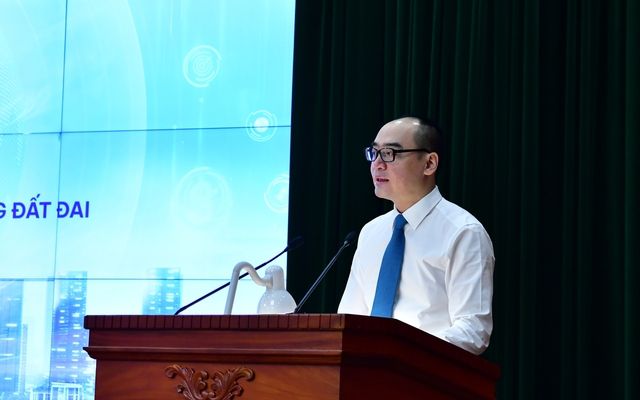
By PV Group | July 2, 2026 - 12:05 PM | Finance - Banking On the morning of July 2, in Hanoi, the State Audit Office (KTNN) organized a knowledge-sharing seminar on the topic 'Land price appraisal linked to management and use of land - current status and solutions.' Deputy Auditor General Bui Quoc Dung attended and delivered the opening remarks. More than 200 delegates from ministries, sectors, and local authorities; BIDV Bank; AASC audit firm; valuation companies; and leaders of KTNN units attended. In his opening remarks, Deputy Auditor General Bui Quoc Dung emphasized that land is a special resource of the nation, a basic means of production, space for development and one of the largest public assets. Efficient management, exploitation and use of land resources directly affect economic growth, infrastructure development, social stability, welfare, and public trust in the effectiveness of state management. Within this framework, land valuation, valuation of land and assets attached to land are key steps. The valuation results serve as the basis for the state to allocate land, lease land, reclaim land, provide compensation and support, resettle, determine financial obligations, auction land-use rights, manage public assets, determine enterprise value, and implement numerous development projects. Land prices should be determined transparently, objectively, and in line with market realities; land resources will be unlocked, allocated rationally, and used efficiently. Conversely, deviations in valuation can lead to revenue leakage, budget shortfalls, increased complaints or lawsuits, delays in projects, and legal risks for the management agency, consulting entities, and land users. In recent times, the land-related policy and legal framework has undergone significant reforms, notably the 2024 Land Law, the 2023 Price Law, and accompanying implementation guidance. New regulations, including Resolution No. 254/2025/QH15, Decrees No. 71/2024/NĐ-CP, No. 226/2025/NĐ-CP, No. 49/2026/NĐ-CP, No. 151/2025/NĐ-CP, and No. 250/2025/NĐ-CP, have created important legal corridors for land valuation, land valuation of assets on land, with a move toward transparency, market-oriented principles, increased decentralization, and greater accountability for participating actors. However, practical implementation at localities reveals many new, difficult, and complex issues. These include not only technical calculation challenges but also the need to harmonize legal understanding, improve data infrastructure, standardize processes, raise professional capacity, and clearly delineate responsibilities among actors in the land valuation process. For KTNN, land, resources, public assets, and projects using land remain key risk areas; Parliament, Government, voters, and society pay special attention. KTNN has been assigned tasks and carried out numerous audit missions under parliamentary resolutions related to land allocation, land leasing, land price determination, land-use fees, infrastructure projects, BOT projects, and other land-financed obligations. According to aggregated audit results over the past three years, KTNN conducted 10 audits related to land price determination in six provinces/cities; identified 296 errors across 12 error types; involved 19 units with errors and 23 units subject to recommendations. Besides subjective causes in implementation, objective reasons in understanding and applying policy documents also appear. Deputy Auditor General Dung stated that the purpose of organizing the seminar is not only to exchange expertise but also to establish a substantive platform to identify issues, engage in targeted dialogue, and move toward practical, applicable solutions. From the synthesis, nearly 100 questions and concerns were submitted, focusing on seven major issues: market data and the selection of comparable assets; applying the comparison, residual, and income approaches under data-scarce conditions; constructing land price schedules, land price adjustment coefficients, and specific land prices; determining development costs, infrastructure costs, and capital expenditure; determining land price for mixed-use projects, projects undergoing planning adjustments, land-use right auctions, and financial obligations; organizing the Land Appraisal Council; responsibilities of government agencies and consulting units; and pricing assets on land in special cases such as used assets, damaged assets, burned assets, missing as-built documentation, or no current status. Deputy Auditor General Dung expressed hope that through these discussions, policy makers will listen directly to localities to continue improving the mechanism; localities and implementing agencies will better understand the spirit, content, and requirements of the regulations to apply them consistently and lawfully. KTNN will also gain a clearer understanding of policy and practice to perform audits objectively, transparently, in compliance with regulations, and with greater constructive value. At the seminar, speakers clarified practical aspects of land valuation and land assets; challenges from the management perspective; market data and planning data in land valuation; existing limitations in land price determination in audit practice and some solutions. By PV Group and Báo Kiểm toán