•
•
•
•
•
•
•
•
•
•
•
•
•
•
•
•
•
•
•
•
•
•
•
•
•
•
•
•
•
•
•
•
•


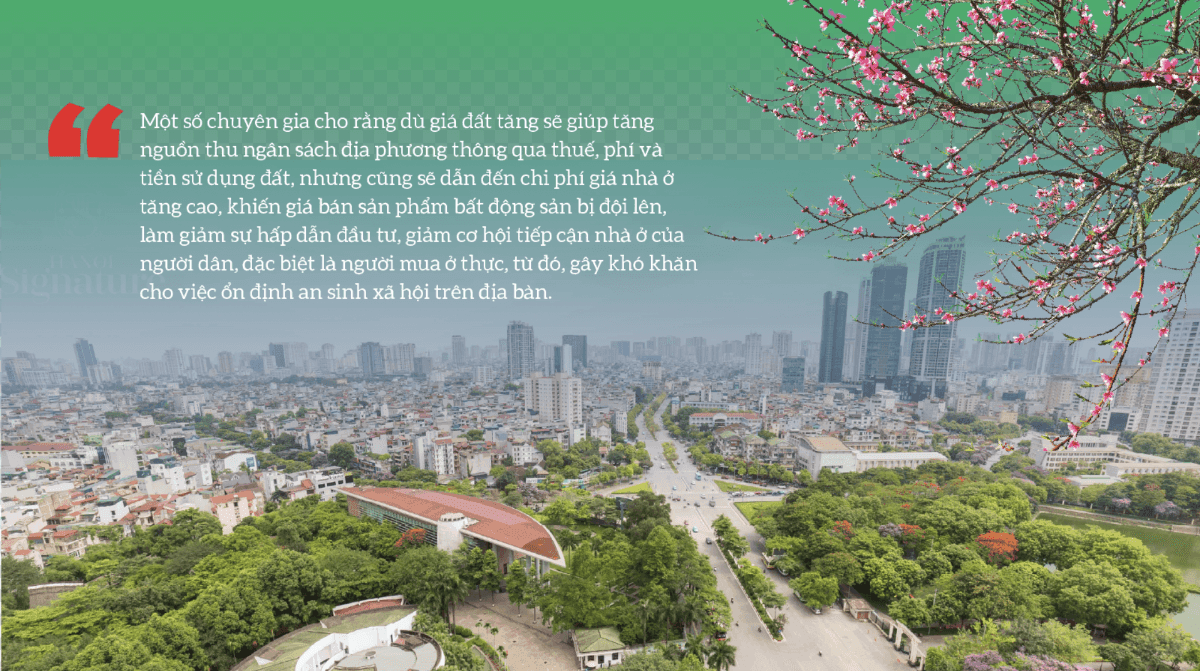
Land prices typically account for 15-30% of input costs in real estate projects. As localities uniformly apply the new land price table from January 1, 2026 with increases higher than the previous levels, housing prices in many places—especially Hanoi and Ho Chi Minh City—are expected to face strong fluctuations.
At the end of November 2025, the Hanoi City People’s Council passed Resolution 52/2025/NQ-HĐND, regulating the land price table for the first time in the city and setting its application from January 1, 2026. Under the resolution, Hanoi’s land prices are divided into 17 zones based on administrative units with similar development conditions, including location, degree of urbanization, infrastructure (technical and social), population density, and production and business activities.
In Zone 1, covering wards around Ring Road 1, including Tây Hồ, Ngọc Hà, Ba Đình, Giảng Võ, Ô Chợ Dừa, Hoàn Kiếm, Văn Miếu - Quốc Tử Giám, Cửa Nam, Hai Bà Trưng, the average residential land price is 255.331 million VND/m2, up 2% from the previous level. The highest price in this zone reaches 702.257 million VND/m2.
Meanwhile, many communes in Hanoi’s outer suburban areas recorded increases of 25-26%.
VIC Appraisal and Trade JSC, the consulting unit implementing land price valuation, said urbanization is progressing quickly in several communes of Hanoi’s former outer districts such as Đông Anh, Phúc Thịnh, Gia Lâm, Bát Tràng, Thanh Trì, Ngọc Hồi, Hoài Đức, Sơn Đồng, and Ô Diên. It added that mechanical population growth from migrant workers and people from outside the city, along with demand to study and work in the capital, has created strong pressure on urban land, pushing up prices in certain areas.
It also noted that in 2024-2025, Hanoi focused investment on major infrastructure works including Ring Road 4, Metro lines 2A and 3, expansion of the Tây Thăng Long corridor, and projects such as Nguyễn Trãi and Trần Phú – Hà Đông. Strong transport connectivity with neighboring provinces, while increasing the land-use value of project areas, contributed to the rise in prices. The unit said continuing to apply the old price table would create inconsistency and complicate state management and the implementation of land-financing policies.
According to a briefing document from the Hanoi Department of Agriculture & Environment, the new land price table complies with the 2024 Land Law and government decrees guiding implementation. The approach aims to follow market principles, meet practical requirements, and reduce the gap between listed land prices and market transaction prices. The briefing said the increases are not too large so as to maintain fiscal balance and avoid affecting business activities or economic development of organizations and individuals.
The document also said building the new land price table helps Hanoi complete its digital data system, publish land prices online, and enable people and businesses to look up information more easily, while meeting requirements for coordinated data updating between different levels of government.
On the afternoon of December 26, 2025, during the seventh session of the Ho Chi Minh City People’s Council, the city approved a resolution to issue the first land price table applicable from January 1, 2026. A key basis for the new table was practical demand in land management, particularly in the context of the city’s merger with Bình Dương and Bà Rịa - Vũng Tàu. The 2026 land price table is divided into zones based on pre-merger administrative boundaries to maintain continuity and alignment with development characteristics and market levels.
Land prices rose in most zones but not uniformly. The old central zone of Ho Chi Minh City saw modest increases, while prices in urban areas of Bình Dương and Bà Rịa - Vũng Tàu rose sharply.
In Zone 1 (central Ho Chi Minh City), land prices increased by a factor of 1 to 1.56. The highest price is 687,200,000 VND/m2 for locations along Đồng Khởi, Nguyễn Huệ, and Lê Lợi. This highest price remains unchanged compared with the 2024 decision.
In Zone 2 (the old Bình Dương area), the highest multiplier reached 8.10 times compared with the 2024 decision 63/2024/QĐ-UBND. The DH. 505 road segment from Cầu Lễ Trang to DH. 507 saw land price increases from 780,000 to 6.3 million VND/m2. The highest adjusted price in Bình Dương reached 89.6 million VND/m2 along Bác sĩ Yersin and Bạch Đằng (old price 52.16 million VND/m2).
In Zone 3 (the old Ba Ria - Vũng Tàu province), land prices were adjusted upward by 1.7-3.78 times compared with the 2024 decision 26/2024/QĐ-UBND. The highest price, 149.8 million VND/m2, applies to the Thùy Vân corridor, an important tourism and service axis for the province.
Briefing notes from the Department of Agriculture and Environment indicate that the prices were built on market transaction price surveys. Authorities then reviewed and balanced them to reflect approximately 60% of market prices.
The survey also showed the old price table was far below actual market prices: in Bình Dương, market prices were higher by up to 13.6 times; in Ba Ria - Vũng Tàu, up to 45.2 times higher than the 2025 table values.
Thus, the new land price table is driven not only by mandatory requirements of the 2024 Land Law but also by practical demand in land management and socioeconomic development. It aims to address limitations of existing price tables and expand the scope of application under new regulations to ensure fairness in calculating land-based fiscal obligations.
The Economic - Budget Committee of Ho Chi Minh City’s People’s Council also stated that the new land price table is not only a management tool but a significant step toward a transparent and effective investment environment. With broad consensus and thorough preparation, the new price table is expected to help stabilize the real estate market and support sustainable development in the coming period.
Despite the stated policy objectives, applying the new land price table has drawn criticism. The Vietnam Real Estate Association said that several localities’ announced increases are “shock” to the market and pose risks to businesses, households, and banking credit activities.
For the real estate market, rising land prices can put developers in a difficult position when deciding whether to proceed with ongoing projects or pause. Higher upfront land-use costs can push total investment beyond a company’s financial capacity.
For projects not yet underway, developers may need to raise selling prices and shift toward higher-end product development to maintain profit margins amid tightened land supply. The article noted that selling prices may rise with input costs, potentially reducing purchasing power.
Some experts argued that while higher land prices can increase local government revenue through taxes, fees, and land use charges, they also raise housing costs. This can reduce market attractiveness for investors and limit access to housing for actual buyers, complicating social stability in the area.
Full article content published in Vietnam Economic Journal issue 7+8/2026, released February 16-23, 2026.






Premium gym chains are entering a “golden era” that is ending or already in decline, as rising operating costs collide with shifting consumer preferences toward more flexible, community-based ways to exercise. Long-term memberships are shrinking, margins are pressured by higher rents and facility expenses, and competition from smaller, more personalized…




