•
•
•
•
•
•
•
•
•
•
•
•
•
•
•
•
•
•
•
•
•
•
•
•
•
•
•
•
•
•
•
•
•


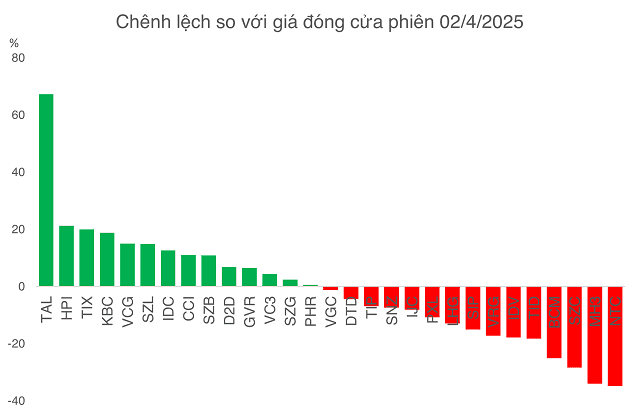
April 2026 marks one year since the tariff shock of 2025. Since Liberation Day, more than 40% of tracked industrial park (KCN) stocks have not returned to their pre-shock price levels. As of the close on 20/04, more than 40% of the tickers tracked still had not reached the pre-shock price range.
By the end of the 20/4 session, the group that fell more than 20% from the close on 02/04/2025 included NTC (-34.82%), MH3 (-34%), SZC (-28.38%), and BCM (-25.04%).
In the under-10% decline group were TID (-18.18%), IDV (-17.79%), VRG (-17.22%), SIP (-15.07%), LHG (-12.89%), and PXL (-10.84%), indicating demand has not yet been sufficient to fully offset the adjustment.
Despite the broad weakness, some names posted strong gains. TAL rose (+67.3%), TIX increased (+20%), and KBC climbed (+18.81%), which stood out in the recent period.
It was reported that VPBank S Securities bought an additional 1.15 million KBC shares, lifting its holding to 5.044% and making it a major shareholder.
Meanwhile, heavyweight GVR (+6.2%) recorded modest gains, reflecting price anchoring rather than a clear breakout.
FDI remains a key pillar for the KCN group, but it has not been enough to lift the entire sector. Vietcap Securities reported that total registered FDI in Q1 2026 rose 42.9% to $15.2 billion. Disbursed capital also stayed positive, up 9.4% year-on-year in March, bringing quarterly disbursement to $5.4 billion (+9.1% year-on-year).
Large Korean firms planning to arrive in Vietnam at the end of April are expected to trigger a new wave of investment, particularly in high-tech sectors. However, Agriseco Securities cautioned that the outlook is not entirely one-sided: in the short term, FDI inflows and demand for KCN land leases may be affected by geopolitical tensions or U.S. policy.
FDI into Vietnam in 2025 and in Q1 2026 continues to rise, signaling international investor confidence in Vietnam’s business environment despite tariff risks and Middle East tensions. The government’s establishment of an Investment Support Fund and special procedures for strategic KCN projects are described as positive signals for maintaining Vietnam’s competitive positioning.
Looking further ahead, improving transport infrastructure and highways to enhance connectivity between regions—along with investment incentives and the global supply chain shift—are expected to remain key drivers.
Agriseco forecasts that the next cycle’s main beneficiaries will be companies with available clean land, MOUs with customers, and strong finances.
Investors are also watching the U.S. tariff refund timeline. Exporters may benefit as the U.S. begins reimbursing $166 billion in tariffs from April 20, with tariff refunds possibly including interest for some importers. If implemented, this could be among the largest tariff refunds in U.S. trade policy history.
On a broader view, the KCN sector’s developments reflect the market’s overall narrative. Mr. Bui Van Huy, Director of Investment Research at FIDT JSC, said the current index rally is moving faster than the market’s underlying health. He attributed the rebound mainly to large-cap stocks and market-upgrade expectations, rather than broad improvements in profits and cash flow.
“If the index continues to rise while breadth and liquidity do not improve, I would view it as a rally that is more vulnerable to shake than a solid uptrend,” he said.




Premium gym chains are entering a “golden era” that is ending or already in decline, as rising operating costs collide with shifting consumer preferences toward more flexible, community-based ways to exercise. Long-term memberships are shrinking, margins are pressured by higher rents and facility expenses, and competition from smaller, more personalized…