•
•
•
•
•
•
•
•
•
•
•
•
•
•
•
•
•
•
•
•
•
•
•
•
•
•
•
•
•
•
•
•
•


On April 22, 2026, the VN-Index rose and tested the February 2026 high in the 1,860–1,900 point range. The Stochastic Oscillator continued to weaken after issuing a negative signal in the overbought region, and if it falls out of that region in the coming sessions, short-term risk is expected to increase.
Major indices advanced across the session. The VN-Index gained 1.3% to 1,857.3 points, while the HNX-Index rose 0.83% to 255.36 points.
The VN-Index saw wide intraday swings, driven mainly by fluctuations in heavyweight stocks. The index opened with a tug-of-war, at times retreating in the morning before stabilizing gradually. In the afternoon, large-cap stocks—particularly the Vingroup group—helped the index accelerate to higher levels. The uptrend was maintained into the close, despite minor fluctuations.
At the end of the session, the VN-Index closed at 1,857.3, up 23.82 points from the previous session.
Large caps supported the overall trend. VS-LargeCap rose 1.41%, helping sustain the uptrend, while VS-MidCap and VS-SmallCap declined by 0.29% and 0.14%, respectively, indicating increasing downside pressure relative to earlier sessions.
The 10 most positive contributors added nearly 30 points to the VN-Index. VIC and VHM alone contributed about 27.48 points. On the downside, HPG, STB, and GEE were the most negative contributors, collectively subtracting about 1.45 points.
Most sectors were red, except real estate, which stayed green due to VIC and SJS hitting the daily up-side limit. Key gains included VHM (+3.09%), KSF (+6.59%), VRE (+2.22%), and NVL (+5.93%).
In contrast, the media/telecom services sector faced pressure, with declines in VGI (−1.81%), FOX (−1.68%), CTR (−1.28%), and VNZ (−0.94%).
Within large-cap groups such as financials and industrials, performance was mixed. Stocks under pressure included STB (−1.77%), HDB (−0.56%), EIB (−1.31%), VCI (−0.93%), as well as VSC (−1.71%), GEE (−2.98%), VCG (−1.59%), PC1 (−1.33%), and VTP (−2.87%). Meanwhile, demand appeared for TCB (+0.92%), MSB (+2.41%), GEX (+1.61%), CII (+2.15%), HAH (+4.87%), and CRC (+1.06%).
The VN-Index continued to test the old February 2026 high (around 1,860–1,900). The Stochastic Oscillator remained weak after a negative signal in the overbought region. If the indicator exits that region in upcoming sessions, near-term risk could rise.
The HNX-Index advanced after testing the 50-day and 100-day SMAs. The next near-term test is considered important for the index. Near-term risk remains as the Stochastic Oscillator has left the overbought region following negative signals, while MACD continues to narrow its distance from the Signal line.
Smart money: The Negative Volume Index for the VN-Index is currently above the 20-day EMA. If this condition persists into the next session, the risk of an abrupt sell-off is viewed as limited.
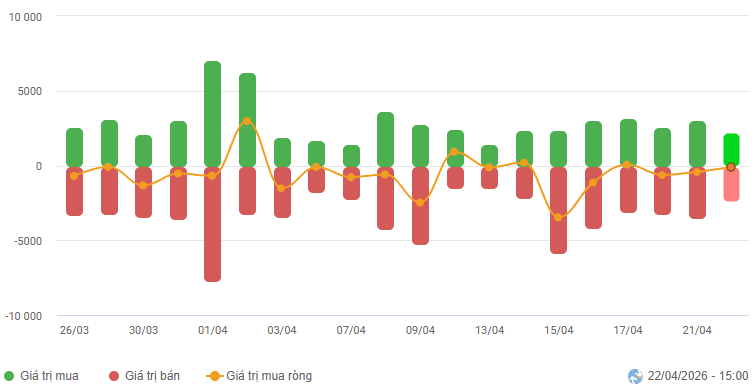
Foreign flow: Foreign investors continued to be net sellers on 22/04/2026. If the pattern continues, downside pressure could intensify.
End of day: VN-Index up 23.82 points (+1.3%) to 1,857.3; HNX-Index up 2.09 points (+0.83%) to 255.36.
The session reflected ongoing volatility, with leadership concentrated in a limited number of large caps. Investors may seek confirmation before increasing exposure. For a more granular view, the report notes that stock-level analyses and market commentary sections provide additional detail.





Premium gym chains are entering a “golden era” that is ending or already in decline, as rising operating costs collide with shifting consumer preferences toward more flexible, community-based ways to exercise. Long-term memberships are shrinking, margins are pressured by higher rents and facility expenses, and competition from smaller, more personalized…