•
•
•
•
•
•
•
•
•
•
•
•
•
•
•
•
•
•
•
•
•
•
•
•
•
•
•
•
•
•
•
•
•


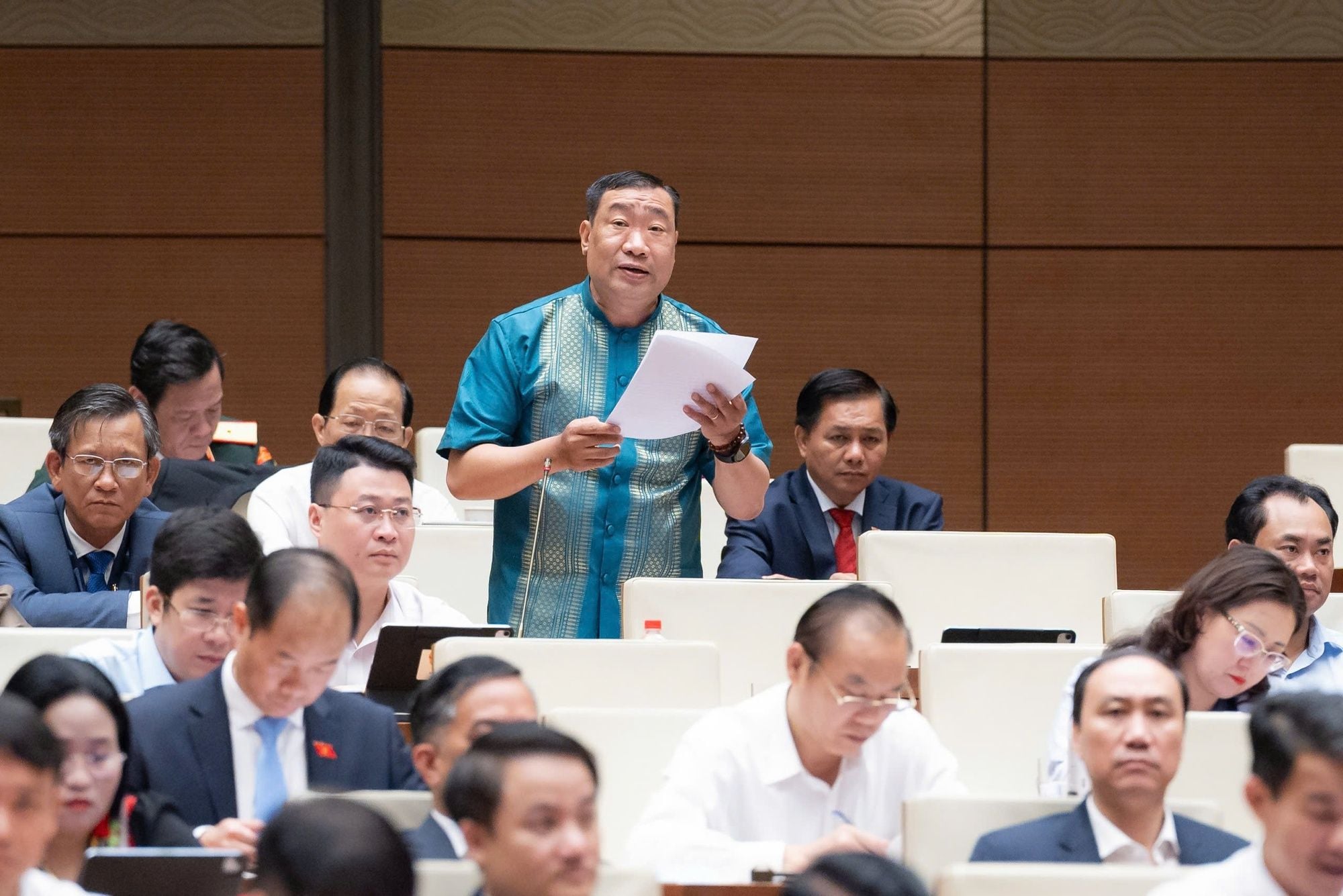
During a debate on the assessment of the 2025 socioeconomic development plan and the state budget for 2026, legislator Thach Phuoc Binh of the Vinh Long provincial delegation proposed a salary reform aimed at improving living standards for public-sector workers while remaining consistent with the state budget’s capacity and creating incentives for civil servants. He suggested raising the base salary to 2.65–2.70 million VND per month.
Thach Phuoc Binh said raising the base salary is not only a technical adjustment but a factor that directly affects living standards, work motivation, and the quality of civil servants.
In recent years, the State has increased the base salary from 1.49 million to 1.8 million, then to 2.34 million VND per month. The plan is to continue raising it to 2.53 million from July 1, 2026.
The legislator argued that the key issue is not whether to increase wages, but how much to ensure living standards, fit within budget constraints, and stimulate development in the public sector.
Thach Phuoc Binh said the 2.53 million base salary from July 1, 2026 is technically reasonable, but not strong enough to guarantee living standards for most public-sector workers.
He noted that workers cannot live independently on salary alone and often rely on supplementary income, which can reduce motivation and living standards. In his view, the 2.53 million level mainly serves a stabilization objective rather than a living-standard guarantee.
He also cited the regional minimum wage in the private sector as of January 1, 2026: 5.31 million VND in Region I, 4.73 million in Region II, 4.14 million in Region III, and 3.70 million in Region IV, with an average of about 4.47 million VND per month.
Using the commonly observed starting coefficients, Thach Phuoc Binh estimated the impact of the planned base salary. Multiplying 2.53 million by a coefficient of 1.86 yields about 4.706 million VND per month; with a coefficient of 2.10, it yields about 5.313 million VND per month.
He said this means the lowest group barely exceeds the regional minimum wage, while those at a coefficient of 2.10 barely reach the Region I minimum. Given urban living costs, he described the outcome as a “bare survival” level rather than “stable living”.
Based on analyses of income and living costs, Thach Phuoc Binh argued that raising the base salary to 2.65–2.70 million VND per month is more reasonable and feasible at this stage.
He said that at this level, a worker with a starting coefficient of 1.86 could earn about 4.9–5.0 million VND per month, while a worker with a coefficient of 2.10 could earn over 5.5 million VND per month. Compared with the 2.53 million base salary, this would represent an additional 200,000–400,000 VND per month.
According to the deputy, the increase would have a meaningful effect on low-income groups, help narrow the gap with the private sector’s regional minimum wage, and reduce pressure on essential living expenses.
Thach Phuoc Binh said the 2.65–2.70 million base salary range would improve life quality. While it does not fully guarantee “living on salary” in major urban areas, he said it would still be significant by reducing reliance on other income, providing a clearer sense of income improvement rather than only nominal increases, and helping stabilize psychology and enhance work motivation.
On budget balance, the legislator said the 2.65–2.70 million range would not create excessive pressure on the state budget if implemented alongside measures such as downsizing civil servants, reallocating public spending, and cutting inefficient expenditures. He emphasized the need to balance affordability with living standards.
On wages and pay structure at commune level, Siu Huong (Gia Lai) said that under the two-tier local government arrangement, communes currently take on a large workload from districts and partially receive duties previously handled by the province, while still performing core functions.
She noted that it is projected the base salary will rise by about 8% from July 1, 2026, but in the long run, given current commune realities, she recommended reviewing wage policy to reflect the status of communes.
Siu Huong also called for an objective and comprehensive assessment of how the two-tier local governance model operates after one year of implementation, focusing on internal organization, human resources, and the degree of decentralization, to develop appropriate and effective solutions.
Source: PV, Government Newspaper.








Premium gym chains are entering a “golden era” that is ending or already in decline, as rising operating costs collide with shifting consumer preferences toward more flexible, community-based ways to exercise. Long-term memberships are shrinking, margins are pressured by higher rents and facility expenses, and competition from smaller, more personalized…