•
•
•
•
•
•
•
•
•
•
•
•
•
•
•
•
•
•
•
•
•
•
•
•
•
•
•
•
•
•
•
•
•


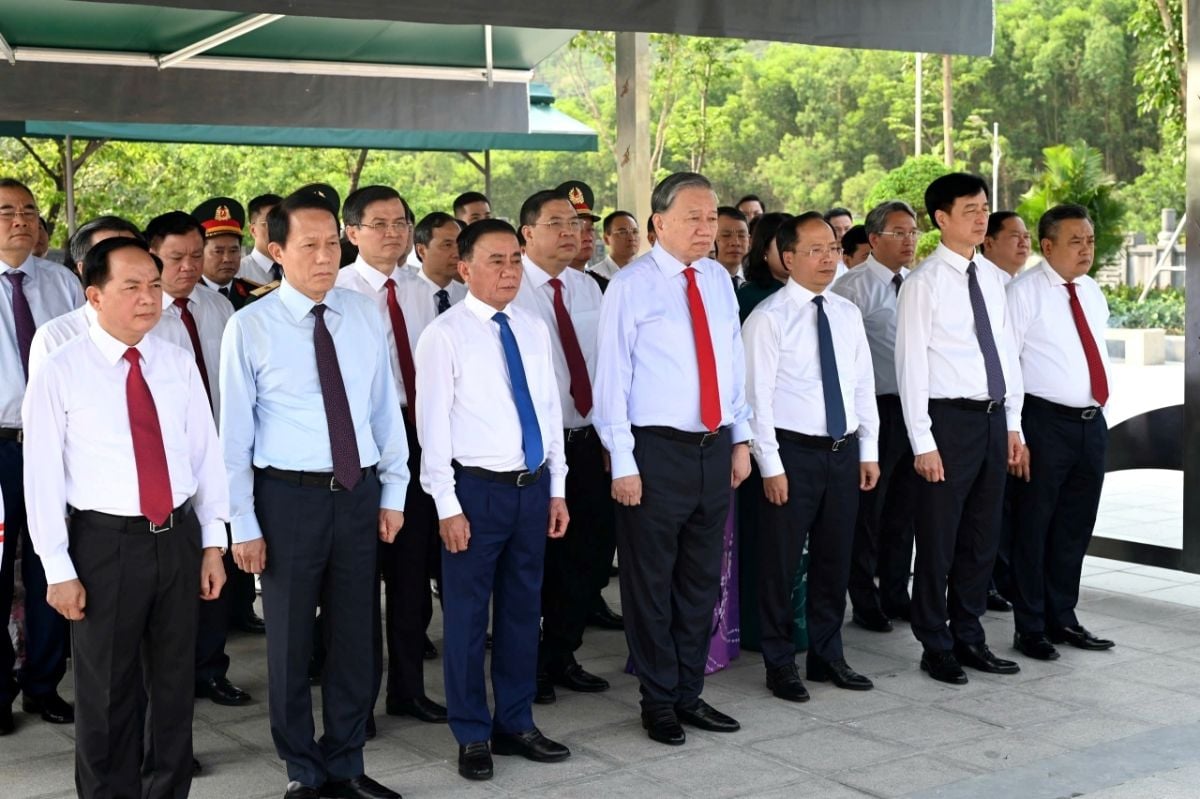
On the morning of April 21 in Ha Tinh, General Secretary and President To Lam, together with a Central delegation, paid tribute and laid flowers at the tomb and memorial site of General Secretary Ha Huy Tap in Cam Hung commune, Ha Tinh, on the occasion of the 120th birth anniversary of comrade Ha Huy Tap (April 24, 1906 – April 24, 2026).
At the tomb of the late General Secretary, To Lam and the delegates offered tributes, laid flowers, and expressed deep reverence and gratitude to a talented Party theorist and steadfast revolutionary fighter who devoted his life to the revolutionary cause.
Subsequently, Ha Tinh Province held a solemn ceremony to mark the 120th birth anniversary of General Secretary Ha Huy Tap, with the attendance of many Party leaders and former leaders of the Party and State, including former General Secretary Nong Duc Manh, former President Truong Tan Sang, former Prime Minister Nguyen Tan Dung, and other former Presidents of the National Assembly.
In his remarks at the ceremony, General Secretary and President To Lam said the event is for the entire Party, people, and armed forces to remember and deeply honor the contributions of comrade Ha Huy Tap to the revolutionary cause of the Party and the nation.
He highlighted Ha Huy Tap’s life and revolutionary career as a noble example of a patriotic intellectual who embraced revolutionary ideals early, demonstrated sharp ideological thinking and an unwavering will, and made lifelong sacrifices for the Fatherland and the People.
From the example of comrade Ha Huy Tap and other revolutionary elders, To Lam called on the entire Party, people, and armed forces to continue increasing responsibility, tirelessly training and learning, and promoting noble revolutionary qualities.
He emphasized urgent tasks including removing bottlenecks in institutions, governance thinking, and implementation; building and perfecting the socialist rule-of-law state; and pushing ahead with administrative reform, decentralization, and empowerment linked with power control, while building a lean and efficient apparatus.
To Lam also called for creating a favorable environment for investment, production, and business; opening up and using all resources effectively; promoting innovation, digital transformation, and green transformation; and improving the quality of the workforce.
In addition, he urged continued strengthening of the Party and the political system, building a clean and robust apparatus, resolutely fighting corruption, waste, and negativity, and overcoming evasion and shirking of responsibility.
For Ha Tinh, described as a homeland with a strong revolutionary tradition and the birthplace of many prominent leaders, To Lam proposed that local authorities promote traditional history and culture and scholarship to create new development momentum.
He said the province should focus on building a cadre with resolve and intellect, and a willingness to think and act; tapping the potential of industry, seaports, logistics, energy, agriculture, and tourism; and paying attention to cultural and educational development, social security, national defense, and security.
He also stressed the reform demand to “look the truth in the eye, assess the truth correctly, speak the truth clearly,” identify bottlenecks for appropriate solutions, and avoid letting old thinking hinder development.
With a 35-year life and 16 years of revolutionary activity, and nearly two years in the position of General Secretary, comrade Ha Huy Tap made major contributions to the revolutionary cause—helping strengthen and develop the Party, completing the Party’s revolutionary path to fit reality, and laying the foundation for the scientific study of Party history.
Comrade Ha Huy Tap was born into a scholarly family in Kim Nac village, Cam Hung commune, Ha Tinh province. In 1923, he graduated with excellence, worked as a teacher in Nha Trang and then Nghe An, and joined the Phuc Viet Association.
In 1929, he went to Russia to study. In 1933, he operated in China and organized the First Congress of the Indochinese Communist Party. In the period 1936–1938, he returned to the country to serve as General Secretary. In 1938, he was arrested by the enemy and executed in 1941. His body was brought back and buried in Cam Hung, Ha Tinh.
Before his death, under enemy gunfire, he said: “I have nothing to regret; if I live I will continue to operate.” This remark is engraved on his tomb.
Finally, on behalf of the Party organization and the people of Ha Tinh, Nguyen Duy Lam, Secretary of Ha Tinh Province, affirmed that the province will thoroughly absorb all directives, continue to promote unity and self-reliance, and strive to achieve development goals in the new stage.





Premium gym chains are entering a “golden era” that is ending or already in decline, as rising operating costs collide with shifting consumer preferences toward more flexible, community-based ways to exercise. Long-term memberships are shrinking, margins are pressured by higher rents and facility expenses, and competition from smaller, more personalized…




