•
•
•
•
•
•
•
•
•
•
•
•
•
•
•
•
•
•
•
•
•
•
•
•
•
•
•
•
•
•
•
•
•


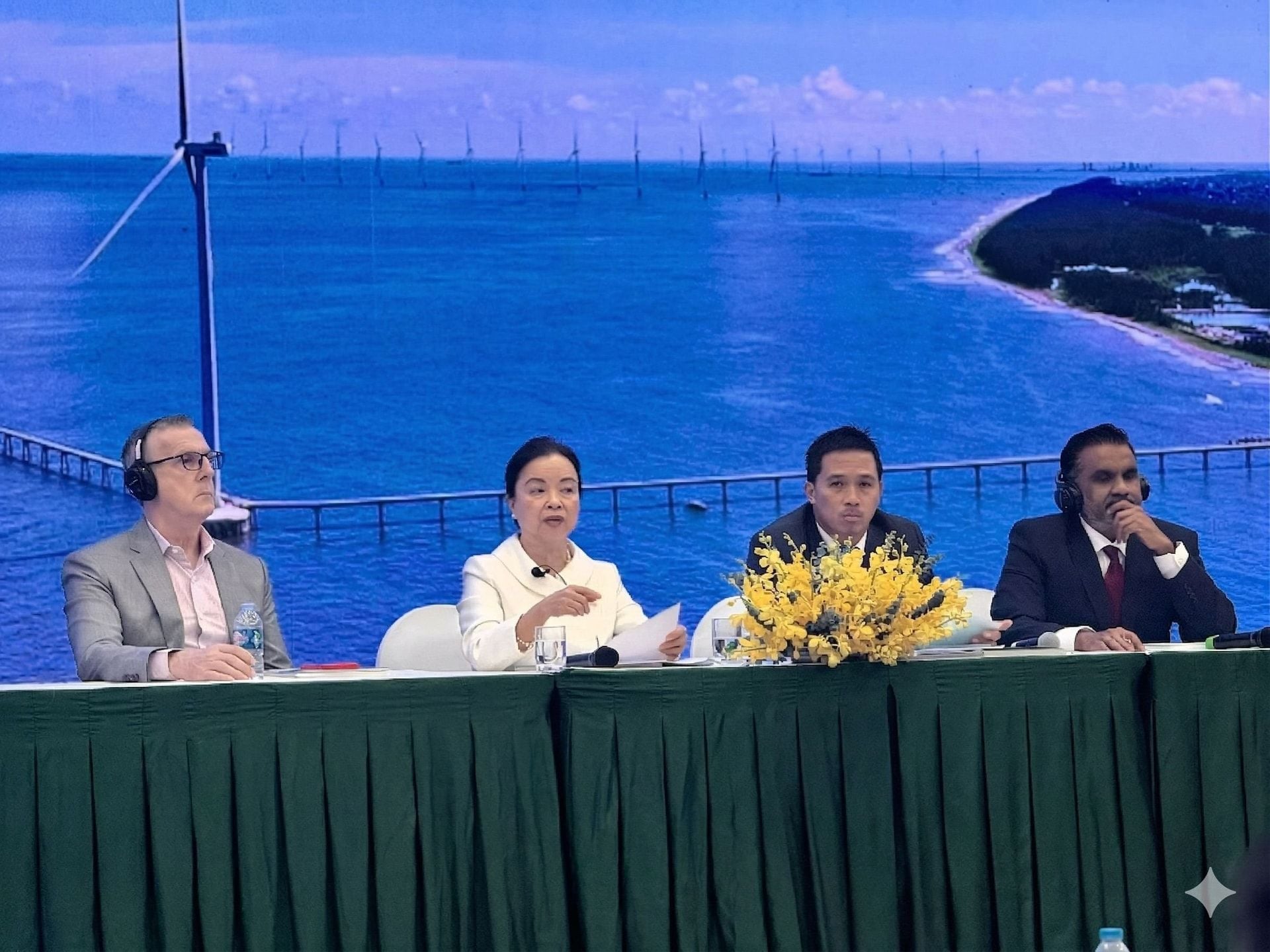
At its annual meeting, REE leadership said the company’s power generation planning is shifting as LNG-fired gas projects face gas supply and turbine availability constraints. REE now expects to reach only 3-4 GW by 2030, compared with an earlier 20 GW target.
In a broader transition where coal-fired plants are gradually being replaced by nuclear and renewables, REE said it is intensifying focus on wind and rooftop solar. The company aims to raise total clean-energy capacity from the current 1 GW to 3 GW by 2030, equivalent to adding about 500 MW per year from 2027 to 2030.
REE said it already holds licenses for 328 MW of wind and is implementing 700 MW of solar.
Chairwoman Nguyen Thi Mai Thanh highlighted currency risk as a major challenge for offshore wind mega-projects, citing a capex ceiling of $3 billion per GW. She noted that borrowing in foreign currency while revenues are in VND, with the VNĐ depreciating by about 5% per year, creates significant financial pressure.
With the regulator committed to purchasing only 85% of output, REE urged the government to consider measures including: offtake for 100% of output; 60% of payments in foreign currency; transmission infrastructure guarantees; and standardization of PPAs to international standards.
Alongside new renewables, REE said it is optimizing its existing portfolio. It cited hydropower Thac Ba, noting low water consumption per kWh supported by favorable ecology. For the VSH (Vietnam-South) cluster, REE said it aims to keep profitability flat by reducing debt amid weaker hydrology.
REE also pointed to growth opportunities from water infrastructure, M&E, and real estate.
The group said it maintains 30-40% ownership in the Da River Water Plant (600,000 m3/day) and the Southern cluster (300,000 m3/day). It noted that retail tariffs have not been adjusted for three years, and said it is coordinating tariff reforms while preparing to bid expansion of Thu Duc 3 in 2028. A waste-to-energy project expected to operate in 2027-2028 was also described as a long-term driver.
In real estate, REE said it is focusing on asset optimization to raise office occupancy from 90% (with 30,000 m2 vacant) to 97-98%.
In electrical and mechanical (M&E), REE said it signed contracts exceeding VND 1 trillion for data-center infrastructure. It also said it is exploring joint-bid opportunities for LNG projects and large-scale real estate projects.
At the close of the AGM, shareholders approved the 2026 financial plan, including record revenue of VND 12,230 billion and after-tax profit of VND 2,814 billion. Shareholders also approved the 2025 dividend at 25%, comprising 10% cash and 15% stock.
Mark Andrew Hutchinson, an IN board member, said REE’s “more than 30 years of credibility” will help the company mobilize capital to triple its scale. He emphasized fixed clean-energy pricing in PPAs as a long-term risk hedge.
To prepare for the next phase, the AGM reconstituted the board to seven members. Nirukt Narain Sapru and Lee Liang Whye from Jardine were elected to replace exiting directors, and Nguyen Thi Mai Thanh will continue as chair.
Premium gym chains are entering a “golden era” that is ending or already in decline, as rising operating costs collide with shifting consumer preferences toward more flexible, community-based ways to exercise. Long-term memberships are shrinking, margins are pressured by higher rents and facility expenses, and competition from smaller, more personalized…