•
•
•
•
•
•
•
•
•
•
•
•
•
•
•
•
•
•
•
•
•
•
•
•
•
•
•
•
•
•
•
•
•


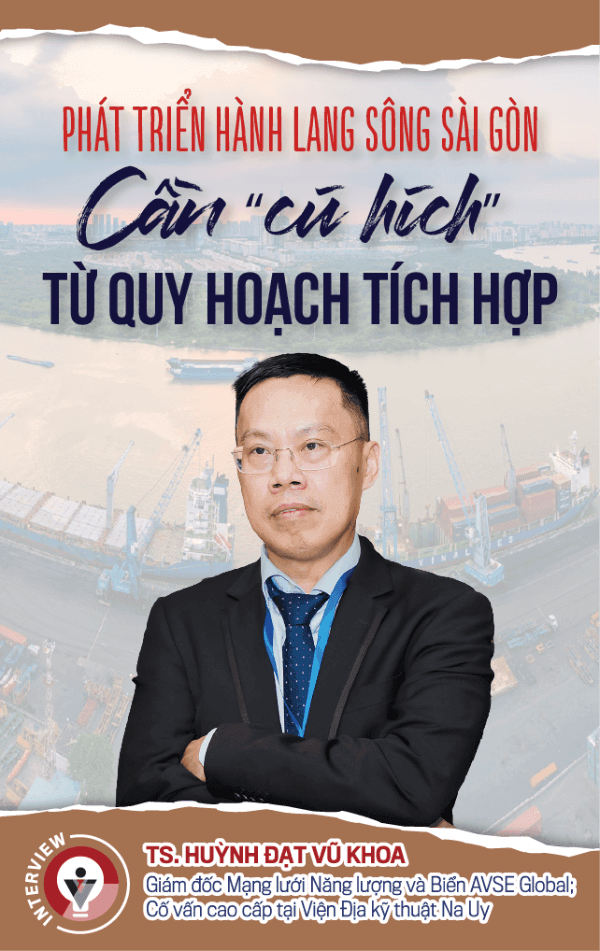
To make the Saigon River truly the backbone of Ho Chi Minh City rather than merely a waterfront landscape, planning for the Saigon River corridor needs to be anchored in a long-term vision, integrated into the city’s overall development framework, and supported by governance mechanisms that can coordinate across jurisdictions as the urban area expands toward a multi-centered model.
The corridor planning should be guided by a coherent, long-term vision backed by institutional measures. Strategic reports from the Paris Region Planning Institute and a global Vietnamese science and expertise organization frame the Saigon River corridor as a pathway of opportunity under the “OPPORTUNITY” framework, covering the city’s 80 km from upstream Cu Chi to downstream Can Gio.
Within the “C-Ơ-H-Ộ-I” interpretation, the approach is organized into five strategic pillars: Connection, Opulence, Happiness, Openness, and Innovation.
On the river axis, Ho Chi Minh City can leverage four key opportunity clusters: economic-technology innovation; business connectivity and regional center positioning; improving quality of life; and developing riverine tourism and culture. The river is described as a rare space capable of realizing these opportunities as the physical backbone.
Data cited in the article highlight the importance of directing planning appropriately. Ho Chi Minh City currently contributes about 22% of the country’s GDP, while flood-related economic losses are around USD 1.3 billion per year and are projected to rise to USD 8.7 billion—equivalent to 3% of GRDP by 2050 if planning interventions are not properly directed. In this context, the article characterizes sustainable river corridor planning as “economic strategic insurance.”
The river corridor must be integrated into the overall planning framework, particularly as Ho Chi Minh City develops into a mega-city after integration. The corridor cannot function as a standalone project; it should serve as a through-line for decisions on transport, housing, industry, and green infrastructure.
In shaping urban identity, the Saigon River should be positioned at the center of strategic consideration. When planned at the right scale, the river is described as not only infrastructure but also a defining element of the mega-city.
The article notes that Resolution 98/2023/QH15 provides a legal basis for the city to actively develop river space toward 2060. It also cites Decision 1528/QĐ-TTg, which designates Ho Chi Minh City as a center of trade, finance, and logistics, with the Saigon River as a key connecting axis.
Because the Saigon River links multiple regions, the article calls for a multi-tier governance model capable of cross-provincial coordination. Upstream, the river connects to Bình Dương, Tây Ninh, and Bình Phước; downstream, it connects to the Cai Mép – Thị Vải port system.
A regional water resources management board could be established—similar to Water Authorities in the Netherlands or Basin Committees in France—to ensure long-term coherence that no single local administration can replace.
The article asks what the biggest challenge is in turning the planning orientations into concrete, coordinated on-ground projects. While strategic direction is clear, implementation faces constraints dominated by four groups.
Holocene soft soil accounts for about 63% of the city area, with thickness ranging from 2–16 m in the center and exceeding 30 m in the southern area. Ground monitoring shows subsidence rates of 2–5 cm/year from 2006–2020, with some highly urbanized areas reaching 7–8 cm/year.
Ho Chi Minh City is described as among the world’s top ten fastest-sinking cities, alongside Shanghai, Jakarta, and Bangkok. As a result, riverfront projects must account for long-term deformation and interactions with groundwater, requiring deep geotechnical surveys and specialized design solutions rather than off-the-shelf approaches.
Along more than 106 km of river within the city, 73% of the mid-reaches’ banks are hardened, while downstream banks are around 48%. Ownership and use rights are intertwined among ports, industry, housing, and agriculture, complicating unified spatial planning.
The article cites Bangkok’s experience with the Chao Phraya River, where many riverfront projects are notable but lack integrated planning. In that case, banks are severed by private fences and public space is not continuous. Continuous physical connectivity along both banks is presented as a prerequisite.
With an 80 km corridor, the article states that public funds alone cannot meet all investment needs. It therefore calls for a mixed financing structure, including land concessions around Thanh Da Park (300 ha), developing a Transit-Oriented Development model around river-adjacent metro stations, and flexible PPPs by sub-areas.
Experiences from Copenhagen and Bordeaux are cited to support the view that, with a clear legal framework and a stable long-term vision, the private sector is willing to invest heavily in waterfront areas previously neglected.
From these experiences, the article lists three principles: classify river segments by function before designing bridges; ensure minimum clearance heights along the corridor before approving new projects; and standardize clearance norms across the entire corridor. It also notes prioritizing underground infrastructure for road traffic in central zones.
The article emphasizes an international lesson that successful river-restoration projects do not pit economy against ecology, but instead treat ecology as the foundation for generating economic value. It cites UNEP data that mangrove forests can create ecosystem value of USD 33,000–57,000 per hectare per year. With the Can Gio mangrove forest near 72,000 hectares, the article highlights significant potential for carbon credits and long-term value.
International experience is presented as showing the approach’s effectiveness. In Cheonggyecheon (Seoul), stream restoration is described as increasing land value, improving the environment, and mobilizing significant investment. In the Netherlands’ Room for the River program, the approach is described as opening space for rivers instead of hard control, reducing flood risk and enhancing urban quality.
The article also notes that such models come with warnings. Singapore’s River cleanup is described as involving high costs and requiring synchronous environmental preparation before riverfront development. It also cites Jakarta, where land subsidence is linked to groundwater extraction and extensive concrete development, forcing the city to consider relocation.
Across these lessons, the article concludes that success does not come from short-term decisions but from a long-term, consistent vision across multiple development phases—an approach it identifies as the key requirement for Ho Chi Minh City in exploiting and reviving the Saigon River’s space.



Premium gym chains are entering a “golden era” that is ending or already in decline, as rising operating costs collide with shifting consumer preferences toward more flexible, community-based ways to exercise. Long-term memberships are shrinking, margins are pressured by higher rents and facility expenses, and competition from smaller, more personalized…



