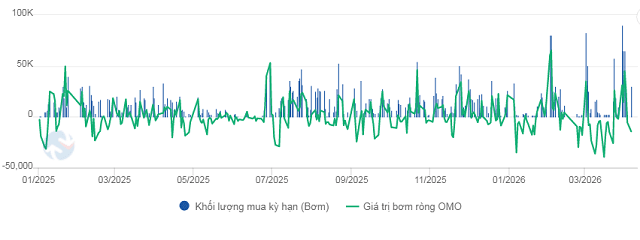
During the week of March 30 to April 6, interbank rates moved sharply, particularly at short tenors toward the end of Q1. In response, the State Bank of Vietnam (SBV) actively intervened to support liquidity through the Open Market Operations (OMO) channel to stabilize the system.
Liquidity injections via OMO over the past year show that SBV injected 286.151 trillion dong into the system with tenors of 7–56 days at an interest rate of 4.5%. At the same time, the amount maturing on lending backed by securities reached 190.385 trillion dong.
In the session on March 30, the bid value in OMO reached 90.000 trillion dong, the highest in a single session to date.
For the week as a whole, SBV net injected 95.766 trillion dong, lifting the outstanding OMO in circulation to 301.405 trillion dong.
On the international front, the USD Index (DXY) closed at 99.81 points on April 3, down 0.17 from the previous week. Although it rose to 100.3 earlier in the week, the index weakened and slipped below 100 by week’s end.
The decline in DXY largely reflected a softening of the USD against the JPY. This occurred in the context of Japan raising the yield on 10-year government bonds issued that month to 2.4%—the highest in almost 30 years—raising expectations that the Bank of Japan would tighten policy soon. This supported the JPY and reduced the relative appeal of the USD.
Domestically, the USD/VND exchange rate in banks remained near the ceiling. By the end of the week of April 3, Vietcombank quoted the rate at 26,112–26,362 dong per USD (buy/sell), up 7 dong from the prior week.