•
•
•
•
•
•
•
•
•
•
•
•
•
•
•
•
•
•
•
•
•
•
•
•
•
•
•
•
•
•
•
•
•


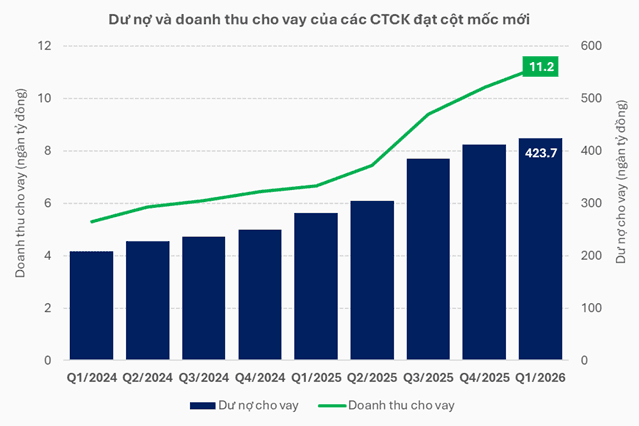
Ending Q1 2026, lending by Vietnam’s securities firms reached a new milestone, with the outstanding amount at about 423.7 trillion dong. In a period of rising interest rates, revenue from margin lending continued to grow strongly, totaling over 11.2 trillion dong, while both margin debt and lending revenue hit new highs.
According to VietstockFinance, total outstanding loans of securities firms at the end of Q1 2026 were nearly 423.7 trillion dong, setting a new historical high for Vietnam’s stock market. However, the growth pace has slowed in recent quarters, increasing only 3% versus end-2025.
Tran Duc Anh, Macro Economy & Market Strategy Director at KBSV, said market volatility boosted liquidity and created opportunities for margin debt to continue rising.
In Q1, the market fluctuated: it peaked at the start of the year as state-owned enterprise stocks benefited from Resolution 79, then adjusted amid Middle East tensions. More recently, signals of recovery emerged following news that some banks reduced lending rates and expectations of a ceasefire between the US and Iran. These developments supported short-term trading activity and helped liquidity rebound after a decline in Q4-2025.
The demand for margin lending remained high, particularly after sessions with significant corrections and when stocks moved into attractive valuation zones, contributing to margin debt reaching a record level.
Data show that total revenue from loans and receivables for the securities industry exceeded 11.2 trillion dong in Q1 2026, up 8% from Q4 2025. While the increase was larger than the size of the lending expansion, the pace slowed compared with previous quarters.
At VPBankS’s 2026 AGM on April 20, CEO Nhâm Hà Hải said the company remains focused on achieving an outstanding margin loan balance of 50 trillion dong by year-end. The CEO noted that the successful mobilization of nearly 13 trillion dong of equity at end-2025 provided funding headroom with competitive lending rates. Looking ahead, VPBankS leadership expects liquidity conditions and margin demand to remain high.






Premium gym chains are entering a “golden era” that is ending or already in decline, as rising operating costs collide with shifting consumer preferences toward more flexible, community-based ways to exercise. Long-term memberships are shrinking, margins are pressured by higher rents and facility expenses, and competition from smaller, more personalized…




