•
•
•
•
•
•
•
•
•
•
•
•
•
•
•
•
•
•
•
•
•
•
•
•
•
•
•
•
•
•
•
•
•



The VN-Index rose solidly today, but overall equity trading remained lackluster, with gains concentrated in a small group of leading stocks. Derivatives outperformed as a leadership-led rebound triggered a wave of short-covering, helping narrow and then reverse the earlier discount.
Both the cash and derivatives markets were weak in the morning. The F1 basis discount averaged around 10 points, while VN30 and VNI showed downward momentum. Among the two VN30 leaders mentioned, VHM fell sharply in line with the indices, while VIC fluctuated weakly. Both stocks, however, surged in the afternoon.
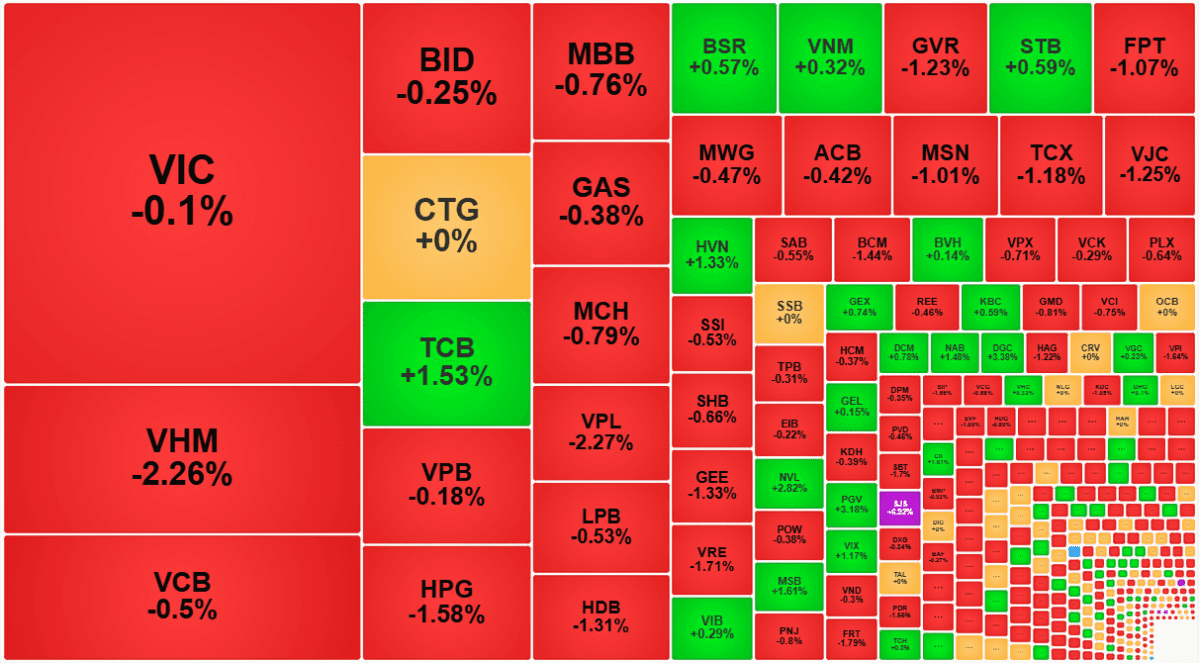
The afternoon rebound in VIC and VHM was attributed in part to information from the shareholders’ meeting, but the stronger effect was described as being driven by large capital inflows. VIC hit the limit up, while VHM rose 3.09%, contributing more to the index than the combined gains of the VNI and VN30. Despite the index impact, the breadth of stock price gains remained muted.
Liquidity recovery was limited. Statistics cited show that only 35% of VNI stocks with liquidity recovered by at least 1% from their lows, and fewer than half of those managed to surpass the reference level. The number of strong gainers was even smaller. When liquidity is included, fewer than 20 stocks were said to have reliably sizable trading volume.
The up/down ratio for the VNI was 0.57/1, a relationship that did not support the VN-Index’s 1.3% rise. The article also noted that the total traded value on both exchanges reached nearly 18.3 trillion dong (excluding settlements), slightly higher than just before the ceasefire pause was first announced.
Before today’s session, the market received news that President Donald Trump extended the ceasefire by two weeks. The article said this was positive because hostilities did not flare up again, but it also emphasized that the negotiation process remains unclear, with the two sides not meeting and issuing opposing demands.
Against this uncertainty, global stock markets reacted cautiously, with mostly narrow gains and losses, while oil prices rose. The piece compared this backdrop with the April 8 session.
On derivatives, the wide discount in the morning was described as reasonable given concerns about the leading stocks. VHM had declined sharply earlier, and the widest basis reached -12 points, with the average morning down-leg around -10 points. VN30 fell to the lowest levels cited as crossing 1997.xx, while F1 fell below 1982.xx.
In the afternoon, the situation shifted quickly. Even though the derivatives reaction initially lagged the underlying market, VIC and VHM were lifted strongly and decisively. When VN30 recovered above 1997.xx, the basis was still near a 10-point discount. The article described this as a moment to go long with a stop-loss if VN30 fell back below 1997. Five minutes later, the basis inverted to below -2 points, and a large amount of long positions appeared alongside the momentum in the leadership stocks.
The delayed basis signal was described as surprising, suggesting long positions may not have entered before the leaders were pushed up. The basis stayed tight for a period before confirming continued long exposure. Around 2 pm, a short-covering wave reversed the basis, and in the final 20 minutes a sharp drawdown phase caused the basis to swing as much as 13 points. The close left the basis at +15 points.
The article suggested the apparent divergence in the basis was driven more by short-covering than by new long positions, noting that betting on leadership was considered relatively risky. It also stated there was no special supporting information about the leadership and that the gap was likely to be corrected soon.
VN30 closed today at 2025.41. The nearest resistance levels for tomorrow were listed as 2027; 2041; 2050; 2063; 2073; 2080; 2091; 2103. Supports were listed as 2014; 1997; 1983; 1973; 1960; 1951.
The article concluded that investors should not place heavy bets on the underlying market at this time, emphasizing patience in an unsettled environment, and noting that index-based technical analysis had become less effective.
Premium gym chains are entering a “golden era” that is ending or already in decline, as rising operating costs collide with shifting consumer preferences toward more flexible, community-based ways to exercise. Long-term memberships are shrinking, margins are pressured by higher rents and facility expenses, and competition from smaller, more personalized…