•
•
•
•
•
•
•
•
•
•
•
•
•
•
•
•
•
•
•
•
•
•
•
•
•
•
•
•
•
•
•
•
•


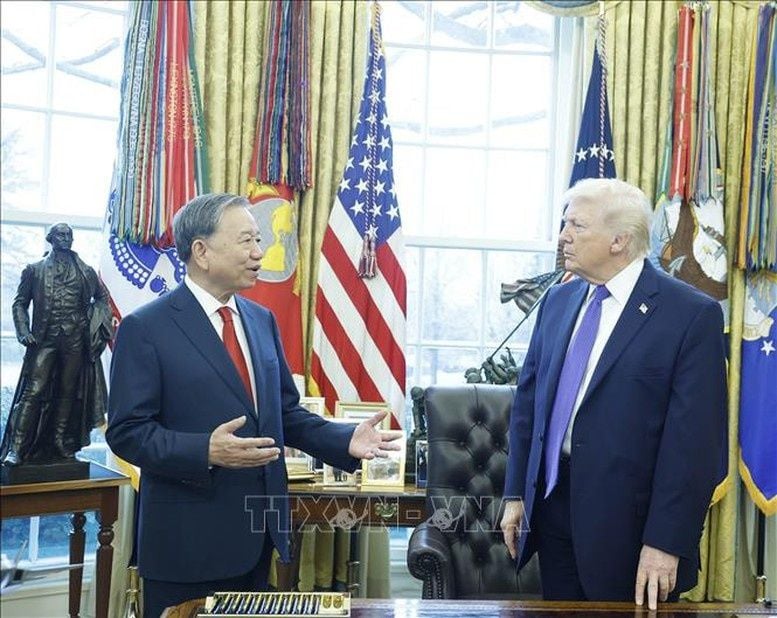
On February 20, during a meeting at the White House between General Secretary Tô Lâm and U.S. President Donald Trump, Trump said he would direct relevant agencies to move Vietnam off the strategic export controls list (D1–D3). The list restricts purchases of advanced technology from American companies.
Experts said removing Washington’s export controls could help Vietnam move beyond chip assembly and packaging toward actual chip production, strengthening its position as a semiconductor partner for the United States.
Diplomatically, the potential removal would be a major win for Vietnam and would support Hanoi’s long-term diplomatic strategy despite ongoing challenges. Vietnam appears to be the first country to secure such an agreement with President Trump after last year’s retaliatory tariffs. While tariffs remain complicated by a Supreme Court ruling, the possible shift away from the symbolic export-control list would still carry substantial significance.
Trump’s characterization of Vietnam as a “strong, independent, self-reliant and prosperous” country also aligns with Hanoi’s approach of positioning itself as a trusted partner to many nations while avoiding entanglement in intensifying geostrategic competition among major powers.
Economically, lifting the restrictions would remove a major structural barrier to Vietnam’s efforts to climb the semiconductor value chain. It would also improve access to high-end tools and software that have previously been unavailable, strengthening industrial capability and expanding Vietnam’s strategic options for semiconductor investment and technology transfer.
With Vietnam’s geographic advantages, European and Asian partners could view it as an alternative route for exporting sensitive technologies, potentially increasing its role as an intermediary in semiconductor supply chains.
Before the announcement, U.S.–Vietnam semiconductor cooperation had been moving steadily. Examples cited include Qualcomm opening a research center in Vietnam in June 2025, Amkor investing $1.6 billion in an advanced packaging facility in Bắc Ninh Province, and Intel expanding assembly and testing using increasingly sophisticated technologies. These developments were described as evidence of progress following the bilateral relationship upgrade during President Biden’s visit.
If export controls are formally lifted, the cooperation could accelerate by reducing regulatory uncertainty for private companies that have been cautious about further capital investments. Removing these barriers, experts said, could “unlock” additional investment, deepen technology cooperation, and strengthen Vietnam’s role in the global semiconductor supply chain.
According to Dr. Nicholas Chapman, a Special Appointee Professor at Tohoku University, Vietnam’s main challenge in making a meaningful global impact is its talent pool. Globally, estimates point to a shortage of up to one million semiconductor engineers. Vietnam currently has about 7,000 engineers, with a target of reaching 50,000 by 2030. Training an engineer to standard can take 4–8 years, creating a major constraint.
Dr. Chapman said Vietnam has laid groundwork, noting that about 30% of university students study STEM. He also pointed to international training partnerships, including collaboration between Korea’s Gachon University and FPT, which allows students to study domestically and abroad while gaining practical experience at leading companies such as Samsung and SK Hynix.
However, he said expanding formal education alone is not sufficient. Vietnam would also need to expand vocational training and provide ongoing professional development to keep pace with rapid technological change. Attracting and retaining global talent would be crucial.
Strategically, Dr. Chapman suggested Vietnam should focus on specific segments of the semiconductor value chain rather than trying to build advanced manufacturing and design capabilities simultaneously. He noted that the current plan to produce 32-nanometer chips, instead of the more advanced 2–3 nanometer nodes, reflects a staged approach.





Premium gym chains are entering a “golden era” that is ending or already in decline, as rising operating costs collide with shifting consumer preferences toward more flexible, community-based ways to exercise. Long-term memberships are shrinking, margins are pressured by higher rents and facility expenses, and competition from smaller, more personalized…




