•
•
•
•
•
•
•
•
•
•
•
•
•
•
•
•
•
•
•
•
•
•
•
•
•
•
•
•
•
•
•
•
•


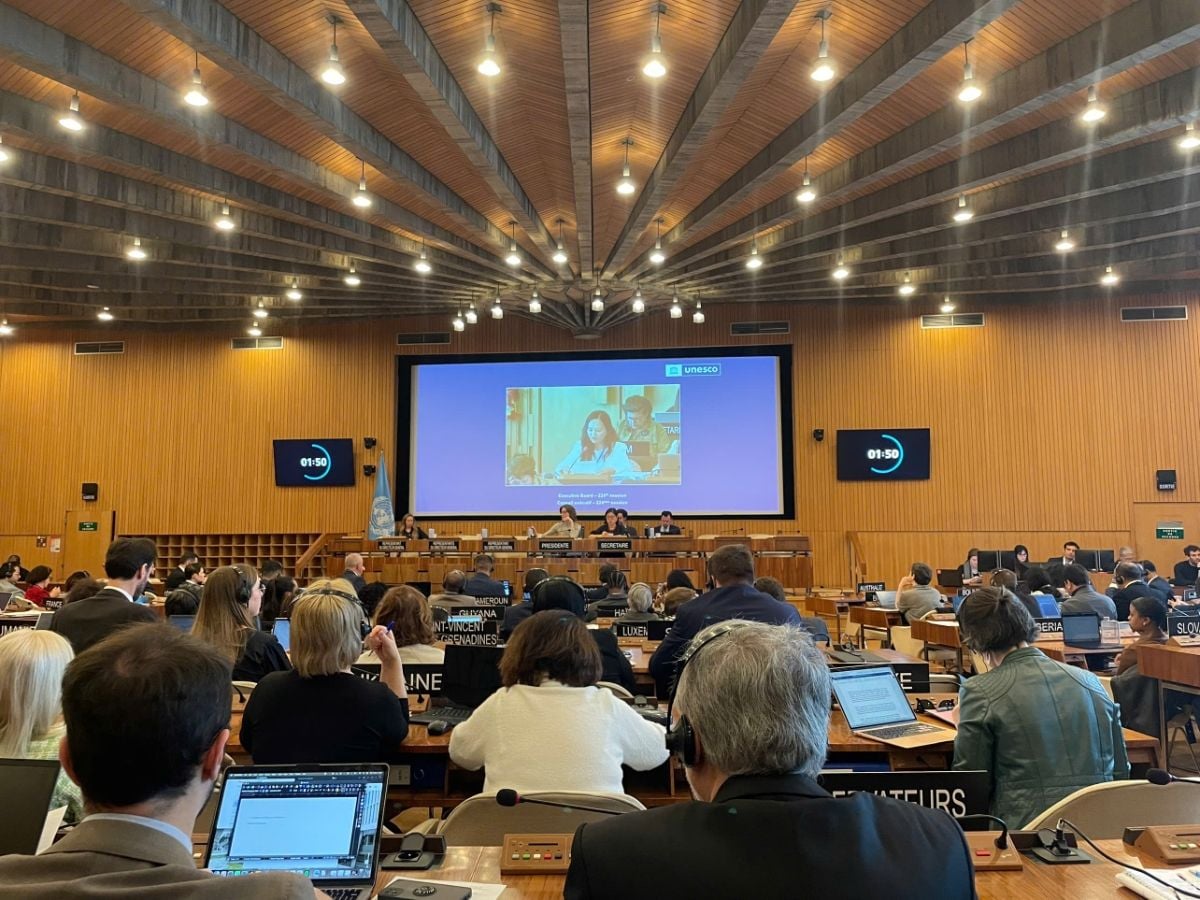
During the 224th session of UNESCO’s Executive Board in Paris, the Executive Board adopted resolutions to extend the Category II status under UNESCO’s patronage for eight more years for Vietnam’s two science centers: the International Center for Research and Training in Mathematics (ICRTM) and the International Center for Physics (ICP), under the Vietnam Academy of Science and Technology.
Professor and Doctor Tran Hong Thai, President of the Vietnam Academy of Science and Technology, said the Academy’s leadership will continue to focus on mathematics and physics, including ensuring staffing for scientists, attracting young talent, and expanding international cooperation by inviting foreign experts to work long-term in Vietnam.
The stated objective is to position ICRTM and ICP as central to Vietnam’s scientific development—supporting not only basic research but also practical applications such as data modeling, weather forecasting, and new technology systems—consistent with the Politburo’s Resolution No. 57-NQ/TW, which calls for science, technology, and innovation as drivers of breakthroughs.
In 2025, the Academy and the two centers worked with UNESCO’s independent evaluators. The assessment results indicated that the legal framework and operating regulations of both centers in Vietnam are well established and operate in line with UNESCO standards.
From 2021 to 2025, the Ministry of Science and Technology, in its capacity as Chair of the Natural Sciences Subcommittee of the Vietnam National Commission for UNESCO, supported and facilitated the centers’ effective operation and ensured compliance with UNESCO agreements.
Between 2020 and 2025, ICRTM reported organizing 15 international schools with more than 500 participants and 35 international faculty. It also hosted 13 international scientific conferences with participation by more than 600 scientists, contributing over 120 internationally indexed publications in the SCIE list.
International experts cited positive progress by the two centers in conducting high-level research, developing scientific human resources, and expanding collaboration networks.
Under the UNESCO Executive Board resolutions, the UNESCO Director-General will sign a bilateral agreement with the Government of Vietnam and a memorandum of understanding with the Vietnam Academy of Science and Technology to continue implementing the centers’ activities in the 2026–2034 period.
Following this, the Ministry of Science and Technology will lead and coordinate with relevant agencies to complete dossiers and submit them to the government for approval and signing of the agreements in accordance with current regulations.
Dr. Phan Thi Ha Duong, Director of ICRTM, said the center has signed agreements with ICTP (Abdus Salam International Centre for Theoretical Physics), TWAS (The World Academy of Sciences for the advancement of science in developing countries), and CIMPA (The International Centre for Pure and Applied Mathematics) to enable scholarly exchanges.
She added that ICRTM plans to invite renowned professors to work long-term (more than two months per year) to develop strong research groups, and to organize six-month thematic semesters each year in coordination with CIMPA to strengthen the research environment and broaden international collaboration.
With the eight-year renewal cycle, Vietnam aims to expand cooperation with international science centers (including ICTP and TWAS), as well as with ASEAN and African countries, with the goal of making ICRTM and ICP leading basic science centers in the region.
The renewal is also linked to Vietnam’s contribution to the United Nations’ International Decade of Science for Sustainable Development (2024–2033), led by UNESCO.
UNESCO Category II centers are specialized facilities established by member states and recognized by UNESCO. They operate in education, science, culture, and information, supported by alignment with UNESCO’s direction and strategy, and undertake research, training, and capacity-building.






Premium gym chains are entering a “golden era” that is ending or already in decline, as rising operating costs collide with shifting consumer preferences toward more flexible, community-based ways to exercise. Long-term memberships are shrinking, margins are pressured by higher rents and facility expenses, and competition from smaller, more personalized…