•
•
•
•
•
•
•
•
•
•
•
•
•
•
•
•
•
•
•
•
•
•
•
•
•
•
•
•
•
•
•
•
•


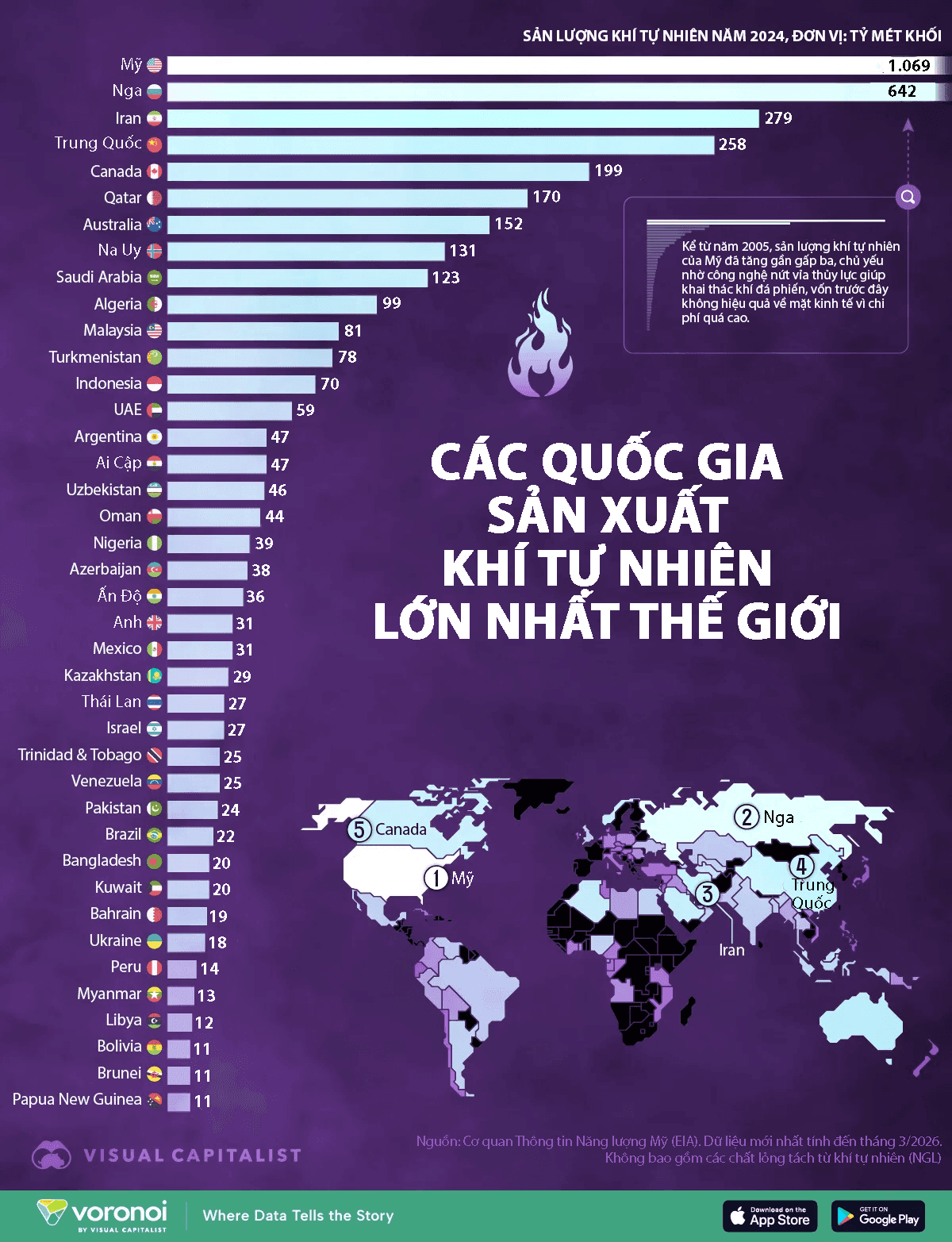
The infographic below ranks the world's largest natural gas producers, showing that global supply is concentrated in a few countries that anchor the energy market. The overwhelming dominance of the United States has become even more pronounced in the context of disruptions in the Middle East that tighten supply and push trade flows toward large, stable suppliers such as the United States. Not only does the U.S. lead, it is far ahead of other countries in production scale. In 2024, the United States produced about 1.069 billion cubic meters (bcm) of natural gas, more than 1.6 times Russia's output and roughly equal to the combined output of Iran and China. No other nation approaches that scale. Even the production gap between the United States and Russia is larger than the total output of most of the remaining top-10 countries. Beyond the top four, the production scale of the remaining countries is much smaller. Canada and Qatar head the next group, followed by several small producers mainly serving regional markets. This indicates that global natural gas supply is currently concentrated in a small number of leading countries. Looking more broadly, these countries form the backbone of the world’s natural gas supply chain, spanning North America, Eurasia, the Middle East, and major LNG export hubs. Since 2005, U.S. natural gas production has almost tripled, driven mainly by hydraulic fracturing technology that enables shale gas extraction, which was previously uneconomical due to high costs. This is one of the main reasons the United States has pulled ahead of other countries and remains central to the LNG market. Meanwhile, recent tensions in the Middle East have disrupted natural gas production infrastructure and energy transportation, especially around the Strait of Hormuz, a strategic chokepoint in the global energy market. As trade flows are disrupted, the global market will rely more on large, stable suppliers. This shift further highlights the United States’ role as the current leader in natural gas production and LNG export capacity. With supply risk expected to persist, countries like the United States will play an increasingly important role in the global natural gas market.






Premium gym chains are entering a “golden era” that is ending or already in decline, as rising operating costs collide with shifting consumer preferences toward more flexible, community-based ways to exercise. Long-term memberships are shrinking, margins are pressured by higher rents and facility expenses, and competition from smaller, more personalized…