•
•
•
•
•
•
•
•
•
•
•
•
•
•
•
•
•
•
•
•
•
•
•
•
•
•
•
•
•
•
•
•
•


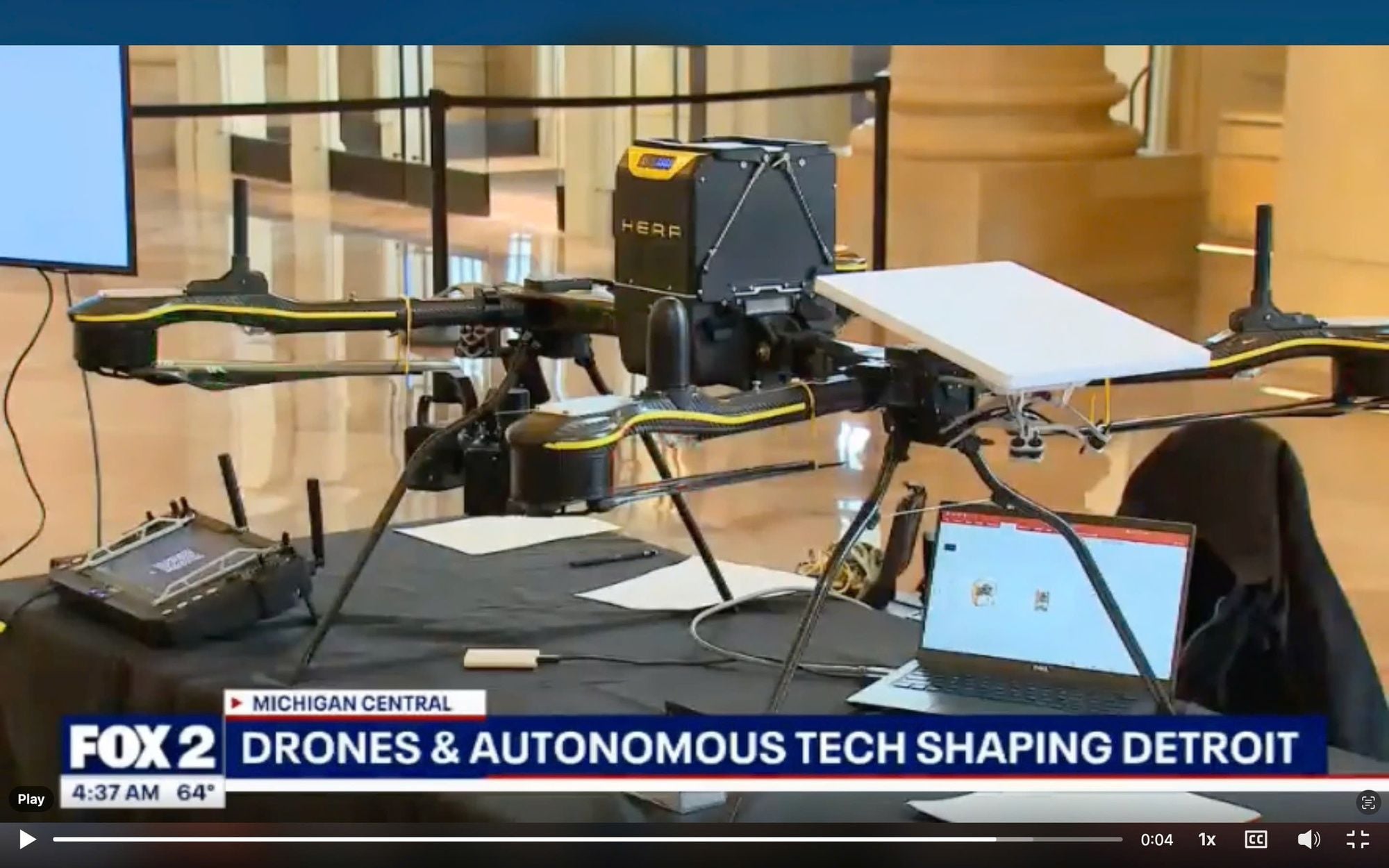
Strong winds forced most aerial demonstrations to be canceled at the Global Drone Expo Xponential 2026 in the United States on April 13. Organizers held a Media Preview to introduce advanced UAV technologies to international press, but all flight demonstrations were called off due to the weather.
Despite the cancellations, Hera’s Vietnamese team proceeded with a flight using a UAV designed to remain stable in harsh conditions. The aircraft had previously operated stably in wind gusts up to level 6 in Alaska, USA. As a result, Hera became the only drone to fly successfully under severe weather conditions, drawing attention from professionals and media at the event.
Hera is a drone designed and manufactured by Vietnamese company Real-time Robotics (RtR). Dr. Le Viet Quoc, founder and CEO of RtR, said the UAV incorporates technologies not yet seen in the global market.
Key features highlighted by RtR include an ultra-compact design that can fit in a backpack while maintaining connectivity and control through the Starlink satellite network. The drone is also equipped with an OmniSight gimbal with expanded imaging and stabilization capability described as twice that of current camera-stabilization technologies on the market.
A central element of Hera’s system is its transmission and control method. Instead of relying on the typical direct transmission range of about 10 km, Hera uses Starlink satellite connectivity to transmit both control signals and imagery from the UAV to the satellite and back to the operator.
This design is intended to remove distance and terrain barriers such as hills, enabling remote operation over a wide area. RtR said the operator in Ho Chi Minh City can receive live imagery and control Hera in real time while it operates in Hanoi.
Dr. Le Viet Quoc noted that some international systems also use Starlink for larger-scale UAVs. Hera’s differentiator is its compact form factor: it can fold up to 14 times, compared with conventional drones that typically fold about 3 times. RtR said this folding capability supports backpack portability, while many Starlink-enabled UAVs available on the market are significantly larger.
Dr. Le Viet Quoc said the drone/UAV is expected to be brought back to Vietnam in May. He added that there are no orders yet because the flight demonstration had just been completed.
He also characterized the test results as evidence that the Vietnam-developed UAV is moving beyond conventional technology paths. “This Drone/UAV is expected to be brought back to Vietnam in May. There are no orders yet as the flight demonstration has just been completed. However, the test results show that the Vietnam-developed drone/UAV is no longer following conventional technology paths and is beginning to chart its own course, potentially ahead of global trends,” Dr. Le Viet Quoc said.







Premium gym chains are entering a “golden era” that is ending or already in decline, as rising operating costs collide with shifting consumer preferences toward more flexible, community-based ways to exercise. Long-term memberships are shrinking, margins are pressured by higher rents and facility expenses, and competition from smaller, more personalized…




