•
•
•
•
•
•
•
•
•
•
•
•
•
•
•
•
•
•
•
•
•
•
•
•
•
•
•
•
•
•
•
•
•


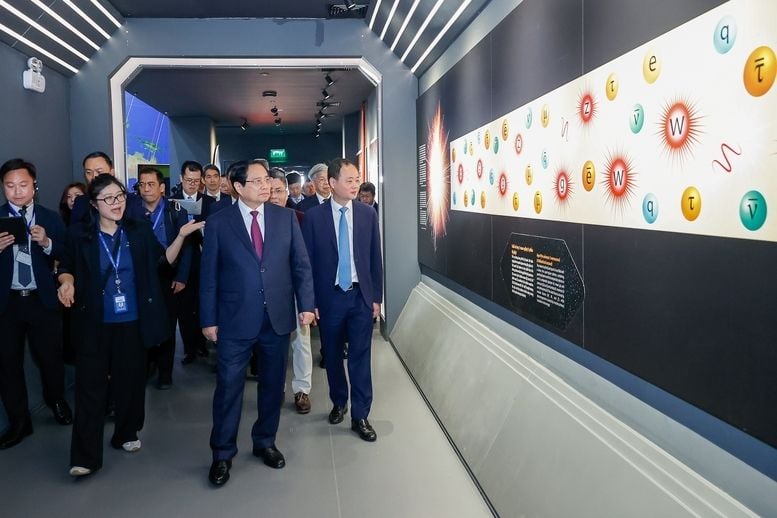
At the opening ceremony of the Vietnam–Japan Space Vision 2026 Forum and the inauguration of the Vietnam Space Center on March 13, Prime Minister Pham Minh Chinh commended and thanked the Government, organizations, and Japanese enterprises for their contributions.
Speaking on Vietnam’s space science and technology development, the Prime Minister noted that in 1980 Vietnam became the first Asian country to send a person into space, with the flight of hero Pham Tuân. In 2006, the Government approved the Strategy for Space Research and Application toward 2020, aiming to develop space technology to support practical, effective modernization and industrialization.
The Prime Minister cited several key achievements. Vietnam launched VINASAT-1 in 2008 and VINASAT-2 in 2012. In 2013, PicoDragon—the first satellite developed by Vietnam—was launched into orbit. In 2019, MicroDragon, co-developed by Vietnam and Japan, was launched to support remote sensing. In 2021, NanoDragon, developed entirely by Vietnam, was successfully launched.
He also highlighted the radar satellite LOTUSat-1, weighing 600 kg, which has completed fabrication and is awaiting launch to operate and exploit its capabilities—presented as evidence of Vietnam’s progress in mastering advanced technology.
The Prime Minister said Vietnam aims to become a country with a mid-to-high level of space science and technology development in Southeast Asia by 2030. After 2030, Vietnam will build national autonomous capacity in satellite technology and apply space data to address global and national security challenges.
In the near future, Vietnam will continue to refine institutions, mechanisms, and policies for space activities in line with national conditions and international practice. The Government will study and prepare the scientific and practical basis to gradually complete the legal framework and move toward enacting Space Law.
Vietnam will mobilize and use all resources for space science and technology development with the spirit of “three has”: government contribution, enterprise contribution, and contributions from institutes, universities, and scientists.
The Prime Minister said Vietnam will focus on strengthening links between institutes, universities, and enterprises; promoting public–private partnerships; and gradually forming a market for satellite data services and an ecosystem of space technology applications in Vietnam.
Vietnam will also create favorable conditions for international organizations, development partners, and domestic and foreign enterprises to support and accompany Vietnam’s space science and technology development under the spirit of “three accelerations” and “three together.”
The “three accelerations” are: accelerate cooperation, share experiences, and policy consultation; accelerate financial and technical support; accelerate training and human resources development.
The “three together” are: listen and understand between enterprises, the State, and the people; share a vision and actions to cooperate and support rapid and sustainable development; together do, share, win, enjoy, develop, and share pride and happiness.
The Vietnam Space Center is described as a modern infrastructure complex with scale and technology among the leading in Southeast Asia, with total investment of over 7,000 billion VND on an area of 9 hectares.
The project includes: Operations Center; Center for Exploitation and Application of Satellite Data; Center for Satellite Research and Development; a Ground Segment with a 9.3 m diameter antenna; Center for Human Resource Development and Technology Transfer at 18 Hoang Quoc Viet; Space Museum; Multimedia Center; International Guest House; and the Nha Trang Observatory. These components have been completed and put into use, forming a foundation for satellite operation, data reception–processing, application development, and training.
The project has two main objectives. First, to build infrastructure to receive technology transfer for earth-observation satellites, including training personnel and manufacturing, and launching LOTUSat-1. Second, to enhance disaster risk reduction, climate change response, resource management, and environmental monitoring through remote sensing data to support socio-economic development and national security.



Premium gym chains are entering a “golden era” that is ending or already in decline, as rising operating costs collide with shifting consumer preferences toward more flexible, community-based ways to exercise. Long-term memberships are shrinking, margins are pressured by higher rents and facility expenses, and competition from smaller, more personalized…


