•
•
•
•
•
•
•
•
•
•
•
•
•
•
•
•
•
•
•
•
•
•
•
•
•
•
•
•
•
•
•
•
•


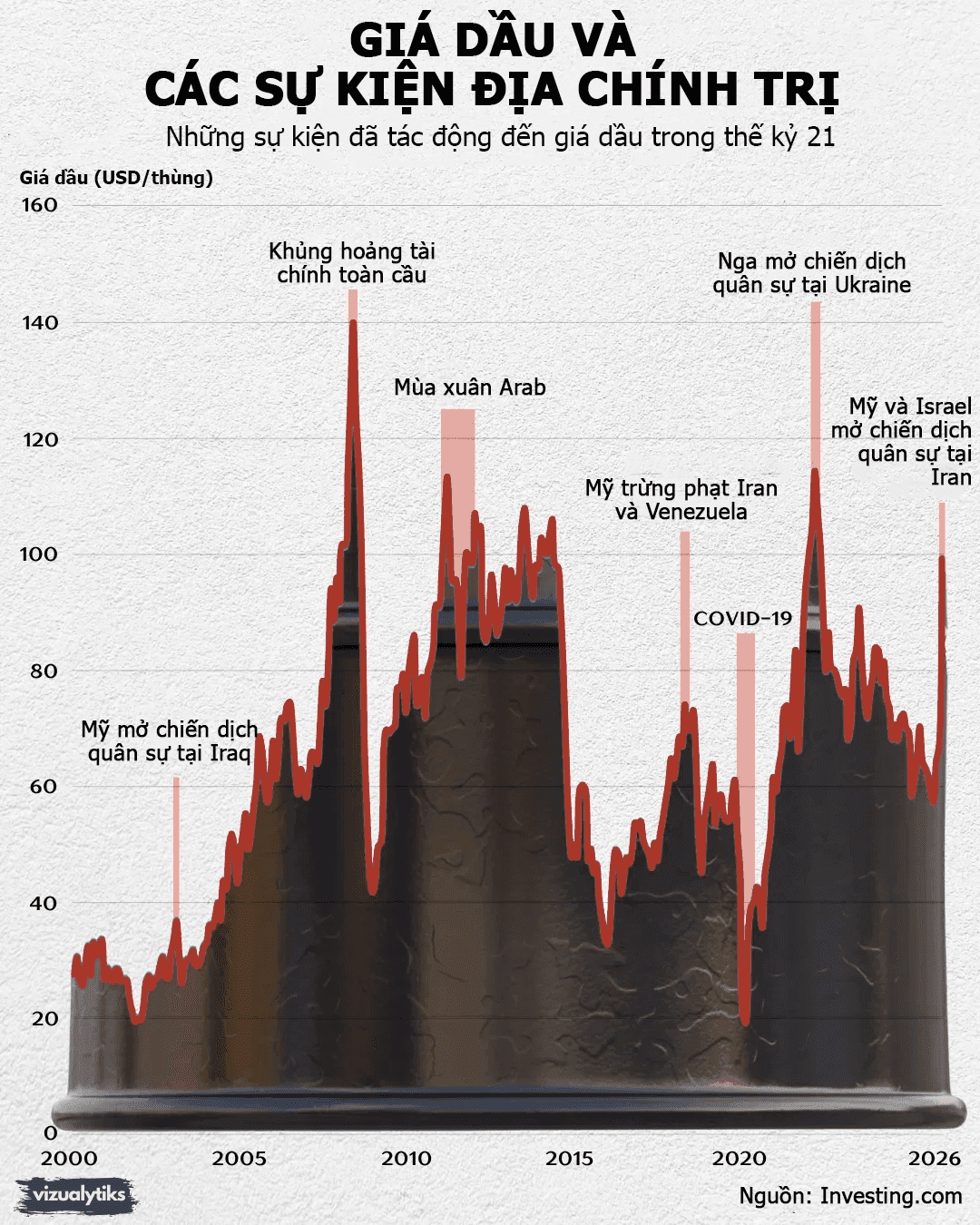
The prolonged tensions around the Hormuz Strait and the lack of a breakthrough in recent US–Iran negotiations highlight a key risk for energy-importing countries: not only oil price volatility, but the ability to secure supply during crises. For Vietnam, this calls for shifting from a “buy cheap” mindset to a “buy secure” approach.
In this environment, the risk is not limited to higher oil prices. Economic damage can also arise when supply becomes difficult to access during market stress. That can raise shipping insurance costs, freight rates, and delivery times, and can force firms to hold more inventory. Trade financing can also tighten: banks become more cautious, increasing capital costs. As a result, energy can become more expensive even if supply is not sharply cut.
When Hormuz is mentioned, markets often focus first on Brent prices. If prices do not spike, some assume the risk is distant. However, the impact can still be significant even without an absolute oil shortage.
As regional spillover risk grows, many countries have called for renewed negotiations. For Vietnam, the direct exposure is clear: domestic fuel prices depend on international markets, and logistics costs for import-export-driven firms are sensitive to energy prices. Industries including plastics, steel, chemicals, textiles, seafood, and construction materials are affected through both energy costs and freight.
Because Vietnam is a highly open economy with rising energy demand and ongoing industrialization, the central question is not only how much Vietnam pays for oil, but whether it can access stable supply when markets tighten.
In stable periods, securing cheaper supplies can provide a competitive edge. During crises, however, the ability to secure goods at the right time often matters more than the initial purchase price. This represents a shift from price optimization to security optimization.
In the Hormuz shock context, the resilience strategy described in the article centers on:
Strategic reserves, storage, and port infrastructure are presented as determining factors for resilience. A key lesson from recent shocks is that countries with limited storage are more vulnerable. In favorable times, storage supports cheaper purchasing and cost optimization; in crises, it acts as a buffer to prevent domestic disruption.
The article argues that Vietnam should treat strategic reserves and commercial storage as part of national security, not only business logistics. If reserves are robust, the economy gains time to respond, reducing pressure on manufacturers to buy at any price during stress.
Port and logistics capacity also matter. In a volatile global supply chain, a country with capable port systems, high handling capacity, fast clearance, and strong domestic connectivity has an advantage. This applies not only to crude oil and fuels, but also to LNG, coal, chemicals, and other industrial inputs. To strengthen energy resilience, Vietnam should treat port infrastructure, warehousing, and logistics as part of its energy policy.
The article notes that crises can leave goods available in the market but inaccessible to all buyers. A major constraint is trade finance. When risk rises, banks tighten credit lines, guarantees become more expensive, margin requirements increase, and cross-border payments become more complex. Firms with weaker balance sheets or less established credit relationships face the earliest and strongest constraints.
Accordingly, energy security cannot rely only on storage and shipping. Vietnam is urged to promote appropriate trade-finance tools for energy importers and strategic-materials traders, and to support banks in assessing commodity risk to maintain market functioning during volatility.
A rapid-response mechanism is also described as essential, because even a few weeks of delay can make a large difference. Beyond long-term policy, the article emphasizes flexible short-term coordination among ministries, hub enterprises, and stakeholders when international markets shift.
The article distinguishes between two extremes—full-blown war and complete normalcy—and a more concerning middle state: no major war, but no full trust; not an absolute blockade, but not smooth trade either. In this environment, firms typically adopt defensive strategies such as increasing inventories to avoid shortages, shortening contract durations, adding risk margins to bids, and delaying new investments. The outcome is sustained higher global costs beyond a single shock.
This is presented as a reason markets remain cautious despite stalled US–Iran talks: the missing element is not only political agreement, but the certainty for firms to act.
The article outlines a five-pillar approach for Vietnam over the next five years:
If implemented coherently, the article argues Vietnam can reduce vulnerabilities from Hormuz and other chokepoints while improving the economy’s resilience and long-term competitiveness in a more uncertain global context.
Overall, Hormuz is framed as a reminder that energy security is about access, storage, transportation, and timely responses to volatility—not merely the presence or absence of oil. For Vietnam, the article concludes that the moment calls for a clear shift: from buying cheap to buying secure, from reactive to proactive, and from a narrow price focus to long-term resilience.

Premium gym chains are entering a “golden era” that is ending or already in decline, as rising operating costs collide with shifting consumer preferences toward more flexible, community-based ways to exercise. Long-term memberships are shrinking, margins are pressured by higher rents and facility expenses, and competition from smaller, more personalized…