•
•
•
•
•
•
•
•
•
•
•
•
•
•
•
•
•
•
•
•
•
•
•
•
•
•
•
•
•
•
•
•
•


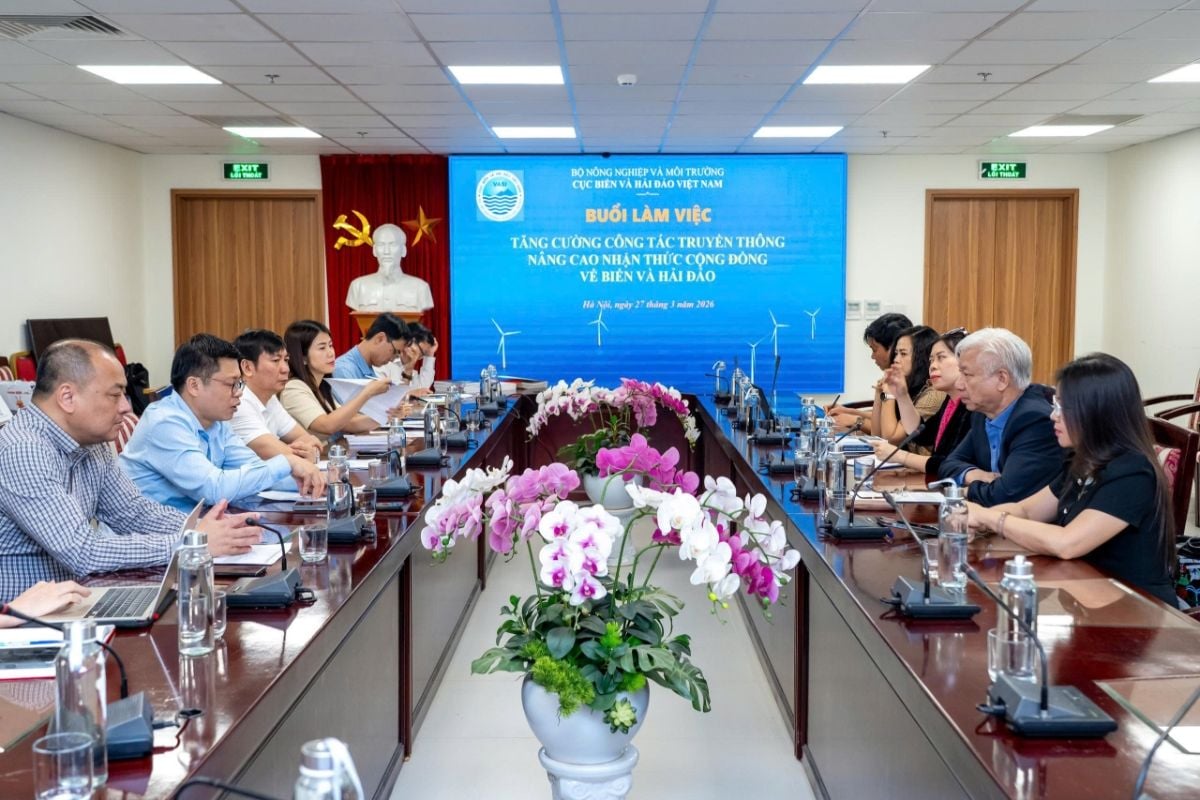
On March 27, 2026, the Department of Seas and Islands under the Ministry of Agriculture and Environment held a working session with Vietnam Economic Times/VnEconomy Magazine to strengthen communications and raise public awareness about seas and islands.
Representing the Department were Mr. Nguyen Quoc Toan, Director of the Department; Mr. Nguyen Viet Dung, Deputy Director; and representatives from the Department’s units. From Vietnam Economic Times/VnEconomy Magazine, the meeting included Mr. Dao Quang Binh, Secretary-General of the Association and Deputy Editor-in-Chief of the Magazine, and Ms. Nguyen Ngoc Diep, Deputy Editor-in-Chief, along with other editorial teams.
At the session, Department Director Nguyen Quoc Toan said that the marine economy includes six main components: maritime economy, tourism, oil and gas, fisheries, logistics, and the continental shelf economy. He noted that sea and island issues are addressed across multiple laws, including the Law on Geology and Mineral Resources, the Law on Tourism, the Oil and Gas Law, the Maritime Law, the Investment Law, the Law on the Sea, and the Law on Marine Resources and Environment.
Mr. Nguyen Quoc Toan said one of the Department’s core tasks is to summarize the implementation of Resolution 36-NQ/TW dated October 22, 2018, adopted by the 8th Plenum of the 12th Central Committee, on the sustainable development strategy for Vietnam’s marine economy to 2030 with a vision to 2045.
He added that a new resolution on the marine economy will be prepared and submitted to the Politburo in the near future. In parallel, the draft Law on Marine Resources and Environment will be amended and submitted to the National Assembly at the October 2026 session.
Emphasizing the development potential of marine space, Toan said that to contribute to double-digit growth in the next period, coastal localities need to further harness marine potential. He stated that marine space is three times larger than the mainland, creating significant opportunities for development.
Toan expressed his desire for Vietnam Economic Times/VnEconomy Magazine to cooperate with the Department to build communications programs across the publication’s channels. The goal is to update policy directions on seas and islands and to develop the marine economy, while highlighting advantages and opportunities for marine-based development.
The cooperation objective is to update directions and policy directions on seas and islands and develop the marine economy; convey the advantages, potentials, and opportunities for developing the marine economy to the governments of 21 coastal localities, businesses, fishermen, and the international community; and gather opinions and perspectives from domestic and international experts on marine development.
Dao Quang Binh, Secretary-General of the Vietnam Economic Science Association and Deputy Chairman of the Editorial Board of Vietnam Economic Times, said that a deep understanding of the role and importance of seas and islands, along with the potential, advantages, and opportunities for marine-based development, will help both sides design communications programs that are appropriate and effective.
He also highlighted the need for the voice of civil society regarding the marine economy and the aspiration to “wealth from the sea” to be heard and reflected in these communications efforts.
The discussion further noted that the oil and gas sector is one of Vietnam’s key advantages amid the current energy crisis, contributing to national energy security. The magazine leadership said it would explore concrete forms of cooperation to communicate policies on seas and islands and the marine economy, including the potential advantages of developing the marine economy, through Vietnam Economy Magazine, VnEconomy, and Vietnam Economic Times.
Toan stated that, “exploiting the potential of the marine economy, enriching from the sea, and venturing offshore to anchor on the sea is also a way to preserve the sea and uphold sovereignty.”
Accordingly, the two sides agreed to study and organize annual conferences and forums, creating an official space to bring together stakeholders to discuss developing the marine economy. They also agreed on the proposed directions for cooperation in communications about seas and islands and marine economic development.


Premium gym chains are entering a “golden era” that is ending or already in decline, as rising operating costs collide with shifting consumer preferences toward more flexible, community-based ways to exercise. Long-term memberships are shrinking, margins are pressured by higher rents and facility expenses, and competition from smaller, more personalized…